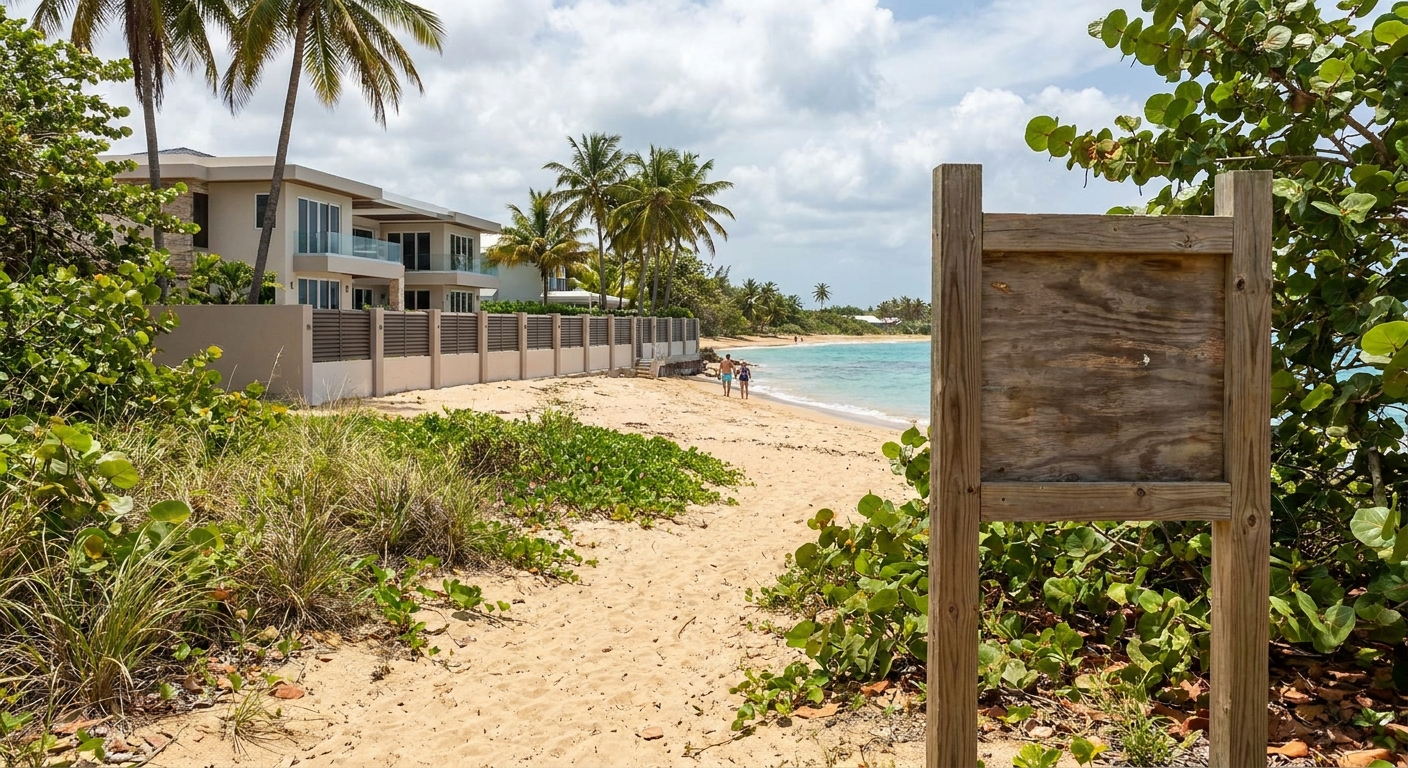

Beach access in Puerto Rico is not a simple matter of private property rights
If you own beachfront property in Puerto Rico or are considering purchasing it, you need to understand the legal framework that governs public access to beaches. Puerto Rico's beach access laws create obligations and restrictions that differ significantly from mainland U.S. property law. These rules affect your ability to exclude the public, develop your property, and generate income from beachfront land. Misunderstanding or ignoring these requirements can result in legal disputes, fines, and forced remediation of your property.
The Constitutional and Statutory Basis for Public Beach Access
Puerto Rico's Constitution establishes that beaches are public property held in trust for the people. This principle is not negotiable, regardless of who holds title to the land behind the beach. Article II, Section 20 of the Puerto Rico Constitution declares that the State holds all beaches in trust for public use and enjoyment. This constitutional mandate supersedes private property rights in the coastal zone.
The Public Beaches Law (Ley de Playas Públicas) codifies this constitutional principle into enforceable regulations. Under this law, all beaches in Puerto Rico are public property, and the public has the right to use them for bathing, recreation, and passage. The law applies to all beaches, including those where private parties own the land immediately behind the beach.
The width of the public beach zone extends to the line of vegetation or the highest tide mark, whichever is further inland. This means that even if you own beachfront property, the public retains rights to a significant portion of your land. The exact boundary depends on the specific characteristics of your property and can be a source of dispute if not properly surveyed and documented.
What the Law Prohibits Property Owners From Doing
Puerto Rico law explicitly prohibits beachfront property owners from taking certain actions that would restrict public access. Understanding these prohibitions is essential for compliance and avoiding liability.
You cannot erect barriers, fences, or walls that prevent the public from accessing the beach. This includes gates, locked doors, or signage that discourages public entry. The prohibition applies even if the barrier is on land you own, if it blocks access to the public beach zone.
You cannot charge fees or require permits for public access to the beach. Some property owners have attempted to monetize beach access by requiring parking fees or entry charges. These schemes violate Puerto Rico law and expose the owner to civil and administrative penalties.
You cannot use private security or other means to physically prevent the public from accessing the beach. While you may have the right to protect your private property from trespass, you cannot use that right to exclude people from the public beach zone.
You cannot develop or construct improvements on the public beach zone without proper authorization. Building structures, installing utilities, or making permanent alterations to the beach requires permits and compliance with environmental and coastal zone regulations.
The Coastal Zone Management Act and Additional Restrictions
Beyond the Public Beaches Law, Puerto Rico's Coastal Zone Management Act (Ley de Política Costera) imposes additional restrictions on beachfront property development and use. This law requires that all development in the coastal zone comply with specific environmental and planning standards.
The Coastal Zone Management Act establishes a buffer zone extending 500 meters inland from the mean high tide line. Within this zone, development is restricted and requires approval from the Puerto Rico Department of Natural and Environmental Resources (DRNA). The law aims to protect coastal ecosystems, prevent erosion, and preserve public access.
If you own property within the coastal zone, you must obtain a coastal zone permit before undertaking any construction, modification, or land use change. The permit process involves environmental review and assessment of impacts on coastal resources. Failure to obtain required permits can result in orders to cease work, removal of unpermitted structures, and significant fines.
The Coastal Zone Management Act also restricts certain activities entirely. For example, you cannot remove sand from the beach or alter natural drainage patterns without authorization. You cannot construct seawalls or other erosion control structures without proper permits and environmental review.
Access Points and Public Facilities
Puerto Rico law requires that beachfront property owners maintain or provide reasonable access points to the beach. This does not necessarily mean you must construct formal access facilities, but you cannot make access unreasonably difficult or impossible.
In some cases, the government or municipalities have established formal public beach access points on or near private property. When this occurs, the property owner must allow the public to use these designated access routes. Blocking or obstructing a designated public access point is a violation of law.
Some municipalities have enacted local ordinances requiring beachfront property owners to maintain public parking areas or walkways. These local requirements vary by municipality and may impose additional obligations beyond the minimum required by state law. You should review the specific ordinances applicable to your property's location.
Enforcement and Penalties
Puerto Rico's Department of Natural and Environmental Resources has authority to enforce beach access laws and coastal zone regulations. The agency can conduct inspections, issue citations, and pursue administrative and civil remedies against property owners who violate these laws.
Penalties for violations include administrative fines ranging from several hundred to several thousand dollars per violation. Fines can accumulate daily if the violation is ongoing. For example, if you maintain an illegal barrier to the beach, you may face daily fines until the barrier is removed.
Beyond administrative penalties, the government can seek court orders requiring you to remove barriers, cease prohibited activities, or restore the property to its legal condition. These court orders are enforceable through contempt proceedings, which can include additional fines and even incarceration in extreme cases.
Private parties also have standing to bring civil actions against property owners who violate beach access laws. Environmental organizations and community groups have successfully sued to enforce public beach access rights. These lawsuits can result in court orders, damages, and attorney's fees awards against the property owner.
Special Considerations for Investors and Developers
If you are considering purchasing beachfront property in Puerto Rico as an investment or for development, you must factor beach access laws into your financial projections and development plans. Many investors have purchased beachfront property expecting to develop it intensively or restrict public access, only to discover that Puerto Rico law prevents these plans.
Before purchasing beachfront property, conduct a thorough legal review of the property's title, existing easements, and applicable regulations. Determine the exact location of the public beach zone boundary on your specific property. Understand what uses and developments are permitted under coastal zone regulations.
If you plan to develop beachfront property, budget for the cost of obtaining coastal zone permits and complying with environmental requirements. These permits can take months or years to obtain and may require modifications to your development plans. In some cases, environmental constraints may make certain development plans infeasible.
Consider whether your investment thesis depends on restricting public access or monetizing beach access. If so, reconsider the investment. Puerto Rico law does not permit these business models for beachfront property.
If you are considering a beachfront property purchase as part of a broader Puerto Rico business strategy, such as developing a resort or hospitality business, understand that your property will be subject to public beach access requirements. You can develop commercial facilities on the private portion of your property, but you cannot restrict public access to the beach itself.
Practical Compliance Steps
If you currently own beachfront property in Puerto Rico, take the following steps to ensure compliance with beach access laws.
First, have a surveyor determine the exact boundary of the public beach zone on your property. This boundary is based on the line of vegetation or the highest tide mark, and it can shift over time due to erosion or accretion. A professional survey provides documentation of the boundary and protects you if disputes arise.
Second, remove any barriers, fences, gates, or signage that restricts or discourages public beach access. If you have installed such barriers, removing them promptly demonstrates good faith compliance and may reduce exposure to penalties.
Third, review any existing permits or authorizations for structures or improvements on your property. If you have constructed anything in the coastal zone without proper permits, consult with a focused commercial law attorney about remediation options.
Fourth, establish clear boundaries between the public beach zone and your private property. You can use low-profile markers or landscaping to indicate the boundary without creating a barrier to access. This helps prevent unintentional trespass onto your private property while maintaining public access to the beach.
Fifth, if you operate a commercial business on beachfront property, ensure that your business operations do not interfere with public beach access. For example, if you operate a restaurant or hotel, you cannot reserve beach areas for exclusive use by your customers or charge customers for beach access.
Interaction With Other Puerto Rico Laws
Beach access laws interact with other areas of Puerto Rico law that may affect your property rights and obligations. Environmental protection laws, for example, may impose additional restrictions on beachfront property beyond those in the beach access statutes.
If your property is located in an area designated as environmentally sensitive, such as a mangrove forest or coral reef area, additional restrictions apply. You may be prohibited from certain activities entirely, or you may be required to obtain specialized permits from environmental agencies.
If you are considering Puerto Rico as a location for a business investment and are evaluating beachfront property, understand how beach access laws interact with your overall business plan. If you are considering Puerto Rico tax incentives under Act 60, for example, understand that these incentives do not exempt you from beach access laws or coastal zone regulations. Your business must comply with all applicable environmental and coastal laws regardless of your tax status.
Next Steps
Beach access laws in Puerto Rico are complex and strictly enforced. If you own beachfront property, are considering purchasing it, or are developing a business plan that involves beachfront property, you need focused legal guidance specific to your situation.
Christian M. Frank Fas, Esq. has over 20 years of experience in Puerto Rico commercial and business law, including coastal property issues. A free initial evaluation will help you understand your specific obligations, identify compliance gaps, and develop a plan to protect your property rights while respecting Puerto Rico's public beach access laws.
Contact the firm for your free initial evaluation at https://lawyerinpr.com/start.