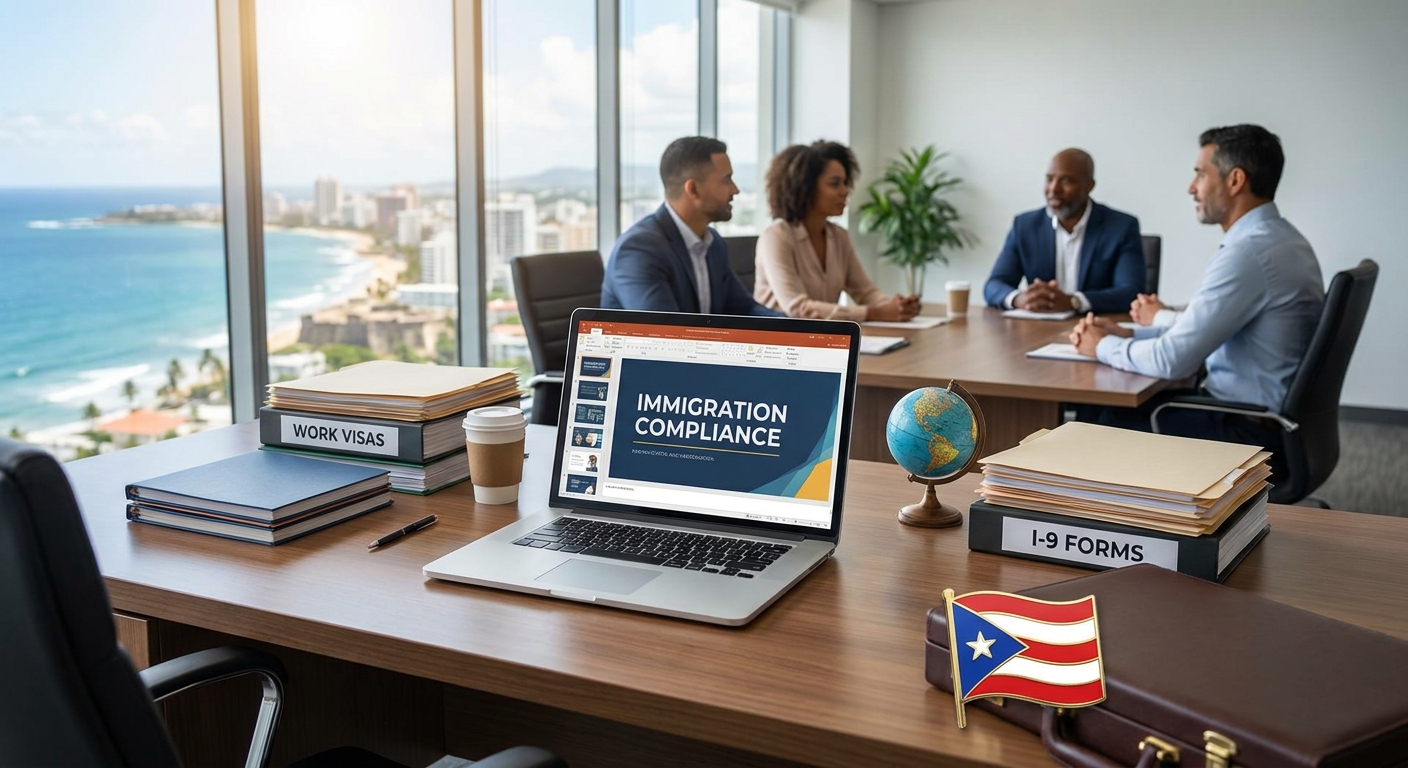

Why Immigration Compliance Matters for Your Puerto Rico Business
Puerto Rico operates under a unique legal framework that blends U.S. federal law with local Puerto Rico statutes. For employers, this creates a distinct set of immigration obligations that differ from mainland United States requirements. Failure to understand and comply with these rules exposes your business to significant penalties, operational disruptions, and reputational damage. Whether you are hiring local talent, bringing in remote workers, or sponsoring foreign nationals, you need a clear understanding of the immigration landscape in Puerto Rico.
The stakes are high. Immigration violations can result in fines ranging from thousands to hundreds of thousands of dollars per violation. Beyond financial penalties, non-compliance can trigger investigations that disrupt normal business operations, damage employee morale, and create liability for company leadership. This article provides the information Puerto Rico employers need to build compliant hiring practices and avoid costly mistakes.
The Basics of Employment Authorization in Puerto Rico
All employees working in Puerto Rico must have valid authorization to work. This requirement applies regardless of whether the worker is a Puerto Rico resident, a U.S. citizen from the mainland, or a foreign national. The authorization requirement is enforced through the I-9 verification process, which is a federal requirement that applies in Puerto Rico just as it does throughout the United States.
The I-9 form serves as the foundation of employment verification. Within three business days of hire, employers must complete Section 1 of the I-9 with the employee. The employer then completes Section 2 by examining documents that establish both identity and work authorization. Acceptable documents include a U.S. passport, a permanent resident card (green card), an employment authorization document (EAD), a state driver's license combined with a Social Security card, or other combinations of documents listed on the USCIS Form I-9 instructions.
Many Puerto Rico employers make the mistake of assuming that Puerto Rico residents automatically have work authorization. This is incorrect. Puerto Rico residents who are not U.S. citizens must have valid work authorization just like any other foreign national. Additionally, employers cannot discriminate based on national origin or citizenship status when hiring. This means you cannot require certain documents from some applicants while accepting different documents from others based on appearance, accent, or perceived national origin.
E-Verify is a voluntary but increasingly important tool for employment verification. This federal system allows employers to electronically confirm that an employee's identity and work authorization documents are consistent with government records. While E-Verify is not mandatory in Puerto Rico, many government contractors and employers in regulated industries use it as a best practice. If you use E-Verify, you must use it consistently for all new hires, not selectively.
Work Visas and Foreign National Employment
If your Puerto Rico business intends to hire foreign nationals, you must understand the visa categories that permit employment in Puerto Rico. The most common visa categories for employment include the H-1B visa for specialty occupations, the L-1 visa for intracompany transfers, the O-1 visa for individuals with extraordinary ability, and the E-2 visa for treaty investors and employees.
The H-1B visa requires employer sponsorship and is subject to annual caps and lottery selection. The process begins with filing a Labor Condition Application (LCA) with the Department of Labor, followed by an I-140 petition with USCIS. The timeline for H-1B sponsorship typically extends six months or longer. Employers must pay the required visa sponsorship fees and comply with wage requirements that mandate paying the foreign national at least the prevailing wage for the position in the relevant geographic area.
The L-1 visa applies when a company transfers an employee from a foreign office to a Puerto Rico office, or vice versa. The employee must have worked for the company abroad for at least one year in the preceding three years. L-1A visas are for managers and executives, while L-1B visas are for employees with specialized knowledge. L-1 sponsorship requires filing an I-129 petition with USCIS.
The E-2 visa is particularly relevant for Puerto Rico because it applies to treaty investors and their employees. If your company is owned by a national of a country with which the United States has a treaty of commerce and navigation, you may qualify for E-2 status. E-2 employees can work in Puerto Rico without the caps and delays associated with H-1B sponsorship. However, E-2 status requires demonstrating a substantial investment in the business and that the business will create jobs.
Regardless of visa category, employers must maintain detailed records of all sponsorship filings, approvals, and employment history. These records must be available for inspection by immigration authorities. Failure to maintain proper documentation can result in penalties even if the employee's visa status is valid.
Act 60 and Immigration Incentives
Puerto Rico's Act 60 provides significant tax incentives for businesses and individuals who relocate to Puerto Rico. While Act 60 is primarily a tax statute, it intersects with immigration considerations in important ways. Individuals who obtain Act 60 tax residency status must establish bona fide Puerto Rico residency, which includes physical presence requirements and the establishment of a permanent home in Puerto Rico.
For employers, Act 60 creates opportunities to attract talent by offering employees substantial tax benefits. Employees who qualify for Act 60 benefits can retain significant portions of their income that would otherwise be subject to federal taxation. This can make Puerto Rico positions more attractive to remote workers and relocated employees. However, employers must ensure that employees claiming Act 60 benefits actually meet the residency requirements and maintain compliance with those requirements throughout their employment.
Employers should not assume that Act 60 status eliminates the need for work authorization verification. All employees, regardless of Act 60 status, must have valid work authorization. Additionally, employers should maintain clear records distinguishing between employees who claim Act 60 benefits and those who do not, as this affects payroll withholding and tax reporting obligations.
For more information on how Act 60 interacts with your business structure and hiring practices, see our Act 60 tax incentives page.
Remote Workers and Telecommuting Arrangements
The rise of remote work has created new immigration considerations for Puerto Rico employers. If your company hires a remote worker who is physically located outside Puerto Rico, you must determine whether that worker is subject to Puerto Rico employment law and immigration requirements.
A worker who is physically located in Puerto Rico and performing work for your company is generally subject to Puerto Rico employment law, regardless of where the company is incorporated or where the worker's employment contract is executed. This means you must comply with Puerto Rico labor laws, tax withholding requirements, and immigration verification obligations.
Conversely, a worker who is physically located outside Puerto Rico and working remotely for a Puerto Rico company may not be subject to Puerto Rico employment law, depending on the circumstances. However, if that worker is a foreign national working from their home country, you must ensure they have valid work authorization in their country of residence. Additionally, if the worker is a U.S. citizen or Puerto Rico resident working remotely from outside Puerto Rico, you should verify their work authorization status in the jurisdiction where they are physically located.
Remote work arrangements also raise questions about tax residency and Act 60 eligibility. If you are hiring a remote worker and offering them Act 60 benefits, you must ensure they understand the physical presence requirements and other conditions for maintaining Act 60 status. Employees who claim Act 60 benefits while working remotely from outside Puerto Rico may jeopardize their tax residency status if they do not meet the required days of physical presence in Puerto Rico.
Compliance Audits and Enforcement
Immigration enforcement in Puerto Rico is conducted by U.S. Immigration and Customs Enforcement (ICE), which has an office in San Juan. ICE conducts worksite investigations and I-9 audits to ensure employer compliance with immigration law. These investigations can be triggered by employee complaints, anonymous tips, or routine enforcement operations.
During an I-9 audit, ICE will request that your company produce I-9 forms for specified employees within a set timeframe, typically three business days. Failure to produce the forms or producing incomplete forms can result in penalties. ICE will review the forms to determine whether they were completed properly, whether the documents examined were acceptable, and whether the employer conducted the verification in a timely manner.
Common I-9 violations include incomplete forms, documents that do not match the employee's identity, missing signatures, and failure to complete the form within the required timeframe. Even technical violations can result in penalties. The penalty structure includes civil fines ranging from several hundred dollars to several thousand dollars per violation, depending on the severity and the employer's history of compliance.
Beyond I-9 audits, ICE may conduct worksite investigations if there is suspicion of unauthorized employment. During a worksite investigation, ICE agents may interview employees, request employment records, and examine I-9 forms. If ICE determines that an employee is unauthorized to work, the employee may be arrested and placed in removal proceedings. The employer may also face criminal charges if there is evidence of knowing employment of unauthorized workers.
To prepare for potential audits, maintain organized I-9 files with all required documentation. Conduct internal I-9 audits periodically to identify and correct errors before government investigators discover them. Train all hiring managers and human resources personnel on proper I-9 completion procedures. Document all training to demonstrate good faith compliance efforts.
Common Mistakes Puerto Rico Employers Make
Puerto Rico employers frequently make preventable immigration mistakes that expose their businesses to liability. One common error is failing to complete I-9 forms within the required three-day window. Some employers delay I-9 completion, assuming they can complete the form later. This creates a record of non-compliance that is difficult to defend during an audit.
Another frequent mistake is accepting documents that do not establish both identity and work authorization. For example, some employers accept only a driver's license without a Social Security card, or accept documents that are expired. The I-9 instructions specify which documents are acceptable, and employers must follow those specifications precisely.
Employers also sometimes make decisions based on assumptions about an employee's work authorization status. For example, an employer might assume that a Puerto Rico resident is automatically authorized to work, or that a person who speaks English without an accent must be a U.S. citizen. These assumptions can lead to selective I-9 enforcement, which violates anti-discrimination rules and creates liability.
A third common mistake is failing to update I-9 forms when an employee's work authorization expires. If an employee's EAD or visa expires, the employer must update Section 3 of the I-9 to reflect the expiration. Failure to do so can result in penalties and potential liability for employing an unauthorized worker.
Finally, many employers fail to maintain proper I-9 documentation or store I-9 forms in a way that makes them easily retrievable during an audit. I-9 forms must be kept for at least three years from the date of hire or one year from the date of termination, whichever is later. Disorganized record-keeping makes it difficult to respond quickly to audit requests and can result in penalties for failure to produce forms.
Developing an Immigration Compliance Program
A comprehensive immigration compliance program protects your business and demonstrates good faith compliance efforts. The program should include written policies that address hiring procedures, I-9 completion, document verification, and record retention. All hiring managers and human resources personnel should receive training on these policies and on proper I-9 procedures.
Your compliance program should include a procedure for verifying work authorization before an employee begins work. This procedure should specify which documents are acceptable, how documents will be examined, and how the I-9 form will be completed. The procedure should also address how the company will handle situations where an employee cannot produce acceptable documents.
Consider implementing E-Verify as part of your compliance program. While E-Verify is voluntary, it provides an additional layer of verification and demonstrates a commitment to compliance. If you use E-Verify, ensure that all hiring managers understand the process and that the company uses E-Verify consistently for all new hires.
Your compliance program should also include a procedure for updating I-9 forms when an employee's work authorization is about to expire. This might involve sending reminders to employees whose work authorization is expiring, requesting updated documents, and updating Section 3 of the I-9 form. Maintaining current I-9 documentation reduces the risk of inadvertently employing an unauthorized worker.
Finally, your compliance program should include a procedure for responding to government audit requests. Designate a person responsible for maintaining I-9 files and responding to audit requests. Ensure that this person understands the timeline for responding to requests and the importance of producing complete and accurate documentation.
Next Steps
Immigration compliance is not a one-time task but an ongoing responsibility. The rules are complex, and mistakes can be costly. If you are uncertain about your current immigration compliance practices or need help developing a compliance program, a free initial evaluation with an experienced Puerto Rico business attorney can help you understand your obligations and identify areas where your current practices may need improvement.
Christian M. Frank Fas, Esq. has over 20 years of experience in Puerto Rico business law and can help you build immigration compliance practices that protect your business. Schedule your free initial evaluation today to discuss your specific hiring situation and compliance needs.