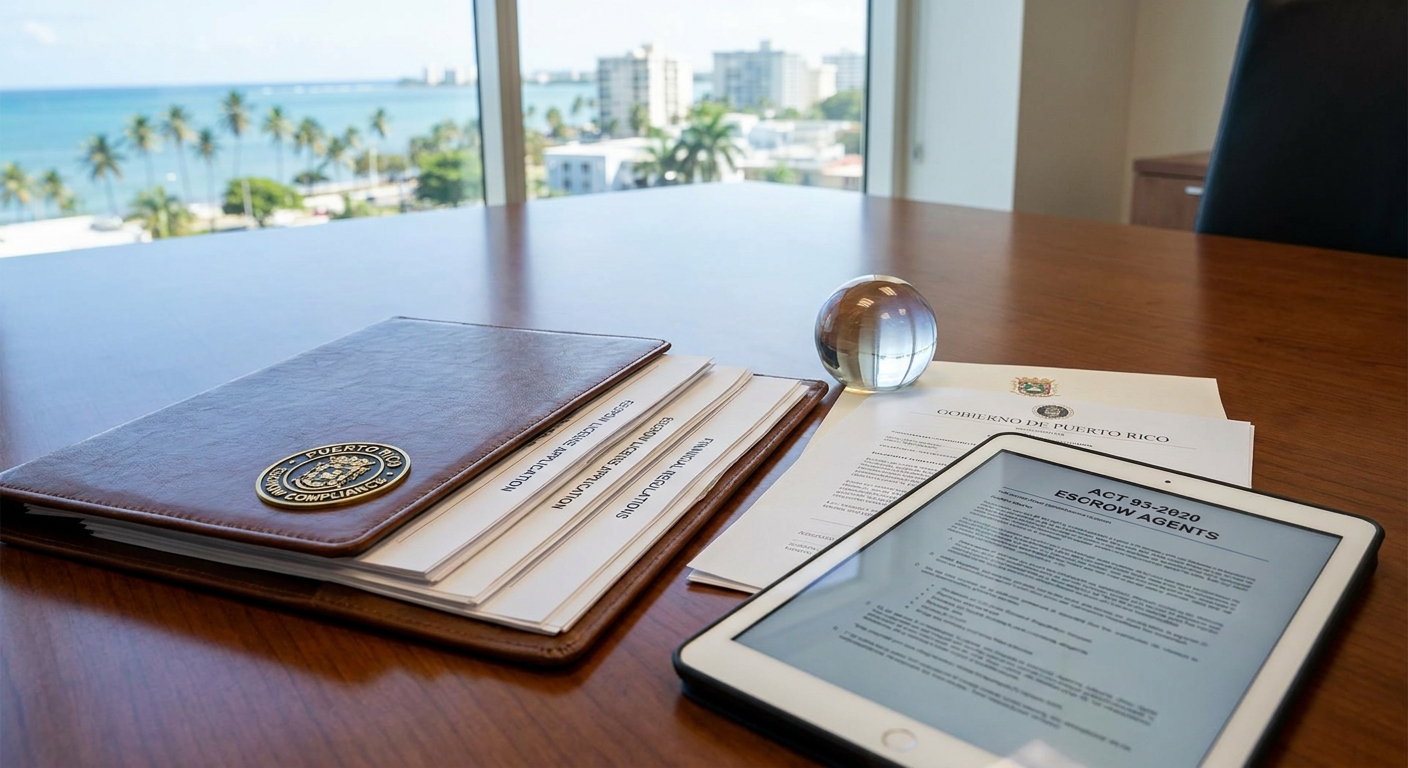

Why Escrow Company Licensing Matters in Puerto Rico
If you operate or plan to establish an escrow company in Puerto Rico, licensing is not optional. The Puerto Rico Office of the Commissioner of Financial Institutions (OCIF) regulates all escrow activities on the island, and operating without proper licensure exposes your business to significant legal and financial penalties. Understanding the licensing framework is essential for anyone handling client funds, managing real estate transactions, or facilitating commercial settlements in Puerto Rico.
Escrow companies serve a critical function in Puerto Rico's economy. They hold funds and documents on behalf of parties in transactions, ensuring that conditions are met before money changes hands. Real estate deals, business acquisitions, and settlement agreements all depend on trustworthy escrow services. The regulatory structure exists to protect consumers and maintain the integrity of these transactions.
This guide covers the licensing requirements, application process, ongoing compliance obligations, and practical considerations for operating an escrow company in Puerto Rico. Whether you are starting a new escrow operation or bringing an existing business into compliance, this information will help you understand what regulators expect.
The Regulatory Framework for Escrow Companies in Puerto Rico
Puerto Rico's escrow licensing system falls under the jurisdiction of the Office of the Commissioner of Financial Institutions. The OCIF enforces regulations that govern how escrow companies must operate, what records they must maintain, and how they must handle client funds.
The primary regulatory authority comes from Puerto Rico's financial institutions laws and the rules established by the OCIF. These regulations require escrow companies to maintain specific capital reserves, segregate client funds from operating accounts, and submit to regular audits and examinations. The OCIF has the power to deny, suspend, or revoke licenses based on violations of these rules.
Puerto Rico's regulatory approach mirrors federal standards in many respects, but the island has its own specific requirements. Companies operating in Puerto Rico cannot simply apply the same procedures they use in other jurisdictions. The OCIF maintains distinct standards for escrow operations, and compliance with those standards is mandatory.
The regulatory framework also addresses the types of escrow services that require licensing. Not all fund-holding activities constitute escrow in the regulatory sense. Understanding which activities trigger licensing requirements is the first step in determining whether your business needs to apply for a license.
Who Must Obtain an Escrow Company License
Any person or entity that receives funds from a third party and holds those funds pending the occurrence of a specified event or condition must determine whether they need an escrow license. The key question is whether the activity falls within the regulatory definition of escrow.
Real estate brokers, title companies, and settlement agents frequently handle escrow funds. In many cases, these professionals can operate under exemptions or alternative regulatory frameworks. However, if your primary business is holding funds in escrow, you almost certainly need a license.
Certain professions have limited exemptions. Attorneys licensed in Puerto Rico may hold client funds in trust accounts without obtaining an escrow license, provided they comply with Puerto Rico's rules of professional conduct regarding trust accounts. However, this exemption applies only to funds held in the course of legal representation. If an attorney's firm operates a separate escrow business, that operation requires licensing.
Real estate brokers licensed by the Puerto Rico Department of Consumer Affairs may hold earnest money deposits and other transaction funds under their broker license, subject to specific requirements. However, this does not exempt them from escrow licensing if they hold funds for purposes beyond real estate brokerage.
If you are uncertain whether your business requires licensing, the safest approach is to contact the OCIF directly or seek guidance from an experienced attorney focused on Puerto Rico financial services law. Operating without a required license creates liability for both the company and its officers.
Capital and Reserve Requirements
Escrow companies in Puerto Rico must maintain minimum capital and reserve requirements established by the OCIF. These requirements ensure that the company has sufficient financial resources to operate safely and to cover potential losses.
The specific capital requirements depend on the volume and nature of escrow business the company conducts. The OCIF evaluates capital adequacy based on the company's business plan, projected transaction volume, and risk profile. A company handling large real estate transactions will face different capital requirements than one handling smaller commercial settlements.
In addition to initial capital, escrow companies must maintain reserve accounts. These reserves serve as a buffer against operational losses and provide assurance that the company can meet its obligations to clients. The OCIF specifies how reserves must be calculated and what assets qualify as reserves.
Capital and reserve requirements are not static. As your escrow business grows, the OCIF may require you to increase capital and reserves proportionally. Failure to maintain required capital levels can result in regulatory action, including license suspension or revocation.
Before applying for an escrow license, you should work with an accountant and legal counsel to ensure you can meet and maintain these requirements. Undercapitalization is a common reason for license denials and regulatory problems.
The Escrow License Application Process
The application process for an escrow company license in Puerto Rico requires submission of detailed documentation to the OCIF. The process is thorough and can take several months from initial submission to final approval.
Your application must include a comprehensive business plan that describes your escrow operations, the types of transactions you will handle, your projected transaction volume, and your fee structure. The business plan should demonstrate that you understand the regulatory requirements and have systems in place to comply with them.
You must provide detailed financial statements showing your initial capital, the source of that capital, and your projected financial performance. The OCIF will review these statements to determine whether you meet capital requirements and whether your financial projections are realistic.
Background information on all owners, officers, and directors is required. The OCIF conducts background checks to ensure that individuals with control over the escrow company have not engaged in financial crimes, fraud, or other conduct that would disqualify them from holding a license. Any criminal history, regulatory violations, or civil judgments must be disclosed.
You must describe your internal controls and compliance procedures. This includes how you will segregate client funds, maintain escrow accounts, handle disputes, and ensure that funds are released only when conditions are satisfied. The OCIF wants to see detailed written policies and procedures.
Your application must identify the location of your principal office in Puerto Rico and describe your physical facilities. The OCIF may require that you maintain a physical presence on the island and that your records be maintained in Puerto Rico.
You must also identify your accountant and any other service providers who will support your escrow operations. The OCIF may contact these providers to verify information in your application.
The application fee is non-refundable, and the OCIF may request additional information or clarification during the review process. Responding promptly and thoroughly to OCIF requests will help move your application forward.
Escrow Account Management and Fund Segregation
Once licensed, your escrow company must maintain strict controls over client funds. The most important requirement is that escrow funds must be segregated from the company's operating funds. Client money cannot be commingled with company money under any circumstances.
Escrow funds must be held in accounts designated as escrow accounts. These accounts must be held in the name of the escrow company as escrow agent, not in the company's general business name. The account must clearly indicate that the funds are held in escrow.
The OCIF requires that escrow accounts be maintained at financial institutions authorized to do business in Puerto Rico. You cannot hold escrow funds in accounts outside Puerto Rico without specific OCIF approval. The financial institution holding your escrow account must be insured by the FDIC or equivalent protection.
Interest earned on escrow funds is subject to specific rules. In some cases, interest belongs to the client. In other cases, interest may belong to the escrow company or may be required to be paid to a designated charity. Your escrow agreements must clearly specify how interest will be handled.
You must maintain detailed records of all escrow transactions. These records must show the source of funds, the date funds were received, the conditions for release, the date funds were released, and the recipient of the funds. Records must be maintained for a specified period, typically at least five years.
Reconciliation of escrow accounts is mandatory. You must regularly reconcile the balance in your escrow account with your records of individual escrow transactions. Any discrepancies must be investigated and resolved immediately.
Audit and Examination Requirements
Escrow companies in Puerto Rico are subject to regular audits and examinations by the OCIF. These examinations verify that the company is complying with all regulatory requirements and that client funds are being handled properly.
The OCIF may conduct examinations on a scheduled basis or at any time if the OCIF has reason to believe that the company is not complying with regulations. During an examination, OCIF examiners will review your records, interview your staff, and test your internal controls.
You must cooperate fully with OCIF examinations. Failure to provide requested documents or information can result in regulatory action. You should designate a compliance officer who will serve as the primary contact for OCIF examiners.
In addition to OCIF examinations, your escrow company must obtain an annual independent audit conducted by a certified public accountant. The audit must verify that your financial statements are accurate and that you are maintaining required capital and reserves. The audit report must be submitted to the OCIF.
The cost of audits and examinations is borne by the escrow company. These costs should be factored into your business plan and financial projections. Larger escrow operations will incur higher audit costs.
Compliance Obligations and Ongoing Requirements
Obtaining a license is only the beginning. Escrow companies must comply with numerous ongoing requirements to maintain their licenses.
You must file annual reports with the OCIF containing financial information, transaction data, and compliance certifications. These reports must be filed by specified deadlines and must be accurate and complete.
Any material changes to your business must be reported to the OCIF. If you change your principal office location, add new owners or officers, significantly expand your business, or change your fee structure, you must notify the OCIF. Some changes may require prior approval before implementation.
You must maintain adequate insurance coverage. The OCIF may require that you carry fidelity bonds and errors and omissions insurance. These insurance requirements protect clients in the event of fraud, theft, or negligence.
Your escrow agreements with clients must comply with OCIF requirements. These agreements must clearly specify the conditions under which funds will be released, the fees the escrow company will charge, and the rights and responsibilities of all parties. The OCIF may review your standard escrow agreements to ensure compliance.
You must establish and maintain written policies and procedures covering all aspects of your escrow operations. These policies must address how you will handle disputes, what happens if conditions for release are not satisfied, how you will communicate with clients, and how you will handle complaints.
Staff training is essential. Your employees must understand the regulatory requirements and your internal procedures. You should maintain documentation of staff training and ensure that all employees with access to escrow funds have been properly trained and vetted.
Common Compliance Issues and How to Avoid Them
Escrow companies frequently encounter compliance problems that can result in regulatory action. Understanding these common issues will help you avoid them.
Commingling of funds is the most serious violation. If escrow funds are mixed with operating funds, even temporarily, this constitutes a major compliance breach. Maintain separate accounts and never transfer funds between escrow and operating accounts except as specifically authorized by escrow agreements.
Inadequate record-keeping is another frequent problem. If you cannot produce clear documentation of how escrow funds were received, held, and released, the OCIF will view this as a serious deficiency. Implement a robust record-keeping system and maintain records for the required period.
Unauthorized release of funds occurs when escrow funds are released without satisfying the conditions specified in the escrow agreement. Before releasing any funds, verify that all conditions have been met and that you have proper authorization from all required parties.
Failure to maintain required capital and reserves can result in license suspension. Monitor your capital position regularly and ensure that you maintain the required levels at all times.
Inadequate disclosure to clients is problematic. Your escrow agreements and communications with clients must clearly explain how funds will be held, when they will be released, what fees you will charge, and what happens if disputes arise.
Hiring individuals with disqualifying backgrounds is a serious issue. Conduct thorough background checks on all employees with access to escrow funds. The OCIF may require that certain positions be filled only by individuals who meet specific qualifications.
Escrow Services and Act 60 Considerations
If your escrow company will serve clients taking advantage of Puerto Rico's tax incentive programs, you should understand how Act 60 tax benefits interact with escrow services. Many individuals relocating to Puerto Rico or establishing businesses on the island use escrow services to facilitate transactions.
Escrow companies serving Act 60 clients must understand the specific requirements of those programs and how escrow arrangements must be structured to comply with Act 60 rules. Improper escrow arrangements can jeopardize a client's tax benefits.
If you plan to market your escrow services to Act 60 clients, you should work with an experienced attorney focused on Puerto Rico tax law to ensure that your procedures comply with Act 60 requirements.
Dispute Resolution and Escrow Disputes
Disputes frequently arise in escrow transactions. Two parties may disagree about whether conditions for release have been satisfied, or they may dispute the proper recipient of funds. Your escrow company must have procedures for handling these disputes.
Your escrow agreements should specify how disputes will be resolved. Some agreements provide that the escrow company will hold funds pending resolution of the dispute. Others may require that disputes be resolved through arbitration or litigation.
If a dispute arises and you cannot determine the proper course of action, you may be able to file an interpleader action in Puerto Rico courts. This allows you to deposit the disputed funds with the court and let the parties litigate the issue. This protects you from liability regardless of how the dispute is resolved.
You should maintain detailed documentation of all disputes and how they were resolved. The OCIF may review your dispute handling procedures during examinations.
Technology and Blockchain Considerations
As escrow services evolve, some companies are exploring the use of technology and blockchain to manage escrow transactions. If you plan to use blockchain or other emerging technologies in your escrow operations, you must ensure that your procedures comply with OCIF requirements.
The OCIF has not yet issued comprehensive guidance on blockchain-based escrow services, but any technology you use must ensure that client funds are properly segregated, that records are maintained as required, and that the OCIF can examine your operations. Before implementing any new technology, consult with an experienced attorney focused on blockchain compliance in Puerto Rico.
Next Steps: Getting Your Escrow Company Licensed
If you are ready to establish an escrow company in Puerto Rico or need to bring an existing operation into compliance with licensing requirements, the first step is to understand your specific situation and regulatory obligations.
Christian M. Frank Fas, Esq. and the team at the Puerto Rico Business Law Firm have over 20 years of experience helping businesses comply with Puerto Rico's financial services regulations. We can review your business plan, help you prepare your license application, establish your compliance procedures, and represent you in your dealings with the OCIF.
Contact us for a free initial evaluation of your escrow company licensing needs. We will assess your situation, explain your obligations, and outline the steps required to obtain and maintain your license. Visit our free evaluation page to get started.