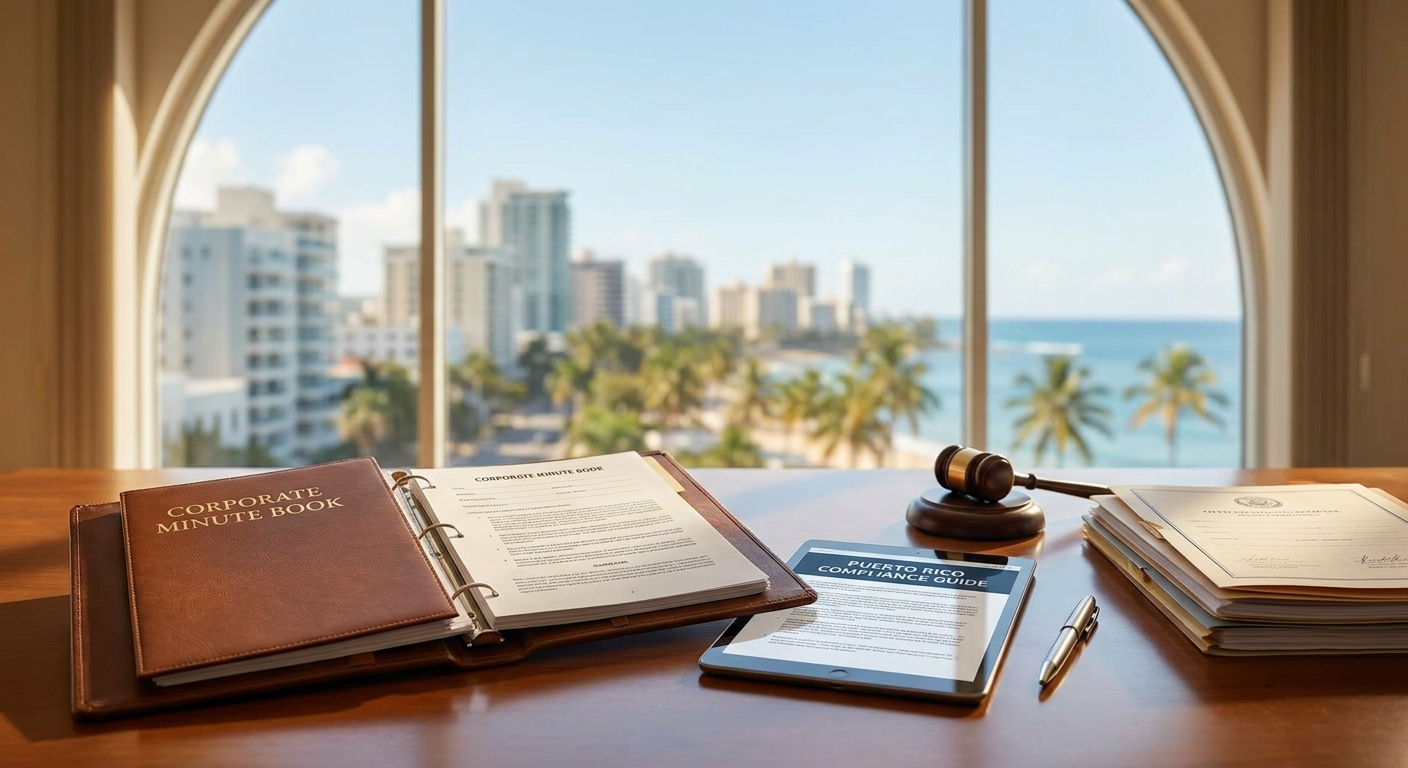

Why Your Corporate Minute Book Matters in Puerto Rico
A corporate minute book is not optional paperwork. It is a legal requirement that documents the decisions, actions, and governance of your Puerto Rico corporation. The minute book serves as the official record of shareholder and board meetings, resolutions, and corporate actions. Without proper minute book maintenance, your corporation faces serious legal and financial consequences, including loss of liability protection, difficulty in disputes, and regulatory penalties.
Puerto Rico corporations must comply with the Puerto Rico Business Corporation Act and related regulations. The minute book is your proof of compliance. It demonstrates that your corporation operates with proper governance, makes decisions through authorized channels, and maintains transparency with shareholders and creditors. Courts and regulatory agencies rely on minute books to verify corporate authority and legitimacy.
This guide covers the specific requirements for corporate minute books under Puerto Rico law, what documents must be included, how to maintain them properly, and what happens when you fail to comply.
What Is a Corporate Minute Book?
A corporate minute book is a bound or organized collection of documents that records the official actions and decisions of a corporation. It contains minutes from shareholder and board meetings, corporate resolutions, bylaws, articles of incorporation, stock certificates, and other governance documents.
The minute book serves multiple purposes. It provides a chronological record of corporate decisions. It demonstrates that the corporation followed proper procedures when taking action. It protects shareholders and directors by showing that decisions were made with proper authority. It helps resolve disputes about what was decided and when. It provides evidence of corporate legitimacy to banks, creditors, and business partners.
Puerto Rico law requires corporations to maintain minute books as part of their corporate records. The minute book is not a suggestion or best practice. It is a mandatory component of corporate governance that protects both the corporation and its owners.
Required Contents of a Puerto Rico Corporate Minute Book
Puerto Rico corporations must include specific documents in their minute books. The following items are required:
- Articles of incorporation and all amendments
- Bylaws and all amendments
- Certificates of good standing
- Minutes from all shareholder meetings, including annual and special meetings
- Minutes from all board of directors meetings
- Board resolutions and shareholder resolutions
- Stock certificates and stock ledger
- Shareholder agreements and voting agreements
- Loan agreements and financing documents
- Contracts and major business agreements
- Tax documents and filings
- Correspondence with the Puerto Rico Department of State
- Records of shareholder and director actions taken by written consent
The minute book should be organized chronologically or by category. Many corporations use a three-ring binder or digital system with clear tabs and indexing. The organization method matters less than completeness and accessibility. You must be able to locate any document quickly when needed.
If your corporation has taken advantage of Puerto Rico tax incentives under Act 60, your minute book should also document the decisions and actions related to those incentives. This documentation protects your eligibility and demonstrates compliance with Act 60 requirements.
Meeting Minutes Requirements
Meeting minutes are the core of your minute book. Puerto Rico law requires that minutes be kept for all shareholder and board meetings. The minutes must be accurate, detailed, and prepared promptly after each meeting.
Shareholder meeting minutes must include the following information:
- Date, time, and location of the meeting
- Whether the meeting was held in person or by remote means
- Names of shareholders present and absent
- Whether a quorum was present
- All motions made and the results of votes
- All resolutions adopted
- All matters discussed and decisions made
- Signature of the secretary or person recording the minutes
Board meeting minutes must include similar information, with directors listed instead of shareholders. The minutes should reflect the substance of discussions, not just the final votes. If a director dissented from a decision, that dissent should be recorded. If a director abstained, that should be noted.
Minutes must be signed by the secretary or the person who recorded them. The signature authenticates the minutes and confirms their accuracy. Unsigned minutes are incomplete and may not be accepted as valid corporate records.
Minutes should be prepared within a reasonable time after the meeting, typically within two weeks. Delays in preparing minutes create gaps in your corporate record and make it difficult to recall what was actually discussed and decided.
Resolutions and Corporate Actions
Resolutions are formal decisions made by the board of directors or shareholders. They authorize specific corporate actions, such as opening a bank account, entering into a major contract, issuing stock, or hiring key employees.
Puerto Rico corporations must document all significant corporate actions through resolutions. A resolution should include the following elements:
- The date the resolution was adopted
- Whether it was adopted at a meeting or by written consent
- The specific action being authorized
- The authority under which the action is taken
- Any conditions or limitations on the action
- Signatures of the directors or shareholders approving the resolution
Many corporations use written consent resolutions instead of holding formal meetings. Puerto Rico law permits this practice. A written consent resolution must be signed by all directors or shareholders whose approval is required. The resolution should state that it is being adopted by written consent and should be dated.
Common resolutions include authorizing the opening of bank accounts, approving loans or lines of credit, authorizing the sale or purchase of assets, approving employment agreements, declaring dividends, and amending bylaws. Each of these actions should be documented with a resolution in your minute book.
Bylaws and Articles of Incorporation
Your minute book must contain the original articles of incorporation and all amendments. The articles establish the corporation's basic structure, including the number of authorized shares, the classes of stock, and the powers of the board of directors.
The bylaws are the internal rules governing how the corporation operates. They cover the number of directors, the frequency of meetings, voting procedures, the powers of officers, and other governance matters. Your minute book must include the original bylaws and all amendments.
When you amend your articles or bylaws, the amendment must be documented in your minute book. The amendment should include the date of adoption, the vote count, and the full text of the amended provision. Keep both the original and amended versions in your minute book so the complete history is clear.
Puerto Rico corporations should review their bylaws periodically to ensure they reflect current operations and comply with Puerto Rico law. If your bylaws are outdated or do not address current business practices, you should consider amending them and documenting the amendment in your minute book.
Stock Records and Certificates
Your minute book must include a stock ledger that shows all shares issued, the names of shareholders, the number of shares held by each shareholder, and the dates of issuance. This ledger is essential for determining voting rights, dividend distributions, and ownership percentages.
Stock certificates should be included in the minute book or referenced with a notation showing where they are stored. Each certificate should show the shareholder's name, the number of shares, the class of stock, and the date of issuance. Certificates should be signed by the president and secretary.
If your corporation has issued stock options, restricted stock, or other equity instruments, these should also be documented in the minute book. The documentation should include the terms of the equity grant, the vesting schedule, and any conditions attached to the equity.
Proper stock records are critical for several reasons. They establish who owns the corporation and in what proportions. They determine voting rights in shareholder meetings. They affect tax treatment of the corporation and its shareholders. They are essential if the corporation is ever sold or if disputes arise among shareholders.
Shareholder Agreements and Voting Agreements
If your corporation has a shareholder agreement, buy-sell agreement, or voting agreement, these documents must be included in the minute book. These agreements control how shareholders interact, what happens if a shareholder wants to sell their shares, and how voting is conducted.
Shareholder agreements often include provisions about the transfer of shares, restrictions on who can own shares, the right of first refusal if a shareholder wants to sell, and the process for buying out a departing shareholder. These provisions are binding on all shareholders and must be enforced consistently.
Voting agreements may require shareholders to vote in a particular way on certain matters or may give one shareholder the right to elect certain directors. These agreements must be documented and included in the minute book so all parties understand their obligations.
If you have a shareholder agreement, make sure it is properly executed by all shareholders and that all amendments are documented in the minute book. Disputes often arise when shareholders disagree about what the agreement says or whether it was properly amended.
Maintenance and Storage of Minute Books
Puerto Rico law requires that minute books be maintained at the corporation's principal office or at another location designated by the board of directors. The minute book must be accessible to shareholders and directors upon reasonable notice.
You have two options for maintaining your minute book. You can use a physical binder with original documents and copies. You can also maintain the minute book in electronic form, provided the electronic records are reliable and can be reproduced in paper form if needed.
If you use an electronic minute book, ensure that the system is secure and that access is restricted to authorized persons. The electronic system should maintain a complete audit trail showing when documents were added, modified, or accessed. Backup copies should be maintained in case of system failure.
Whether you use a physical or electronic minute book, the documents must be organized logically and indexed so they can be located quickly. A table of contents at the beginning of the minute book helps users find specific documents. Tabs or digital folders should separate different categories of documents.
Update your minute book promptly after each meeting or corporate action. Do not allow documents to accumulate in a pile waiting to be filed. Delays in updating the minute book create gaps in your corporate record and make it difficult to maintain accurate documentation.
Retain your minute book indefinitely. Some documents, such as articles of incorporation and bylaws, should be kept permanently. Meeting minutes and resolutions should be retained for at least seven years, though many corporations keep them indefinitely. Tax documents should be retained according to applicable tax law requirements.
Common Mistakes in Minute Book Maintenance
Many Puerto Rico corporations fail to maintain proper minute books. Common mistakes include the following:
- Failing to hold meetings or document decisions through resolutions
- Preparing minutes long after meetings occur, resulting in inaccurate or incomplete records
- Failing to sign minutes or resolutions
- Keeping minutes and documents scattered in different locations
- Failing to update the minute book when bylaws or articles are amended
- Failing to document stock issuances or transfers
- Failing to include shareholder or board agreements in the minute book
- Maintaining disorganized or incomplete minute books
- Failing to retain minute books or destroying them prematurely
These mistakes can have serious consequences. If your corporation is sued, the opposing party will demand to see your minute book. If the minute book is incomplete or disorganized, it suggests that the corporation was not properly managed. Courts may infer that corporate procedures were not followed, which can result in piercing the corporate veil and holding shareholders personally liable.
If your corporation has failed to maintain a proper minute book, you should take steps to correct the problem immediately. Reconstruct missing minutes based on available information. Prepare resolutions documenting past corporate actions. Organize all documents and create a complete minute book going forward.
Minute Books and Liability Protection
One of the primary reasons for maintaining a proper minute book is to protect the liability shield that the corporate form provides. The corporate veil protects shareholders from personal liability for corporate debts and obligations. However, this protection is not automatic. It must be earned through proper corporate governance.
Courts will pierce the corporate veil and hold shareholders personally liable if the corporation fails to follow proper procedures. A poorly maintained or nonexistent minute book is evidence that the corporation was not properly managed. It suggests that the corporation was merely a shell used to avoid personal liability rather than a legitimate business entity.
A complete and well-organized minute book demonstrates that the corporation followed proper procedures, made decisions through authorized channels, and maintained transparency. This documentation protects the corporate veil and ensures that shareholders retain their liability protection.
If your corporation is involved in litigation, the minute book will be one of the first things requested. A complete minute book shows that the corporation was properly managed and strengthens your position in the dispute. An incomplete or disorganized minute book weakens your position and may result in adverse inferences.
Minute Books and Tax Compliance
Your minute book should document all decisions related to tax matters. This includes decisions about the corporation's tax classification, elections under Puerto Rico tax law, and distributions to shareholders.
If your corporation has elected to be taxed as a partnership or S corporation, the minute book should document that election and the date it became effective. If your corporation has made elections under Act 60 to obtain tax incentives, the minute book should document those elections and the actions taken to comply with Act 60 requirements.
Distributions to shareholders should be documented through board resolutions. The resolution should specify the amount of the distribution, the date it will be paid, and the shareholders who will receive it. This documentation is important for tax purposes and for determining each shareholder's basis in their stock.
If the Puerto Rico tax authorities ever audit your corporation, they will request to see the minute book. A complete minute book showing proper documentation of tax decisions and distributions will help you defend your tax position.
Digital Minute Books and Modern Practices
Many corporations now maintain digital minute books using specialized software or cloud-based platforms. Digital minute books offer several advantages over physical binders, including easier access, better organization, and automatic backup.
If you choose to maintain a digital minute book, ensure that the system meets Puerto Rico legal requirements. The system should maintain the integrity and authenticity of documents. It should prevent unauthorized modification of documents. It should maintain an audit trail showing when documents were added or accessed. It should allow documents to be printed and reproduced in paper form if needed.
Digital signatures are acceptable for minute books in Puerto Rico, provided they meet applicable legal standards. Electronic signatures should be used consistently and should be verifiable. If you use electronic signatures, ensure that the signatory has the authority to sign and that the signature is properly authenticated.
Hybrid minute books that combine physical and digital documents are also acceptable. For example, you might maintain original stock certificates and shareholder agreements in physical form while keeping minutes and resolutions in digital form. The key is ensuring that all documents are organized, accessible, and properly maintained.
Next Steps
If your corporation does not have a complete minute book or if your minute book is disorganized or outdated, you should take action immediately. A proper minute book is essential for protecting your liability shield, demonstrating compliance with Puerto Rico law, and defending your corporation in disputes.
Start by gathering all corporate documents, including articles of incorporation, bylaws, meeting minutes, resolutions, stock certificates, and agreements. Organize these documents chronologically or by category. Create a table of contents and index so documents can be located quickly.
If you are missing minutes or resolutions from past meetings, reconstruct them based on available information. Prepare resolutions documenting significant corporate actions that were not previously documented. Have all documents signed by the appropriate officers.
Going forward, maintain your minute book by documenting all shareholder and board meetings, preparing minutes promptly, and filing all corporate documents in the minute book. Update the minute book whenever bylaws or articles are amended or when significant corporate actions are taken.
If you need assistance with your minute book or have questions about Puerto Rico corporate governance requirements, contact the Puerto Rico Business Law Firm for a free initial evaluation. Christian M. Frank Fas, Esq. has over 20 years of experience with Puerto Rico business law and can help you establish and maintain a proper minute book that protects your corporation and complies with Puerto Rico law. Visit https://lawyerinpr.com/start to schedule your free initial evaluation.