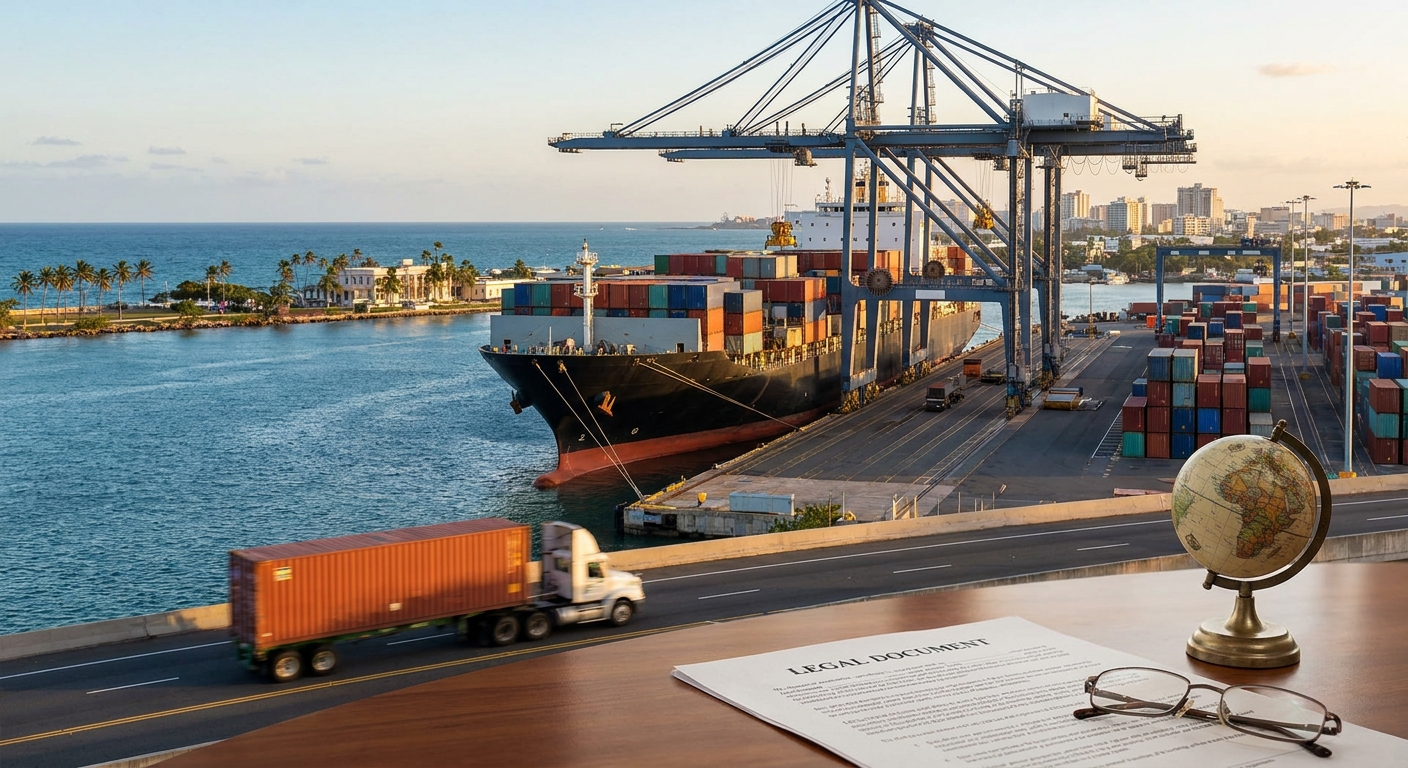

Why Shipping and Logistics Law Matters to Your International Trade Operations
If you move goods across borders through Puerto Rico, you operate in a complex regulatory environment where a single misstep can halt shipments, trigger penalties, or create liability disputes that damage your bottom line. Shipping and logistics law governs the movement of cargo, the obligations of carriers and shippers, the allocation of risk, and compliance with customs, tariff, and trade regulations. For businesses using Puerto Rico as a hub for international trade, understanding these rules is not optional. It is the foundation of reliable operations.
Puerto Rico occupies a unique position in global trade. The island serves as a gateway between North America, the Caribbean, and Latin America. Its ports handle containerized cargo, breakbulk shipments, and specialized goods. Its geographic location and infrastructure make it attractive for distribution centers and transshipment operations. However, this advantage comes with regulatory obligations that differ from mainland U.S. operations and from trade conducted in other jurisdictions.
The cost of getting shipping and logistics law wrong extends beyond fines. Delayed shipments lose customers. Cargo disputes tie up working capital. Liability claims from damaged goods or injuries can exceed insurance coverage. Customs violations can result in seizure of merchandise. For companies operating on thin margins or managing just-in-time inventory, these consequences are not theoretical. They are operational threats that require prevention through sound legal structure and compliance.
The Core Elements of Shipping and Logistics Law
Shipping and logistics law encompasses several distinct but interconnected areas. Understanding each one helps you identify where your business faces the greatest risk and where legal guidance adds the most value.
Bills of Lading and Cargo Documentation
A bill of lading is more than a receipt. It is a contract of carriage, a document of title, and evidence of the terms under which a carrier accepts responsibility for your goods. The bill of lading specifies what is being shipped, its condition, the carrier's obligations, and the limits of the carrier's liability. When disputes arise over damaged cargo, lost shipments, or delivery failures, the bill of lading is the controlling document. Ambiguities in the bill of lading language can shift liability in ways that harm your business. Experienced counsel reviews bills of lading before you sign them and ensures that terms protect your interests or clearly allocate risk in a way you understand and accept.
Related documentation includes packing lists, commercial invoices, certificates of origin, and insurance certificates. Each document serves a specific purpose in customs clearance, proof of ownership, and claims handling. Errors or omissions in these documents delay clearance, trigger inspections, or create gaps in insurance coverage. Proper documentation practices prevent these problems before they occur.
Customs and Tariff Compliance
Goods entering or leaving Puerto Rico must comply with U.S. Customs and Border Protection regulations, tariff classifications, and trade agreement requirements. Tariff classification determines the duty rate applied to your goods. Misclassification results in underpayment of duties, which triggers penalties and interest when discovered, or overpayment, which wastes money. Trade agreements such as those with Caribbean nations or Latin American countries may provide preferential tariff rates, but only if you meet rules of origin and other eligibility requirements.
Customs brokers handle the mechanics of entry and clearance, but they do not provide legal advice on tariff strategy or trade compliance. An experienced attorney works with your customs broker to ensure that your classification strategy is defensible, that you claim all available trade benefits, and that your documentation supports your positions. This coordination prevents costly disputes with customs authorities and protects your margins on international sales.
Carrier Liability and Insurance
Carriers limit their liability for cargo loss or damage through contract terms and through federal maritime law. Under the Carriage of Goods by Sea Act, ocean carriers can limit liability to a specified amount per package or per unit of weight, whichever is lower. This limitation applies unless the shipper declares a higher value and pays additional freight charges. Inland carriers and air carriers operate under different liability regimes. Understanding these limits and how to exceed them through proper declaration and insurance is essential to protecting the full value of your shipments.
Insurance for cargo in transit covers losses that the carrier does not cover. However, insurance policies contain exclusions, conditions, and deductibles. Coordination between the carrier's liability limits, your insurance coverage, and your contractual obligations to your customers determines who bears the cost of loss. Gaps in this coordination leave you exposed. Proper structuring ensures that losses are covered and that you can recover from the responsible party.
Port Operations and Terminal Liability
Ports and terminals in Puerto Rico operate under specific regulations governing cargo handling, storage, and liability. Terminal operators limit their liability for cargo damage or loss through tariffs and contracts. Demurrage charges accumulate when containers remain at the terminal beyond the free time allowed. Storage charges apply to cargo held in the terminal warehouse. These charges can become substantial if cargo is delayed in customs clearance or if you do not arrange timely pickup. Understanding terminal tariffs and negotiating favorable terms reduces these costs and prevents disputes over charges you did not anticipate.
Puerto Rico's Unique Position in International Trade
Puerto Rico is a U.S. territory, which means that goods moving between Puerto Rico and the mainland United States are domestic shipments under U.S. law. However, goods moving between Puerto Rico and foreign countries are international shipments subject to customs regulations and trade agreements. This dual status creates opportunities and complications.
The island's ports are subject to U.S. maritime law, including the Jones Act, which requires that vessels engaged in the coastwise trade between U.S. ports be U.S.-built, U.S.-owned, and U.S.-crewed. This requirement affects shipping costs and service frequency for goods moving between Puerto Rico and the mainland. Understanding the Jones Act's scope and exceptions helps you evaluate shipping options and plan supply chains efficiently.
Puerto Rico also participates in the Caribbean Basin Initiative and other trade preference programs that provide duty-free or reduced-duty access to certain goods from eligible countries. If your business sources goods from the Caribbean or Central America, these programs can significantly reduce your landed costs. However, claiming these benefits requires compliance with rules of origin and proper documentation. An experienced attorney ensures that your sourcing and documentation strategies maximize these benefits.
Additionally, Puerto Rico's tax incentives under Act 60 can benefit businesses engaged in international trade and logistics. Certain activities related to the export of services or the operation of distribution centers may qualify for preferential tax treatment. Coordinating your shipping and logistics structure with your overall tax strategy amplifies the benefits of both.
Risk Allocation in Shipping Contracts
Shipping contracts define the relationship between shippers, carriers, freight forwarders, and other service providers. These contracts allocate the risk of loss, damage, delay, and liability. Standard form contracts used by carriers and freight forwarders heavily favor the service provider. They limit liability, exclude certain types of damage, require notice of claims within short timeframes, and impose other conditions that protect the carrier but expose the shipper to risk.
Negotiating favorable contract terms requires understanding what terms are negotiable and what terms are standard in the industry. Some carriers will not negotiate their standard bills of lading, but they may accept side agreements or endorsements that modify specific terms. Freight forwarders often have more flexibility in their contracts. An experienced attorney identifies which terms create unacceptable risk for your business and negotiates modifications or alternative arrangements.
Key contract terms to review include liability caps, exclusions for certain types of damage, notice requirements for claims, time limits for filing claims, choice of law and jurisdiction, and insurance requirements. Each term affects your ability to recover losses and your exposure to liability. Proper contract review and negotiation before you enter into a relationship with a service provider prevents disputes and protects your interests.
Dispute Resolution in Shipping and Logistics
Disputes in shipping and logistics arise from cargo damage, delivery delays, billing disputes, and disagreements over liability allocation. These disputes can be resolved through negotiation, mediation, arbitration, or litigation. The method of resolution depends on the contract terms, the amount in dispute, and the relationship between the parties.
Many shipping contracts include arbitration clauses that require disputes to be resolved through arbitration rather than court litigation. Arbitration is often faster and more private than litigation, but it also limits your ability to appeal an unfavorable decision. Understanding the arbitration clause in your contract and how it affects your rights is important before disputes arise.
When disputes do arise, prompt action is essential. Notice requirements in shipping contracts are strict. Failure to provide notice within the required timeframe can bar your claim entirely. Preserving evidence, documenting losses, and communicating with the other party in writing creates a record that supports your position. An experienced attorney guides you through the dispute resolution process and represents your interests in negotiation, mediation, or arbitration.
Compliance with International Trade Regulations
International trade is subject to regulations that go beyond shipping and logistics. Export controls, sanctions, anti-dumping duties, and trade agreement requirements all affect your ability to move goods across borders. Violations of these regulations can result in criminal penalties, civil fines, and seizure of merchandise.
Export controls restrict the shipment of certain goods to certain countries or end-users. These controls are administered by the U.S. Department of Commerce and the State Department. Goods subject to export controls include items with military applications, advanced technology, and certain chemicals. Shipping controlled goods without proper authorization is a federal crime. If your business handles goods that may be subject to export controls, compliance review is essential.
Sanctions programs administered by the Office of Foreign Assets Control restrict trade with certain countries and individuals. Shipping goods to or from sanctioned countries or to sanctioned individuals violates federal law. Due diligence on your customers and suppliers ensures that you do not inadvertently violate sanctions regulations.
Trade agreements such as the United States-Mexico-Canada Agreement provide preferential tariff treatment for goods that meet rules of origin. Claiming preferential treatment requires proper documentation and compliance with the agreement's requirements. Misrepresenting the origin of goods to claim preferential treatment is fraud and can result in penalties and loss of trade benefits.
Structuring Your Shipping and Logistics Operations
The way you structure your shipping and logistics operations affects your liability, your tax obligations, and your ability to manage risk. Some businesses operate their own logistics operations. Others use third-party logistics providers. Some use a combination of both. Each approach has advantages and disadvantages.
If you operate your own logistics operations, you assume direct liability for cargo handling, storage, and delivery. You also assume the cost of maintaining facilities, equipment, and personnel. However, you maintain control over the process and can implement procedures that reduce risk and improve efficiency. Proper insurance and contractual protections with your customers and suppliers are essential.
If you use third-party logistics providers, you transfer some of the operational risk to the provider. However, you remain liable to your customers for the performance of the provider. Proper contracts with your logistics provider allocate liability and ensure that the provider maintains adequate insurance. Regular audits of the provider's operations and compliance with your requirements prevent problems before they occur.
Some businesses use a hybrid approach, operating certain functions in-house and outsourcing others. This approach allows you to maintain control over critical functions while reducing costs and risk in other areas. The key is to clearly define the responsibilities of each party and to ensure that all parties maintain adequate insurance and comply with applicable regulations.
The Role of Technology in Shipping and Logistics Compliance
Technology increasingly plays a role in shipping and logistics operations. Blockchain systems track cargo movement and verify documentation. Automated systems process customs entries and manage inventory. Data analytics identify inefficiencies and reduce costs. However, technology also creates new compliance obligations and risks.
If your business uses blockchain or other distributed ledger technology in your supply chain, you must ensure that the system complies with customs regulations and trade agreement requirements. Documentation recorded on a blockchain must be accurate and must support your positions in customs disputes. An experienced attorney reviews your technology implementation to ensure that it supports compliance rather than creating new risks.
Automated systems that process customs entries must be configured correctly to ensure that tariff classifications are accurate and that all required information is provided to customs authorities. Errors in system configuration can result in systematic misclassification or underpayment of duties. Regular audits of your automated systems prevent these errors.
Next Steps: Protecting Your International Trade Operations
Shipping and logistics law is complex, but the principles are clear. Proper documentation, accurate tariff classification, appropriate insurance, favorable contract terms, and compliance with trade regulations protect your operations and your bottom line. The cost of legal review and planning is small compared to the cost of disputes, penalties, and operational disruptions.
If your business moves goods through Puerto Rico or uses Puerto Rico as a hub for international trade, a free initial evaluation with an experienced attorney focused on business law and international trade can identify gaps in your current structure and recommend improvements. Christian M. Frank Fas, Esq. has over 20 years of experience in commercial and business law, including shipping and logistics matters. A review of your operations, contracts, and compliance procedures takes a few hours but can save you thousands in costs and prevent disruptions to your business.
Contact the Puerto Rico Business Law Firm for a free initial evaluation of your shipping and logistics operations. We will review your current structure, identify risks, and recommend practical solutions that protect your business and improve your efficiency.