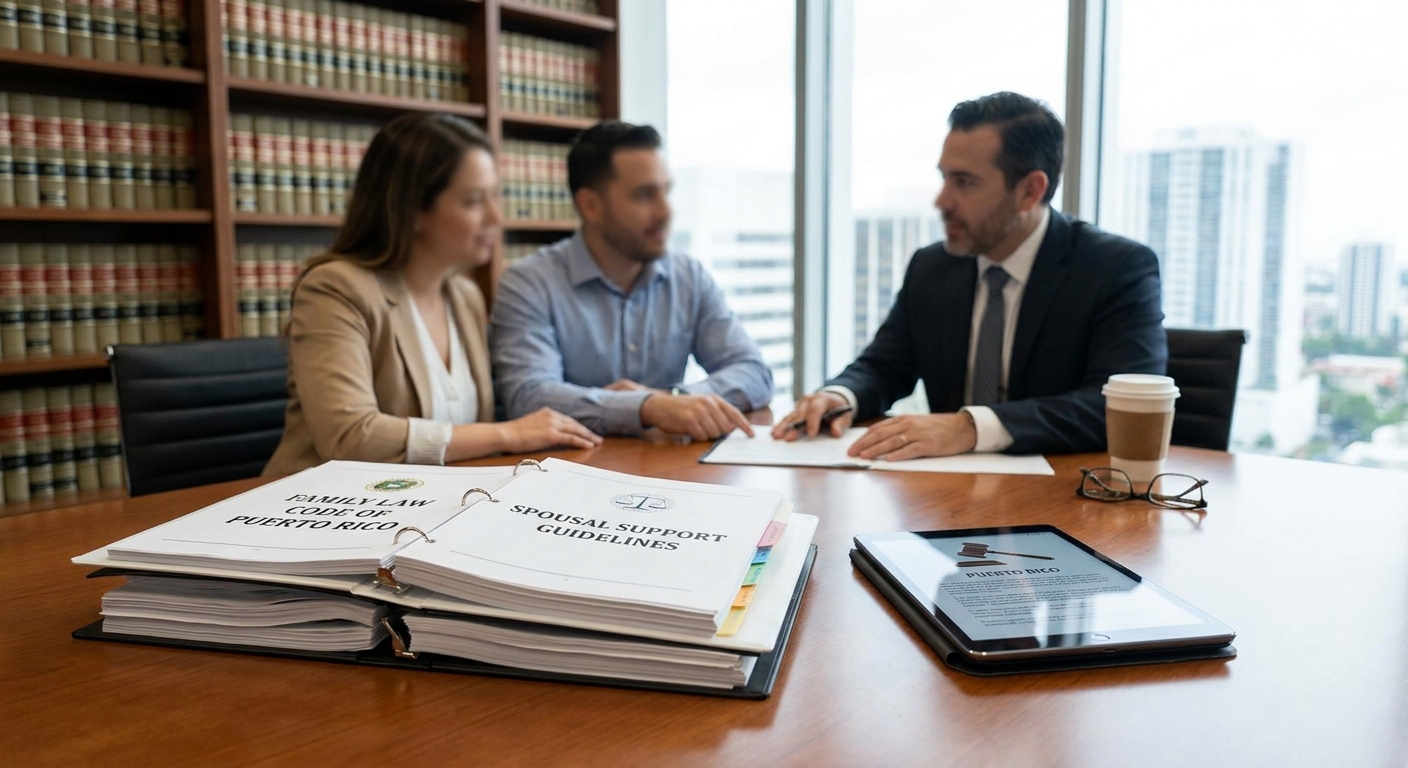

Spousal support obligations in Puerto Rico follow a distinct legal framework that differs significantly from mainland U.S. law. If you are going through a separation, divorce, or family law matter in Puerto Rico, understanding how spousal support is calculated, awarded, and enforced directly affects your financial obligations and rights. This article explains the rules governing spousal support under Puerto Rico law and what factors courts consider when making these determinations.
The Legal Basis for Spousal Support in Puerto Rico
Puerto Rico's family law is codified primarily in the Puerto Rico Civil Code, which establishes the framework for spousal support, also called "pensión alimentaria" or "alimentos" in Spanish. Unlike some jurisdictions that distinguish between temporary and permanent alimony, Puerto Rico law treats spousal support as a form of financial obligation rooted in the duty to provide sustenance and basic living expenses to a spouse or former spouse.
The obligation to provide spousal support arises from the marital relationship itself. Puerto Rico law recognizes that during marriage, both spouses have a duty to contribute to the household and support one another. When a marriage ends, this obligation may continue in the form of court-ordered spousal support if one spouse lacks sufficient income or resources to meet their basic needs.
The Civil Code establishes that spousal support is not a penalty or punishment. Instead, it is a recognition that one spouse may have become economically dependent during the marriage and requires financial assistance to maintain a reasonable standard of living after separation or divorce. The amount and duration of support depend on specific factors that courts evaluate on a case-by-case basis.
Factors Courts Consider When Awarding Spousal Support
Puerto Rico courts do not apply a formulaic approach to spousal support the way some mainland jurisdictions do. Instead, judges have discretion to evaluate multiple factors and determine what is fair and reasonable under the circumstances of each case.
The primary factors courts examine include:
- The length of the marriage. Longer marriages typically result in higher support obligations and longer duration of payments.
- The age and health of both spouses. A spouse who is older or in poor health may have greater difficulty becoming self-sufficient.
- The earning capacity and income of both spouses. Courts look at actual income as well as the potential earning capacity of each party.
- The standard of living established during the marriage. Support awards aim to allow the receiving spouse to maintain a lifestyle reasonably close to what existed during the marriage.
- The education and professional skills of both spouses. A spouse with limited education or job training may require support for a longer period.
- The contributions of each spouse to the marriage, including homemaking and child-rearing. Non-monetary contributions are valued in the analysis.
- The financial resources and assets of both spouses. Courts consider not only income but also property, investments, and other assets.
- The ability of the paying spouse to meet their own needs while providing support. Courts will not order support that leaves the paying spouse unable to cover basic living expenses.
- The conduct of the parties during the marriage. While Puerto Rico is a no-fault divorce jurisdiction, egregious conduct may be considered in some circumstances.
- Any other relevant circumstances the court deems appropriate. This gives judges flexibility to address unique situations.
Courts do not apply these factors in a rigid order. Instead, judges weigh them together to reach a decision that reflects the specific facts of the case. Two similar marriages may result in different support awards if the circumstances differ in meaningful ways.
Eligibility for Spousal Support
Not every spouse who requests support will receive it. Puerto Rico law requires that the requesting spouse demonstrate a genuine need for financial assistance. A spouse with substantial income or assets may not qualify for support even if their former spouse earns significantly more.
The requesting spouse must show that they lack sufficient resources to meet their basic needs and reasonable living expenses. This includes housing, food, utilities, transportation, healthcare, and other necessities. Courts also consider whether the requesting spouse can become self-sufficient through employment or education.
A spouse who is capable of working but chooses not to work may face reduced support or no support at all. However, courts recognize that some spouses may have limited employment prospects due to age, health, or time spent out of the workforce during the marriage. In these cases, support may be awarded even if the requesting spouse could theoretically work.
The paying spouse's ability to pay is equally important. A court will not order support that is impossible for the paying spouse to meet. If the paying spouse has minimal income and substantial obligations, the court may award reduced support or no support at all, depending on the circumstances.
Duration of Spousal Support Obligations
Puerto Rico law does not establish a fixed duration for spousal support based on the length of marriage. Instead, the duration is determined by the court based on the factors mentioned above and the specific circumstances of the case.
Support may be awarded for a defined period, such as five years or ten years, after which the obligation terminates. Alternatively, support may be awarded for an indefinite period, continuing until the death of either spouse or until a significant change in circumstances occurs.
Shorter marriages typically result in shorter support periods. A marriage lasting two or three years may result in support lasting one to three years. Longer marriages, particularly those lasting fifteen years or more, often result in longer support periods or indefinite support.
The court may also award support that terminates upon the occurrence of a specific event, such as the receiving spouse reaching retirement age, remarrying, or cohabiting with another person in a stable relationship. These termination provisions are common in Puerto Rico spousal support orders.
Modification and Termination of Spousal Support
Spousal support orders are not permanent unless the court explicitly states they are. A significant change in circumstances may justify modification or termination of the support obligation.
Changes that may warrant modification include a substantial increase or decrease in the paying spouse's income, job loss, serious illness or disability, retirement, or a significant change in the receiving spouse's financial situation. The party seeking modification must demonstrate that the change is substantial and material, not merely a minor fluctuation in income.
If the receiving spouse remarries, the support obligation typically terminates. Similarly, if the receiving spouse enters into a stable cohabitation arrangement with another person, the paying spouse may petition the court to terminate or reduce support. The court will examine the nature and stability of the new relationship before making a decision.
The receiving spouse may also petition for modification if their circumstances change significantly. For example, if the receiving spouse becomes unable to work due to illness or injury, they may request an increase in support. If the paying spouse's income increases substantially, the receiving spouse may request an increase in the support amount.
Modifications are not automatic. The party seeking modification must file a petition with the court and demonstrate that the change in circumstances justifies a change in the support order. The court will review the evidence and make a new determination based on current circumstances.
Enforcement of Spousal Support Orders
A spousal support order is a court judgment that is enforceable through various legal mechanisms. If a paying spouse fails to make required payments, the receiving spouse has several options for enforcement.
The most common enforcement method is wage garnishment. If the paying spouse is employed, the court can order the employer to withhold support payments directly from the employee's paycheck. This ensures that payments are made consistently and reduces the likelihood of arrears accumulating.
If the paying spouse is self-employed or has income from sources other than employment, the court may order the paying spouse to make payments directly to the receiving spouse or to a court-administered account. The court may also place a lien on the paying spouse's property or assets to secure the support obligation.
Failure to pay court-ordered spousal support can result in contempt of court charges. A paying spouse who willfully fails to pay support may face fines, jail time, or both. However, courts recognize that some paying spouses may be unable to pay due to genuine financial hardship. A paying spouse who cannot pay must demonstrate this to the court and may request a modification of the support order rather than face contempt charges.
The receiving spouse can also pursue collection through the Puerto Rico Department of the Treasury if support payments are not made. The government agency can use various collection tools, including tax refund intercepts and other enforcement mechanisms, to collect unpaid support.
Tax Implications of Spousal Support in Puerto Rico
The tax treatment of spousal support in Puerto Rico differs from federal tax law. Under Puerto Rico law, spousal support payments are generally not deductible by the paying spouse and are not taxable income to the receiving spouse. This is an important distinction from federal law, where the tax treatment of alimony has changed in recent years.
If you are subject to Puerto Rico tax law, you should understand how spousal support affects your overall tax liability. A paying spouse cannot reduce their taxable income by the amount of support paid. A receiving spouse does not need to report support payments as income on their Puerto Rico tax return.
If you are a resident of Puerto Rico and subject to Act 60 tax incentives, spousal support obligations may affect your tax planning. You should consult with a tax professional who understands both Puerto Rico law and your specific tax situation to ensure compliance and optimize your tax position.
Spousal Support vs. Property Division
Spousal support is distinct from property division. When a marriage ends in Puerto Rico, the court divides marital property between the spouses. This is a one-time division of assets and liabilities accumulated during the marriage.
Spousal support, by contrast, is an ongoing financial obligation that continues after the property division is complete. A spouse may receive a substantial share of marital property but still be awarded spousal support if they lack sufficient income to meet their needs. Conversely, a spouse may receive little property but be ordered to pay substantial support if they have significant income.
Courts consider both property division and spousal support when determining the overall financial settlement. The goal is to reach a result that is fair to both parties and reflects their respective contributions to the marriage and their current financial circumstances.
Negotiating Spousal Support Agreements
Many couples in Puerto Rico resolve spousal support issues through negotiation rather than litigation. A couple can agree on the amount, duration, and terms of spousal support without asking a judge to decide. Such agreements must be fair and reasonable, and both parties should understand the terms before signing.
A negotiated agreement offers several advantages. It allows both parties to control the outcome rather than leaving the decision to a judge. It is typically faster and less expensive than litigation. It also allows for creative solutions that a court might not consider, such as a lump-sum payment instead of monthly payments, or support that terminates upon a specific event.
However, a negotiated agreement must still comply with Puerto Rico law. An agreement that is unconscionable or that violates public policy may not be enforceable. Both parties should have the opportunity to consult with an experienced attorney before signing an agreement to ensure that their rights are protected.
Common Mistakes in Spousal Support Cases
Many people make errors when dealing with spousal support that can have serious financial consequences. Understanding these mistakes can help you avoid them.
One common mistake is failing to disclose income or assets. Both parties have a duty to provide accurate financial information to the court. Hiding income or assets can result in sanctions, including contempt of court charges, and can lead to modification of the support order once the hidden information is discovered.
Another mistake is assuming that spousal support will automatically terminate upon remarriage. While remarriage often terminates support, the original order must explicitly state this. If the order does not address remarriage, the paying spouse may need to file a petition for modification to terminate support.
Some paying spouses make the mistake of stopping payments without court approval. Even if you believe you cannot afford the payments or that circumstances have changed, you must continue paying until the court modifies or terminates the order. Stopping payments without court approval can result in contempt charges and accumulation of arrears.
Receiving spouses sometimes make the mistake of not enforcing the order when payments are late or missed. If you are entitled to support and the paying spouse is not paying, you should take action promptly. Delaying enforcement can result in substantial arrears that become difficult to collect.
Next Steps
Spousal support issues are complex and fact-specific. The rules governing spousal support in Puerto Rico require careful analysis of your particular circumstances, income, assets, and family situation. If you are facing a spousal support issue, whether as a paying spouse or a receiving spouse, you should understand your rights and obligations under Puerto Rico law.
Christian M. Frank Fas, Esq. is a Puerto Rico licensed attorney with over 20 years of experience in commercial and business law, including family law matters. The firm offers a free initial evaluation to discuss your situation and explain your options. During the evaluation, you will receive straightforward advice about how Puerto Rico spousal support rules apply to your case and what steps you should take next.
To schedule your free initial evaluation, visit lawyerinpr.com/start or contact the firm directly. The sooner you understand your rights and obligations, the sooner you can make informed decisions about your financial future.