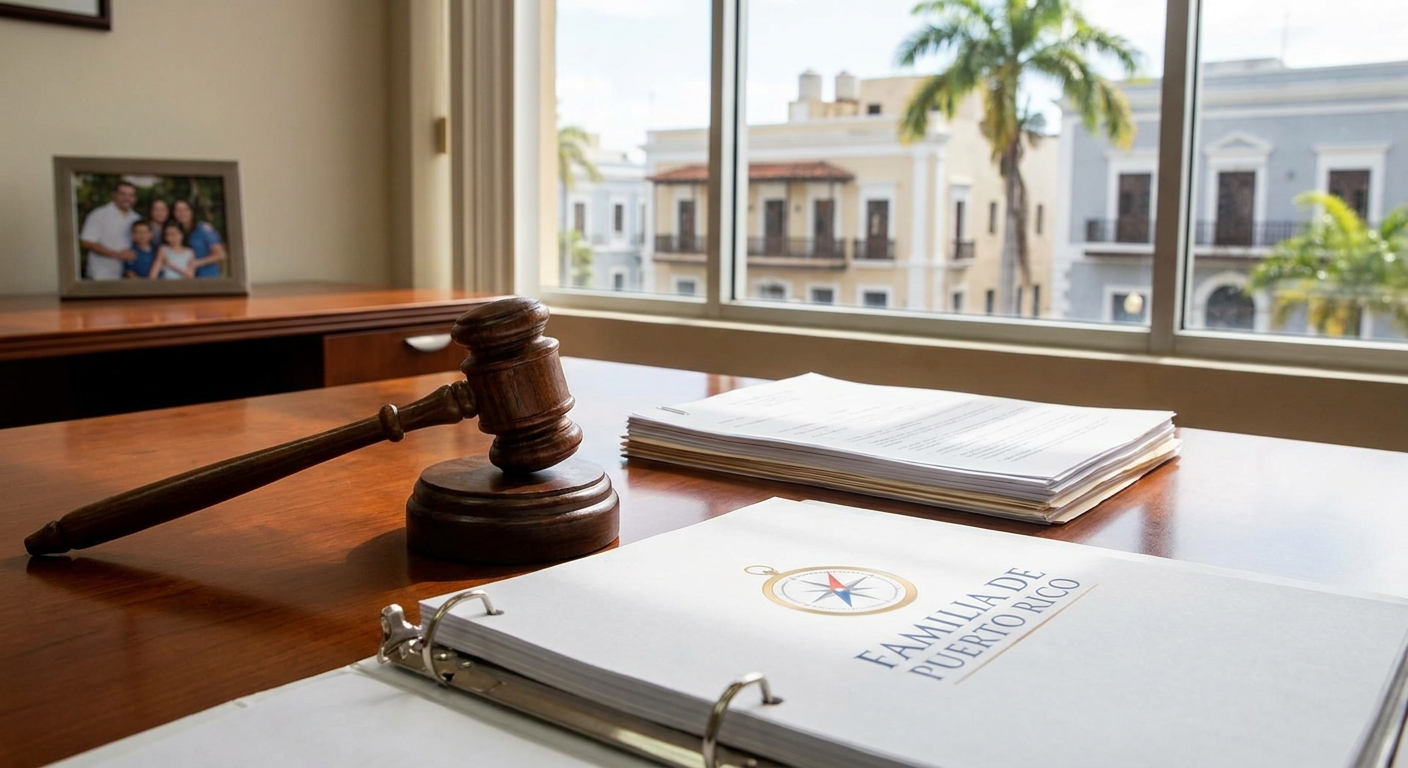

Family law in Puerto Rico operates under a distinct legal framework that differs significantly from mainland United States law. If you live in Puerto Rico, own property here, or have family members subject to Puerto Rico jurisdiction, understanding the local family law system is essential. The rules governing marriage, divorce, child custody, support obligations, and property division follow Puerto Rico's Civil Code and specific statutes that reflect the island's legal traditions and current policies.
This overview covers the fundamental areas of Puerto Rico family law that affect residents and business owners. Whether you are contemplating marriage, facing a separation, or dealing with custody matters, knowing how Puerto Rico law applies to your situation helps you make informed decisions and protect your interests.
Marriage and Divorce in Puerto Rico
Puerto Rico recognizes marriage as a civil contract between two persons. The legal requirements for marriage include a valid marriage license issued by the Puerto Rico Department of State, a ceremony performed by an authorized official, and compliance with waiting periods and other procedural rules. Same-sex marriage is legal in Puerto Rico and receives the same recognition and protections as opposite-sex marriage.
The process for obtaining a marriage license requires both parties to appear in person at the Department of State office or an authorized municipal office. You must provide proof of identity, proof of age, and a medical certificate confirming that you have undergone required health screenings. Puerto Rico law imposes a three-day waiting period between the issuance of the license and the ceremony, though this period can be waived in certain circumstances by court order.
Divorce in Puerto Rico is available on both fault and no-fault grounds. No-fault divorce, called divorce by mutual consent or by separation, allows either spouse to petition for dissolution of the marriage without proving wrongdoing by the other party. Fault-based grounds include adultery, abandonment, cruelty, and other conduct that violates the duties of marriage. The specific grounds and procedures are set forth in Puerto Rico's Civil Code.
The divorce process begins with filing a petition in the appropriate court. If both parties agree on the terms of the divorce, including property division and custody arrangements, the process can proceed more quickly through a settlement agreement. If the parties cannot agree, the court will hold hearings and make determinations regarding all contested issues. Puerto Rico courts have broad discretion in awarding property, determining support obligations, and establishing custody arrangements based on the best interests of any children involved.
Property Division and Marital Assets
Puerto Rico follows a community property system for married couples. This means that property acquired during the marriage by either spouse is generally considered community property owned jointly by both spouses, regardless of which spouse earned the income or whose name appears on the title. Property owned before marriage or acquired by gift or inheritance during marriage remains separate property belonging to the spouse who owns it.
When a marriage ends through divorce or death, community property is divided equally between the spouses unless the parties have agreed otherwise in a prenuptial or postnuptial agreement. The court will classify each asset as either community or separate property and then divide the community property accordingly. This classification process can become complex when assets have been commingled or when one spouse has made contributions to property owned by the other spouse.
Separate property remains the property of the spouse who owns it and is not subject to division in a divorce. However, if separate property has been substantially improved or maintained using community funds, the other spouse may have a claim for reimbursement or contribution. Similarly, if community property has been used to pay down debt on separate property, the community estate may be entitled to reimbursement.
Business interests owned by one or both spouses present particular challenges in property division. If a business was established before marriage, it is typically separate property, but the increase in value during the marriage may be treated as community property. If a business was established during marriage, it is generally community property subject to division. Valuation of business interests requires careful analysis and often involves appraisals or expert testimony regarding the business's fair market value.
Spousal Support and Alimony
Puerto Rico law allows courts to award spousal support, also called alimony, to either spouse in a divorce case. The purpose of spousal support is to provide financial assistance to a spouse who lacks sufficient income or property to meet reasonable needs, particularly when one spouse sacrificed education or career opportunities during the marriage to support the family.
Courts consider multiple factors when determining whether to award spousal support and in what amount. These factors include the length of the marriage, the age and health of each spouse, the earning capacity and income of each spouse, the standard of living established during the marriage, the contributions of each spouse to the marriage including homemaking and child-rearing, and the ability of the paying spouse to provide support while meeting his or her own needs.
Spousal support can be awarded as a lump sum payment, periodic payments over a specified period, or a combination of both. Temporary support may be awarded during the divorce proceedings to help the lower-earning spouse meet expenses while the case is pending. Permanent support may be awarded at the conclusion of the divorce, though it typically terminates upon the death of either spouse or the remarriage of the receiving spouse.
The amount and duration of spousal support awards vary widely depending on the specific circumstances of each case. Puerto Rico courts have discretion to fashion support awards that are fair and reasonable under the facts presented. Spousal support obligations can be modified if there is a substantial change in circumstances, such as a significant change in income or employment status of either party.
Child Custody and Parental Rights
Puerto Rico law prioritizes the best interests of the child when determining custody arrangements. Courts consider factors including the relationship between the child and each parent, the child's adjustment to home and school, the mental and physical health of all parties, the preference of the child if the child is of sufficient age and maturity, and the ability of each parent to provide for the child's physical, emotional, and educational needs.
Custody can be awarded as sole custody to one parent or joint custody shared between both parents. Sole custody means that one parent has primary responsibility for the child's care, control, and education, while the other parent may have visitation rights. Joint custody means that both parents share decision-making authority regarding major decisions affecting the child, such as education, medical treatment, and religious upbringing, though one parent may have primary physical custody.
Visitation rights are granted to the non-custodial parent unless the court determines that visitation would be harmful to the child. Puerto Rico courts typically encourage frequent and meaningful contact between children and both parents. Visitation schedules can be structured in various ways, from specific schedules set by the court to flexible arrangements agreed upon by the parents.
Parental rights include the right to make decisions regarding the child's upbringing, education, medical care, and religious training. These rights are not absolute and can be limited or removed if a parent is found to be unfit or if exercising parental rights would be contrary to the child's best interests. Courts may also appoint a guardian ad litem to represent the child's interests in custody disputes.
Child Support Obligations
Both parents have a legal obligation to support their children financially. This obligation continues until the child reaches the age of majority, which is eighteen in Puerto Rico, or longer if the child is pursuing education or has special needs. Child support is calculated based on the income of both parents, the custody arrangement, and the needs of the child.
Puerto Rico uses guidelines to calculate child support based on the combined parental income and the number of children requiring support. The guidelines provide a presumptive amount of support that is considered appropriate, though courts can deviate from the guidelines if the circumstances warrant. Factors that may justify deviation from the guidelines include the financial resources of both parents, the standard of living the child would have enjoyed if the marriage had not been dissolved, and the special needs or talents of the child.
Child support is typically paid by the parent with primary earning capacity to the parent with primary custody. If both parents share custody equally, the parent with higher income may still be required to pay support to equalize the financial burden of child-rearing. Child support obligations can be modified if there is a substantial change in circumstances, such as job loss, significant increase in income, or changes in custody arrangements.
Enforcement of child support orders is taken seriously in Puerto Rico. Parents who fail to pay court-ordered child support can face contempt of court charges, wage garnishment, suspension of professional licenses, and other enforcement mechanisms. The Puerto Rico government also provides support collection services through the Department of the Family.
Prenuptial and Postnuptial Agreements
Puerto Rico law recognizes prenuptial agreements, also called antenuptial agreements, which allow couples to define their property rights and obligations before marriage. A valid prenuptial agreement must be in writing, signed by both parties, and entered into voluntarily with full disclosure of each party's financial situation. The agreement cannot be unconscionable or contrary to public policy.
Prenuptial agreements can address property division, spousal support, and other financial matters. They cannot address child custody or child support, as these matters are determined based on the best interests of the child at the time of divorce or separation. Prenuptial agreements are particularly useful for individuals with significant assets, business interests, or prior family obligations.
Postnuptial agreements serve a similar function but are entered into after marriage. These agreements can be used to clarify property rights, establish support obligations, or modify the terms of a prenuptial agreement. Postnuptial agreements must also be in writing, signed by both parties, and entered into voluntarily with full disclosure.
For business owners and individuals with substantial assets, prenuptial and postnuptial agreements provide important protections. These agreements can preserve the separate property status of a business, clarify how business income will be treated, and establish clear expectations regarding property division in the event of divorce. Proper drafting of these agreements is essential to ensure they are enforceable and accomplish the parties' intentions.
Domestic Violence and Protective Orders
Puerto Rico law provides protections for individuals who are victims of domestic violence. Domestic violence includes physical abuse, emotional abuse, sexual abuse, economic abuse, and threats of abuse by a current or former intimate partner or family member. Victims of domestic violence can seek protective orders from the court to prevent further abuse.
A protective order, also called a restraining order or order of protection, is a court order that prohibits the abuser from contacting, harassing, threatening, or abusing the victim. The order can also require the abuser to stay away from the victim's home, workplace, or school. Violation of a protective order is a criminal offense that can result in arrest and prosecution.
Victims of domestic violence can seek emergency protective orders that are issued immediately without a hearing, typically lasting for a short period until a full hearing can be held. After a hearing where both parties have an opportunity to present evidence, the court can issue a longer-term protective order lasting up to one year or longer if circumstances warrant.
Domestic violence can also affect custody and visitation arrangements. A parent who has committed domestic violence may have custody or visitation restricted or supervised to protect the child. Courts consider domestic violence as a factor in determining the best interests of the child and may limit contact between the abusive parent and the child.
Inheritance and Succession Rights
Puerto Rico law provides specific inheritance and succession rights for spouses and children. A surviving spouse has certain rights to inherit from the deceased spouse's estate, and children have rights to inherit from their parents. These rights exist regardless of whether the deceased person left a will.
If a person dies without a will, Puerto Rico's intestacy laws determine how the estate is distributed. Generally, the surviving spouse and children inherit the estate in proportions determined by law. If there is no surviving spouse or children, the estate passes to other relatives in a specified order of priority.
A surviving spouse may have the right to remain in the family home and to receive a portion of the deceased spouse's separate property in addition to the spouse's share of community property. These rights provide important protections for surviving spouses and ensure that they are not left without resources after the death of their spouse.
Children born during marriage have full inheritance rights. Children born outside of marriage have inheritance rights if paternity is established. Establishing paternity is important for ensuring that children have rights to inherit from their father and to receive social security and other benefits.
Adoption and Parental Rights
Puerto Rico law allows for adoption of children by individuals and married couples. Adoption creates a legal parent-child relationship and grants the adoptive parent all rights and responsibilities of a biological parent. Adoption proceedings are conducted in family court and require compliance with specific statutory procedures.
Adoptions can be arranged through licensed adoption agencies, private arrangements with the consent of the biological parents, or through the foster care system. All adoptions require court approval and a finding that the adoption is in the best interests of the child. The biological parents must consent to the adoption unless their parental rights have been terminated by the court.
Stepparent adoption is a common form of adoption in which the spouse of a biological parent adopts the biological parent's child. Stepparent adoption requires the consent of both the biological parent who is married to the adopting stepparent and, in most cases, the other biological parent. If the other biological parent cannot be located or refuses to consent, the court may terminate parental rights and allow the adoption to proceed.
Next Steps
Family law matters in Puerto Rico require careful attention to local law and procedures. Whether you are planning for marriage, facing a divorce, dealing with custody issues, or addressing other family law concerns, understanding your rights and obligations under Puerto Rico law is essential.
Christian M. Frank Fas, Esq. is a Puerto Rico licensed attorney with over twenty years of experience in commercial and business law, including family law matters affecting business owners and individuals with significant assets. If you have questions about how Puerto Rico family law applies to your situation, contact the firm for a free initial evaluation. Visit lawyerinpr.com/start to schedule your evaluation and discuss your family law concerns with an experienced attorney who understands Puerto Rico's legal system.