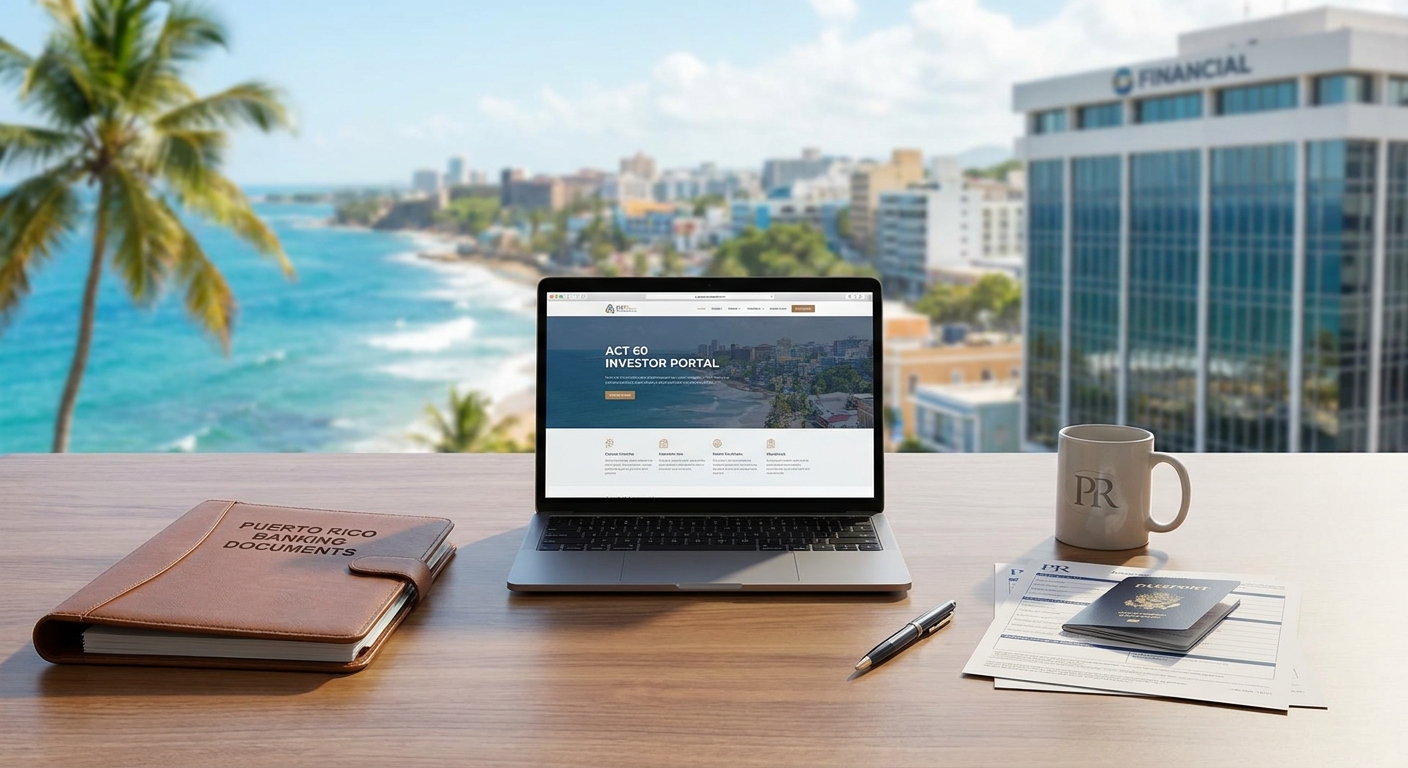

Why Act 60 Investors Need a Puerto Rico Bank Account
If you have obtained Act 60 tax residency status in Puerto Rico, opening a local bank account is not optional. It is a practical necessity that affects your tax compliance, business operations, and ability to demonstrate genuine economic ties to the island. The Puerto Rico tax authority requires Act 60 investors to maintain banking relationships within Puerto Rico as part of the residency verification process. Without a local account, you cannot effectively manage business transactions, pay employees, or document the economic activity that supports your tax residency claim.
A Puerto Rico bank account serves multiple functions for Act 60 investors. It provides a clear paper trail of your financial activity on the island. It allows you to pay local taxes, utilities, and business expenses through established financial channels. It demonstrates to tax authorities that you are conducting real economic activity in Puerto Rico, not simply claiming residency on paper. For investors operating businesses, managing real estate, or running professional practices, a local account is the foundation of compliant financial management.
The process of opening an account as an Act 60 investor differs from standard banking procedures. Banks in Puerto Rico apply heightened scrutiny to Act 60 applicants because they understand the regulatory environment and the importance of proper documentation. This article explains what you need to know before approaching a bank, what documents to prepare, and how to avoid common delays or rejections.
Understanding Act 60 Status and Banking Requirements
Act 60 provides significant tax benefits to individuals who establish bona fide residency in Puerto Rico. The law requires that you spend a minimum number of days on the island, maintain a permanent residence, and demonstrate genuine economic ties. Your bank account is one of the primary tools for demonstrating those ties.
Puerto Rico banks are familiar with Act 60 requirements because they work with these accounts regularly. However, they must comply with both Puerto Rico regulations and federal banking laws, including anti-money laundering rules and know-your-customer requirements. This means the application process will be more thorough than opening a standard personal checking account.
The tax authority in Puerto Rico, known as the Department of Treasury, does not directly require a specific bank account. However, your residency status depends on demonstrating that you have established a genuine life in Puerto Rico. A bank account is concrete evidence of that commitment. Additionally, if you are operating a business or receiving income in Puerto Rico, you will need a local account to manage those funds properly and file accurate tax returns.
For more information on how Act 60 status works and what it requires, see our Act 60 overview page.
Documents You Will Need to Prepare
Banks in Puerto Rico will request a standard set of documents from Act 60 applicants. Preparing these materials before you visit the bank will speed up the process and reduce the likelihood of rejection or delays.
First, you will need a valid passport or government-issued photo identification. Puerto Rico banks accept U.S. passports, foreign passports, and Puerto Rico identification cards. If you have already obtained a Puerto Rico driver's license or ID card, bring that as well. Banks prefer multiple forms of identification to verify your identity against their records.
Second, you will need proof of Puerto Rico residency. This can take several forms. A lease agreement or property deed showing your name and a Puerto Rico address is the strongest evidence. If you own property in Puerto Rico, bring a copy of the deed. If you rent, bring a signed lease agreement. Some banks will also accept a utility bill in your name, though this is typically used as a secondary document rather than primary proof.
Third, you will need documentation of your Act 60 status. This includes your Act 60 certificate of residency, which you receive from the Puerto Rico tax authority after your application is approved. Bring the original certificate or a certified copy. If your certificate is still pending, bring a copy of your application receipt or approval letter from the tax authority. Some banks will open an account based on a pending application, but others will wait for the final certificate.
Fourth, prepare documentation of your income or source of funds. This is required under federal anti-money laundering rules. If you are employed, bring recent pay stubs or an employment letter from your employer. If you are self-employed or operate a business, bring tax returns from the past two years or business financial statements. If you are receiving investment income, bring statements from your investment accounts. If you are retired, bring documentation of your retirement accounts or pension income.
Fifth, you will need a completed application form from the bank. Most Puerto Rico banks have specific forms for Act 60 applicants. You can often download these from the bank's website or request them when you call to schedule an appointment. Completing the form before you visit the bank will save time.
Sixth, some banks may request a reference letter from your current bank or financial institution. This is not always required, but it can help if you have a long banking history. The letter should confirm that you have maintained an account in good standing and have not had any fraud or compliance issues.
Choosing the Right Bank in Puerto Rico
Puerto Rico has several major banks that actively serve Act 60 investors. The largest institutions include Oriental Bank, Banco Latinoamericano de Exportaciones (Bladex), Banco Popular, and FirstBank. Each has different requirements, fees, and account features.
Oriental Bank is one of the largest banks in Puerto Rico and has extensive experience with Act 60 accounts. They offer business and personal accounts and have online banking platforms that work well for investors who need to manage accounts remotely. Their minimum balance requirements are moderate, and they provide customer service in English.
Banco Popular is another major institution with a strong presence in Puerto Rico. They offer a range of account types and have experience with Act 60 applicants. Their branches are widely distributed across the island, which can be helpful if you need in-person service.
FirstBank is a smaller but well-established institution that has built a reputation for working with Act 60 investors and business owners. They tend to have more personalized service and may be more flexible with certain documentation requirements.
Before choosing a bank, consider the following factors. First, what are the minimum balance requirements? Some banks require $5,000 to $10,000 to open an account, while others have lower minimums. Second, what are the monthly maintenance fees? These can range from $0 to $25 per month depending on the account type and balance. Third, does the bank offer online banking and mobile apps? If you will be managing the account remotely, this is important. Fourth, what is the bank's experience with Act 60 accounts? Call the bank and ask directly. A bank that regularly handles Act 60 applications will process yours faster.
You do not need to open an account at the largest bank. Smaller institutions often provide better service and faster processing for Act 60 applicants. Research several options and compare their offerings before making a decision.
The Application Process and Timeline
The process of opening a Puerto Rico bank account as an Act 60 investor typically takes two to four weeks from start to finish. The timeline depends on how quickly you provide documentation and how busy the bank is at the time of your application.
Start by contacting the bank directly. Call the main branch or visit the bank's website to find the contact information for their business or Act 60 account department. Explain that you are an Act 60 investor and want to open an account. Ask what documents they need and whether they have a specific application form for Act 60 applicants. Many banks have dedicated staff who handle these applications and can guide you through the process.
Schedule an appointment if the bank requires in-person verification. Some banks will allow you to submit documents by mail or email, but most prefer to meet with you in person to verify your identity. If you are not currently in Puerto Rico, you can often arrange a video call with the bank to complete the verification process. Bring all required documents to the appointment or have them ready to share during the video call.
Submit your completed application and all supporting documents. The bank will review your application against their internal policies and federal compliance requirements. This review typically takes one to two weeks. During this time, the bank may contact you with questions or requests for additional information. Respond promptly to any inquiries to avoid delays.
Once the bank approves your application, they will issue you account numbers and provide you with online banking credentials. You can then begin using the account immediately. The bank will mail you a debit card and checks if you requested them. These typically arrive within one to two weeks.
If the bank denies your application, they are required to provide a reason. Common reasons for denial include incomplete documentation, unclear source of funds, or concerns about your identity verification. If your application is denied, you can address the bank's concerns and reapply, or you can approach a different bank.
Account Types and Features for Act 60 Investors
Puerto Rico banks offer different account types designed for different purposes. Understanding the options will help you choose the right account for your situation.
A personal checking account is the most basic option. It allows you to deposit funds, write checks, use a debit card, and transfer money electronically. This account type is suitable if you are an individual Act 60 investor who does not operate a business in Puerto Rico. Minimum balances typically range from $1,000 to $5,000, and monthly fees are usually $5 to $15.
A business checking account is designed for Act 60 investors who operate a business or professional practice in Puerto Rico. This account type allows you to separate business and personal finances, which is important for tax purposes and liability protection. Business accounts often have higher minimum balance requirements, typically $5,000 to $10,000, and higher monthly fees, usually $15 to $30. However, they offer features like multiple authorized users, higher transaction limits, and business-focused services.
A savings account can be opened in addition to a checking account. This allows you to earn interest on funds you are not using immediately. Interest rates in Puerto Rico are typically low, but a savings account provides a safe place to hold emergency funds or money set aside for tax payments.
Some banks offer Act 60 specific account packages that combine checking and savings with other services like investment advisory or tax planning referrals. These packages can be useful if you want a comprehensive banking relationship, but they are not necessary for basic banking needs.
When choosing an account type, consider your actual needs. If you operate a business in Puerto Rico, a business account is essential for proper accounting and tax compliance. If you are an individual investor with passive income, a personal checking account is sufficient. You can always upgrade or add accounts later as your situation changes.
Compliance and Ongoing Obligations
Opening a bank account is the beginning of your banking relationship, not the end of your compliance obligations. Act 60 investors must maintain their accounts properly and use them in ways that support their residency status.
Keep your account active by using it regularly. Banks may close accounts that show no activity for extended periods. Make deposits, pay bills, and conduct transactions through your Puerto Rico account on a regular basis. This demonstrates that you are genuinely using the account and maintaining economic ties to the island.
Maintain accurate records of all transactions. Keep receipts, invoices, and statements for at least three years. These records support your tax filings and demonstrate the legitimacy of your financial activity. If the tax authority ever questions your residency status, your banking records will be important evidence.
Report all income and file tax returns as required by Puerto Rico law. Your bank account will generate interest income, and you may have other Puerto Rico source income. File annual tax returns with the Puerto Rico tax authority and report all income. Failure to file returns or report income can result in loss of Act 60 status and significant penalties.
Do not use your Puerto Rico bank account for illegal activities or to hide funds from creditors or other authorities. Banks are required to report suspicious activity to federal authorities. Using your account improperly can result in account closure, civil liability, and criminal prosecution.
Maintain your Act 60 residency requirements. Your bank account is one piece of evidence that you are a bona fide Puerto Rico resident. You must also spend the required number of days in Puerto Rico each year, maintain a permanent residence, and not maintain a permanent home outside Puerto Rico. Your banking activity should be consistent with your residency claim.
Common Issues and How to Avoid Them
Several issues commonly arise when Act 60 investors open bank accounts in Puerto Rico. Understanding these problems in advance will help you avoid them.
Incomplete documentation is the most common reason for application delays or denials. Banks need clear, legible copies of all documents. If your passport is worn or difficult to read, get a new one before applying. If your lease agreement is missing a signature or date, get a corrected copy. Do not submit incomplete or unclear documents and expect the bank to contact you for clarification. Provide everything upfront.
Unclear source of funds is another frequent issue. Banks must comply with federal anti-money laundering rules and cannot open accounts for individuals whose source of funds is unclear or suspicious. If you are receiving income from a business, provide business tax returns or financial statements. If you are receiving investment income, provide account statements. If you are retired, provide documentation of your retirement accounts. Be specific and provide documentation that clearly shows where your money comes from.
Timing issues can arise if you apply for a bank account before your Act 60 certificate is approved. Some banks will open an account based on a pending application, but others will not. If your certificate is still pending, ask the bank whether they will accept an application receipt or approval letter. If not, wait until your certificate is approved before applying.
Address verification problems can occur if your Puerto Rico address is new or if there are discrepancies between documents. Make sure all documents show the same Puerto Rico address. If you recently moved, update your address with all relevant institutions before applying for a bank account. Consistency across documents will speed up the verification process.
Language barriers can slow down the process if you do not speak Spanish and the bank staff do not speak English. Most major banks have English-speaking staff, but smaller branches may not. Call ahead and confirm that English-speaking staff will be available for your appointment.
Next Steps
Opening a Puerto Rico bank account as an Act 60 investor is straightforward if you prepare properly and understand what banks require. The process typically takes two to four weeks and requires standard documentation of your identity, residency, and source of funds.
Before you approach a bank, gather all required documents, choose a bank that has experience with Act 60 applicants, and schedule an appointment. Provide complete, clear documentation and respond promptly to any questions from the bank. Once your account is open, use it actively and maintain accurate records of all transactions.
If you have questions about Act 60 requirements, tax compliance, or how banking fits into your overall Puerto Rico tax strategy, contact our office for a free initial evaluation. We can review your situation and provide guidance on the steps you need to take. Visit our evaluation page to schedule your consultation.