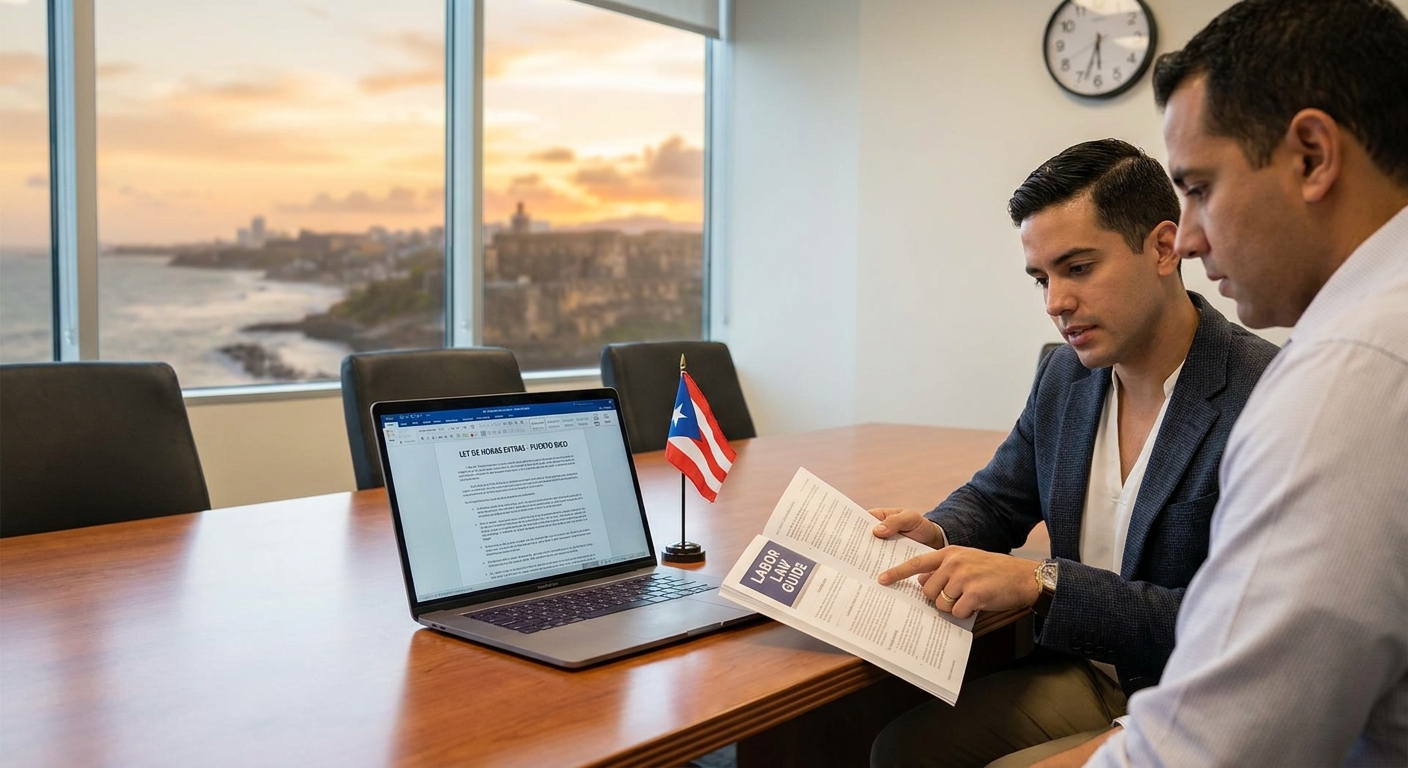

Overtime compensation in Puerto Rico operates under a distinct legal framework that differs significantly from federal law. Business owners, HR managers, and employees working in Puerto Rico need to understand these rules to remain compliant and avoid costly violations.
Puerto Rico's overtime regulations are codified in the Puerto Rico Labor Code and enforced by the Department of Labor and Human Resources. Unlike the federal Fair Labor Standards Act, which applies in the mainland United States, Puerto Rico has established its own wage and hour requirements that employers must follow. Misunderstanding or ignoring these rules exposes businesses to wage claims, penalties, and litigation.
The Basic Overtime Threshold in Puerto Rico
Puerto Rico requires employers to pay overtime compensation when an employee works more than 40 hours in a single workweek. This aligns with the federal standard, but the calculation and application of overtime rules in Puerto Rico contain important distinctions.
The standard overtime rate in Puerto Rico is one and one-half times the employee's regular hourly wage. This applies to all hours worked beyond 40 in a workweek. Employers cannot avoid this obligation by classifying workers as independent contractors if the relationship is actually one of employment. The Department of Labor and Human Resources applies a multi-factor test to determine true employment status, focusing on the degree of control the employer exercises over the worker.
Certain categories of employees are exempt from overtime requirements under Puerto Rico law. These exemptions are narrower than federal exemptions and include executive, administrative, and professional employees who meet specific salary and duty tests. Sales employees working on commission may also qualify for exemption under certain conditions. However, the burden falls on the employer to prove that an employee qualifies for an exemption. Courts and the Department of Labor interpret exemptions strictly.
Calculating Overtime Pay in Puerto Rico
The calculation of overtime compensation requires careful attention to what constitutes the employee's regular rate of pay. The regular rate includes all compensation paid to the employee for work performed, with limited exceptions. This includes hourly wages, piece rates, commissions, bonuses tied to productivity, and shift differentials.
Certain payments are excluded from the regular rate calculation. These include gifts, discretionary bonuses unrelated to hours worked, payments for unused vacation or sick leave, and certain fringe benefits. However, if a bonus is tied to production, sales, or hours worked, it must be included in the regular rate calculation.
Once the regular rate is determined, the overtime rate is calculated by multiplying that rate by 1.5. For example, if an employee's regular rate is $15 per hour and the employee works 45 hours in a week, the employee is entitled to 40 hours at $15 per hour ($600) plus 5 hours at $22.50 per hour ($112.50), for a total of $712.50 in wages for that week.
Employers must track hours worked with precision. Time records must be maintained for at least three years and must show the hours worked each day and each week. Failure to maintain accurate records can result in the Department of Labor imposing penalties and can shift the burden to the employer to prove the hours actually worked.
Daily Overtime and Premium Pay Requirements
Puerto Rico law provides for additional protections beyond the weekly 40-hour threshold. Employees are entitled to premium pay for work performed on certain days and under certain conditions.
Work performed on Sundays and certain holidays is subject to premium pay requirements. Employees working on these days are entitled to an additional 25 percent premium on top of their regular rate, in addition to any overtime compensation owed. This means an employee working on a Sunday for more than 40 hours in the week could be entitled to both the Sunday premium and overtime compensation.
Night shift work, defined as work performed between 6 p.m. and 6 a.m., may also trigger premium pay obligations depending on the industry and the specific circumstances. Some industries have sector-specific rules that impose additional requirements.
Employees working more than 8 hours in a single day may be entitled to daily overtime compensation, separate from weekly overtime. This daily overtime rule applies in certain industries and under certain conditions. Employers in manufacturing, construction, and other sectors should verify whether daily overtime rules apply to their operations.
Exempt vs. Non-Exempt Employees
Determining whether an employee is exempt from overtime requirements is one of the most common sources of wage and hour disputes in Puerto Rico. The exemptions are specific and cannot be applied based on job title alone.
Executive employees must have primary duties involving management of the business or a department, must supervise at least two full-time employees, and must have authority to hire, fire, or make recommendations regarding hiring and firing. The employee must also earn a salary above a statutory minimum threshold. In Puerto Rico, this threshold is adjusted periodically and employers must verify the current amount with the Department of Labor.
Administrative employees must have primary duties involving office or non-manual work directly related to management policies or general business operations. The employee must exercise independent judgment and discretion in significant matters. Like executive employees, administrative employees must meet a minimum salary requirement.
Professional employees include those with advanced degrees in fields such as law, medicine, engineering, accounting, and teaching. The employee's primary duties must involve work requiring knowledge of an advanced nature in the field. Professionals must also meet the minimum salary requirement.
Computer professionals may qualify for exemption if they are engaged in the design, development, or testing of computer systems or programs and meet the salary threshold. However, this exemption is narrowly construed and does not apply to all employees in the technology sector.
Misclassifying an employee as exempt when the employee does not meet all requirements of an exemption is a violation of Puerto Rico labor law. The consequences include back pay, penalties, and potential liability for attorney fees and costs.
Compensatory Time Off and Overtime Alternatives
Puerto Rico law does not permit employers to offer compensatory time off in lieu of overtime pay. Employees must be paid overtime compensation in cash. An employer cannot require or allow an employee to work overtime hours and then provide time off in a future week as a substitute for overtime pay.
This rule applies regardless of whether the employee agrees to the arrangement. The prohibition on compensatory time is a matter of public policy in Puerto Rico and cannot be waived by agreement between the employer and employee.
Some employers attempt to structure work schedules to avoid overtime obligations. For example, an employer might schedule an employee to work 30 hours one week and 50 hours the next week, hoping to average 40 hours across the two weeks. Puerto Rico law requires overtime to be calculated on a weekly basis, not averaged across multiple weeks. Each week stands alone for purposes of calculating overtime obligations.
Minimum Wage and Its Relationship to Overtime
Puerto Rico's minimum wage is set by statute and is adjusted periodically. The current minimum wage applies to all employees unless a specific exemption applies. Certain employees, such as those in training programs or employees with disabilities, may be subject to a lower minimum wage under specific conditions and with proper authorization from the Department of Labor.
The minimum wage sets the floor for the regular rate calculation. An employee cannot be paid less than the minimum wage for any hour worked, including hours worked at a reduced rate as part of a piece-rate or commission-based compensation structure. If an employee's compensation falls below the minimum wage when calculated on an hourly basis, the employer must make up the difference.
Overtime compensation is calculated based on the regular rate, which must be at least the minimum wage. If an employee is paid on a piece-rate or commission basis, the regular rate is determined by dividing total compensation by total hours worked. If this calculation results in a rate below the minimum wage, the employer must adjust the compensation to ensure the employee receives at least the minimum wage for all hours worked.
Record-Keeping and Documentation Requirements
Employers in Puerto Rico must maintain detailed records of hours worked by each employee. These records must show the date, the hours worked each day, and the total hours worked each week. Records must be kept for at least three years and must be made available to the Department of Labor upon request.
Payroll records must show the gross wages paid, the regular rate of pay, the overtime rate, the number of overtime hours worked, and the overtime compensation paid. Deductions from pay must be itemized and documented. Employers must provide employees with a detailed pay stub showing all of this information.
Failure to maintain adequate records can result in penalties imposed by the Department of Labor. Additionally, if an employer fails to maintain records and an employee files a wage claim, the burden shifts to the employer to prove the hours actually worked and the compensation paid. This can be difficult or impossible if records are incomplete or missing.
Electronic timekeeping systems are acceptable and are often preferable to manual records because they create a contemporaneous record that is difficult to alter. However, the system must be reliable and must accurately capture the hours worked.
Penalties for Overtime Violations
Employers who fail to pay overtime compensation as required by Puerto Rico law face significant penalties. The Department of Labor can assess civil penalties, and employees can file wage claims seeking back pay plus penalties.
An employee who is not paid overtime compensation owed is entitled to recover the unpaid wages plus an equal amount as a penalty. This means the total liability is double the unpaid overtime compensation. Additionally, the employee may be entitled to recover attorney fees and costs if the case is litigated.
Willful violations of overtime requirements can result in criminal penalties, including fines and imprisonment. While criminal prosecution is less common than civil enforcement, it demonstrates the seriousness with which Puerto Rico treats wage and hour violations.
The Department of Labor can also conduct investigations and audits of employer payroll records. If violations are found, the Department can assess penalties and require the employer to pay back wages to affected employees. These investigations can be triggered by employee complaints or can be conducted as part of routine enforcement activities.
Industry-Specific Overtime Rules
Certain industries in Puerto Rico have additional or modified overtime requirements. The hospitality industry, including hotels and restaurants, has specific rules regarding overtime and meal periods. The construction industry has rules regarding daily overtime and premium pay for work on certain days.
Agricultural workers are subject to different rules under Puerto Rico law. Some agricultural workers may be exempt from certain overtime requirements, but this exemption is narrowly construed and applies only to specific types of agricultural work.
Employers in these industries must be familiar with the specific rules that apply to their operations. Relying on general overtime rules without considering industry-specific requirements can result in violations.
Practical Compliance Steps for Employers
Employers should begin by conducting an audit of their current payroll practices and overtime policies. Review job classifications to ensure that employees are correctly classified as exempt or non-exempt. Verify that the salary thresholds for exempt employees meet current Puerto Rico requirements.
Implement a reliable timekeeping system that accurately captures hours worked. Train managers and supervisors on overtime rules and the importance of accurate record-keeping. Ensure that payroll staff understand how to calculate overtime compensation correctly.
Review compensation structures to ensure that all forms of compensation are properly included in the regular rate calculation. If bonuses are paid, document whether they are discretionary or tied to performance, as this affects whether they must be included in the regular rate.
Establish a policy regarding overtime authorization and approval. While Puerto Rico law requires payment of overtime compensation for all hours worked, employers can require that overtime be authorized in advance. Document all overtime work and the business reason for it.
Conduct periodic audits of payroll records to identify and correct any errors. If errors are discovered, correct them promptly and consider whether affected employees should be notified and compensated for any underpayment.
Next Steps
Overtime rules in Puerto Rico are complex and the consequences of non-compliance are serious. If you are an employer with questions about your overtime obligations, or if you are an employee who believes you have not been paid overtime compensation owed, a free initial evaluation with an experienced Puerto Rico business law attorney can help clarify your situation and identify the appropriate course of action.
Christian M. Frank Fas, Esq. has more than 20 years of experience in Puerto Rico commercial and business law, including wage and hour matters. Schedule your free initial evaluation today to discuss your specific circumstances and receive guidance on compliance or enforcement of your rights.