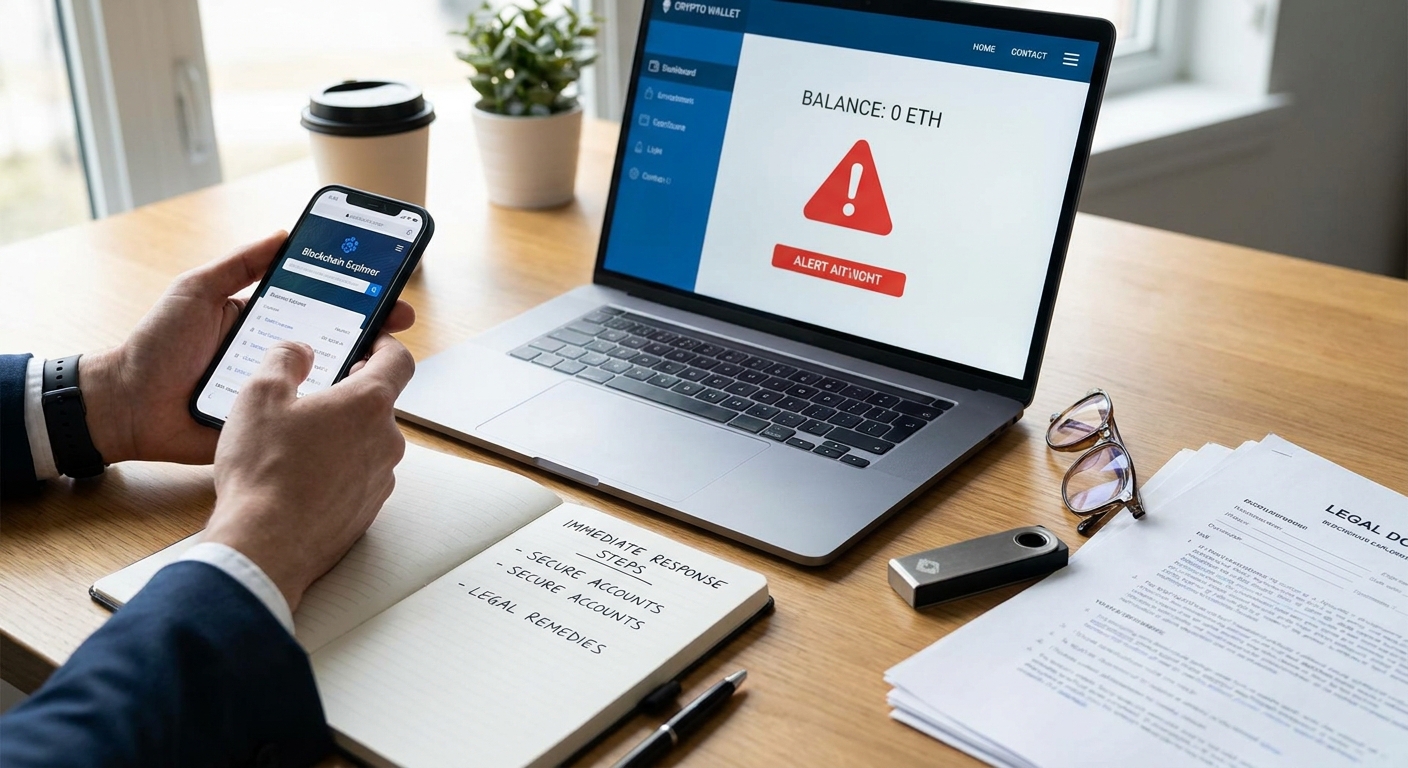

Your MetaMask wallet has been compromised and funds are gone. What happens next determines whether you recover anything and whether you can hold responsible parties accountable.
A drained MetaMask wallet represents a financial loss that demands immediate action. Unlike traditional bank accounts, cryptocurrency transactions are irreversible once confirmed on the blockchain. The window for effective response is narrow. This article outlines the concrete steps you must take when your MetaMask wallet has been drained, the legal framework that applies, and how to work with experienced professionals to pursue recovery and accountability.
Understanding How MetaMask Wallets Get Drained
MetaMask wallets are compromised through several common vectors. Phishing attacks direct users to fake websites that capture seed phrases or private keys. Malware installed on your computer or mobile device monitors keyboard input and clipboard activity, capturing sensitive information as you type or copy it. Compromised browser extensions that mimic MetaMask functionality steal credentials during the installation process. Social engineering attacks manipulate users into revealing their seed phrases through false urgency or authority claims.
Some drains occur through smart contract vulnerabilities. Users approve token transfers or interact with malicious contracts that execute unauthorized transactions. Others result from exchange or service provider breaches where MetaMask credentials are stored or synced. The method of compromise matters because it determines what evidence exists, who may be liable, and what recovery options are available.
Understanding the specific mechanism behind your wallet drain is the first step toward response. Different compromise vectors leave different digital trails and implicate different parties in the chain of responsibility.
Step One: Secure Your Remaining Assets Immediately
Before investigating the drain or pursuing recovery, you must prevent further loss. If your MetaMask wallet still contains any assets, move them to a new wallet immediately. Create a new MetaMask wallet using a fresh browser profile or a hardware wallet like Ledger or Trezor. Do not reuse any passwords, seed phrases, or recovery methods associated with the compromised wallet.
If you have other cryptocurrency holdings on different platforms or wallets, change the passwords on those accounts now. Use strong, unique passwords that you have never used before. Enable two-factor authentication on every account that supports it. If you use the same email address across multiple platforms, change the password on that email account as well.
Check your browser extensions and remove anything you do not recognize or have not actively used in the past month. Verify that your MetaMask extension is the official version by checking the publisher in your browser's extension store. Scan your computer with reputable antivirus software to identify and remove malware.
This containment phase typically takes a few hours but prevents cascading losses that would compound your initial damage.
Step Two: Document Everything for Legal and Recovery Purposes
Detailed documentation creates the foundation for any recovery effort or legal claim. Record the date and time you discovered the drain. Screenshot your MetaMask transaction history showing the unauthorized transactions. Note the wallet addresses that received your funds. Record the amounts transferred and the tokens or assets involved.
Preserve all communications related to your wallet, including emails, messages, or notifications from MetaMask or other services. If you received a phishing email or visited a fake website, save copies of those materials. Document your actions leading up to the compromise, including what websites you visited, what extensions you installed, and what transactions you approved.
Export your MetaMask transaction history in full. Most blockchain explorers like Etherscan allow you to view and download transaction records for any wallet address. Create a spreadsheet listing each unauthorized transaction with the date, amount, receiving address, and transaction hash. This documentation serves multiple purposes: it establishes the timeline and scope of loss, it provides evidence for law enforcement, and it supports any civil claims you may pursue.
Photograph or screenshot your device settings, browser extensions, and security software status as they exist after the compromise. This creates a record of the state of your systems at the time you discovered the problem.
Step Three: Report the Compromise to Relevant Authorities
File a report with the Federal Bureau of Investigation's Internet Crime Complaint Center (IC3) at ic3.gov. Provide detailed information about the compromise, the amounts involved, and the wallet addresses that received your funds. The IC3 does not investigate individual cases but aggregates reports to identify patterns and coordinate with law enforcement agencies.
Report the incident to your state's attorney general office. Many states have consumer protection divisions that track cryptocurrency fraud and scams. Provide the same documentation you compiled in Step Two.
If you believe the compromise involved a specific service provider, exchange, or platform, report the incident to that company's security team. Most major platforms have dedicated security reporting channels. Provide evidence of the compromise and request that they preserve any logs or records related to your account.
If you are located in Puerto Rico or the compromise involved Puerto Rico-based services or parties, report the incident to the Puerto Rico Department of Consumer Affairs. This creates an official record that may support future legal action.
Law enforcement agencies rarely recover individual cryptocurrency losses, but these reports create official records that establish the crime, document the pattern of attacks, and may support civil litigation or regulatory action against responsible parties.
Step Four: Trace the Funds on the Blockchain
Blockchain analysis can reveal where your funds went and whether they remain traceable. Use blockchain explorers to follow the transaction trail from your wallet to the receiving addresses. Many stolen funds move through multiple wallets in rapid succession, but the complete transaction history remains visible on the blockchain.
Services like Chainalysis, TRM Labs, and Elliptic specialize in blockchain forensics and can trace fund movements across exchanges and platforms. Some of these services offer free or low-cost analysis for victims of theft. Provide them with your wallet address and the addresses that received your funds.
Determine whether your funds were deposited to a known exchange or service. If stolen assets moved to a major exchange like Coinbase, Kraken, or Gemini, those platforms may have frozen the account or preserved records that could support recovery efforts. Contact the exchange's compliance team with your documentation and request that they preserve all records related to the receiving account.
Some stolen funds are converted to other cryptocurrencies or fiat currency through mixing services or privacy coins. This makes tracing more difficult but not impossible. Experienced blockchain analysts can often follow the trail even through multiple conversions.
The goal of this step is to determine whether your funds are still traceable and whether they are held by identifiable parties or services that may be subject to legal action or regulatory pressure.
Step Five: Identify Potentially Liable Parties
Liability for your drained wallet may extend beyond the person or group that directly stole your funds. If the compromise involved a phishing attack that directed you to a fake website, the domain registrar and hosting provider may be liable for failing to prevent the fraudulent use of their services. If malware was involved, the software vendor that failed to detect or prevent the malware may bear responsibility.
If you installed a malicious browser extension, the extension platform may be liable for inadequate vetting of third-party developers. If you were directed to the fake website through a compromised advertisement, the advertising platform may share liability. If the compromise involved a breach of a service where you stored or synced your credentials, that service provider may be liable for inadequate security measures.
MetaMask itself is generally not liable for user error or compromise of private keys, as the wallet is designed to give users complete control and responsibility for their assets. However, if the compromise involved a vulnerability in MetaMask's code or a failure to warn users of known risks, liability may attach to MetaMask or its parent company Consensys.
Identifying liable parties requires understanding the specific chain of events that led to your compromise. This is where experienced legal counsel becomes essential. An attorney with focused knowledge of blockchain technology and cryptocurrency law can analyze your situation and identify all potentially responsible parties.
Step Six: Pursue Civil Recovery Through Legal Action
Once you have identified potentially liable parties, you may pursue civil claims for damages. These claims typically fall into several categories: negligence, breach of contract, violation of consumer protection statutes, and fraud.
Negligence claims assert that a defendant owed you a duty of care, breached that duty, and caused your loss. A service provider that failed to implement reasonable security measures, for example, may be liable for negligence. A platform that failed to verify the identity of account holders before allowing large withdrawals may be negligent.
Breach of contract claims arise when a service provider violated the terms of service or failed to provide the security or functionality promised. If an exchange promised to maintain certain security standards and failed to do so, resulting in a breach that compromised your account, you may have a breach of contract claim.
Consumer protection statutes in most states prohibit unfair or deceptive practices. If you were directed to a fake website through deceptive advertising or if a service provider misrepresented its security measures, you may have a claim under consumer protection law. These statutes often allow recovery of treble damages and attorney fees, making them valuable tools for victims.
Fraud claims require proof that a defendant made a false statement with intent to deceive, that you relied on that statement, and that you suffered damages as a result. If you were socially engineered into revealing your seed phrase through false claims about a security update or account verification, you may have a fraud claim against the person or entity that deceived you.
Civil litigation is expensive and time-consuming, but it may be the only path to recovery when law enforcement cannot or will not act. The decision to pursue litigation depends on the amount of your loss, the strength of your evidence, and the financial resources of the defendant.
Step Seven: Explore Regulatory and Administrative Remedies
Regulatory agencies have authority over certain parties in the cryptocurrency ecosystem. If your funds were deposited to a regulated exchange, you may file a complaint with the Financial Industry Regulatory Authority (FINRA) or the Securities and Exchange Commission (SEC). If the exchange is a bank or operates as a money transmitter, you may file a complaint with the Consumer Financial Protection Bureau (CFPB) or your state's banking regulator.
These agencies cannot directly recover your funds, but they can investigate the exchange or service provider, impose fines, and require restitution to victims. Filing complaints with multiple agencies increases the likelihood that your case will receive attention and that regulatory pressure will be applied to the responsible party.
If the compromise involved a domain name or website, you may file a complaint with the Internet Corporation for Assigned Names and Numbers (ICANN) or request that the domain be suspended through the National Center for Missing and Exploited Children's CyberTipline or similar services.
Step Eight: Consider Tax and Accounting Implications
A drained cryptocurrency wallet has tax consequences that you must address. The loss may be deductible as a casualty loss or theft loss on your federal income tax return, subject to certain limitations. You must report the loss in the year it occurred and provide documentation of the amount and the circumstances.
Consult with a tax professional or accountant who has experience with cryptocurrency taxation. They can advise you on the proper treatment of your loss and ensure that you claim all available deductions and credits. If you recover any portion of your stolen funds, that recovery may have tax implications as well.
Step Nine: Strengthen Your Security Going Forward
After your wallet has been drained, you must implement security measures that prevent future compromise. Use a hardware wallet for any significant cryptocurrency holdings. Hardware wallets store your private keys offline, making them immune to malware and phishing attacks. Ledger and Trezor are the most widely used hardware wallets and are compatible with MetaMask.
Enable hardware wallet verification for all transactions. This requires you to physically confirm each transaction on your hardware wallet device, preventing unauthorized transactions even if your computer is compromised.
Use a dedicated computer or virtual machine for cryptocurrency transactions. This isolates your cryptocurrency activities from your regular browsing and email, reducing the risk of malware infection.
Implement a multi-signature wallet for large holdings. Multi-signature wallets require approval from multiple parties or devices before funds can be transferred, preventing a single point of compromise from resulting in total loss.
Store your seed phrase in a secure location, separate from your computer and devices. Consider using a metal seed phrase storage device that is resistant to fire and water damage. Never store your seed phrase in digital form, email, or cloud storage.
Use unique, strong passwords for every account and service. A password manager like 1Password or Bitwarden can generate and store complex passwords securely.
Legal Considerations for Puerto Rico Residents and Businesses
If you are a Puerto Rico resident or operate a business in Puerto Rico, your situation may involve additional legal considerations. Puerto Rico has its own civil code and procedural rules that differ from the mainland United States. If the compromise involved a Puerto Rico-based service provider or party, Puerto Rico courts may have jurisdiction over your claim.
Puerto Rico has also enacted legislation addressing blockchain technology and cryptocurrency. Understanding this regulatory framework can inform your response strategy and may create additional remedies or protections available to you.
If you are considering cryptocurrency investments or blockchain-based business activities in Puerto Rico, you should be aware of the tax incentives available under Act 60 and the compliance requirements that apply to cryptocurrency businesses. A drained wallet is a painful lesson in the importance of security, but it also highlights the need for proper legal and tax planning around cryptocurrency holdings.
When to Seek Legal Counsel
You should consult with an experienced attorney as soon as you discover that your MetaMask wallet has been drained. An attorney can help you understand your legal options, identify liable parties, and pursue recovery through civil litigation or regulatory channels. An attorney can also help you navigate the intersection of cryptocurrency law, consumer protection law, and tax law that your situation involves.
The decision to pursue legal action depends on several factors: the amount of your loss, the strength of your evidence, the financial resources of the defendant, and the likelihood of recovery. An experienced attorney can assess these factors and advise you on whether litigation or other remedies make sense in your specific situation.
If your situation involves a Puerto Rico connection, either because you are a Puerto Rico resident or because the compromise involved a Puerto Rico-based party or service, you should work with an attorney who understands both cryptocurrency law and Puerto Rico law. This combination of knowledge is essential to identifying all available remedies and pursuing them effectively.
Next Steps
A drained MetaMask wallet demands immediate action. The steps outlined above will help you contain your loss, document what happened, and pursue recovery through law enforcement, civil litigation, and regulatory channels. The sooner you act, the better your chances of recovery and accountability.
If you are a Puerto Rico resident or your situation involves Puerto Rico, contact the Puerto Rico Business Law Firm for a free initial evaluation. Christian M. Frank Fas, Esq. has over 20 years of experience in commercial and business law and can advise you on your legal options and the best path forward. Visit lawyerinpr.com/start to request your free evaluation today.
For more information on blockchain compliance and cryptocurrency law, visit our blockchain compliance page.