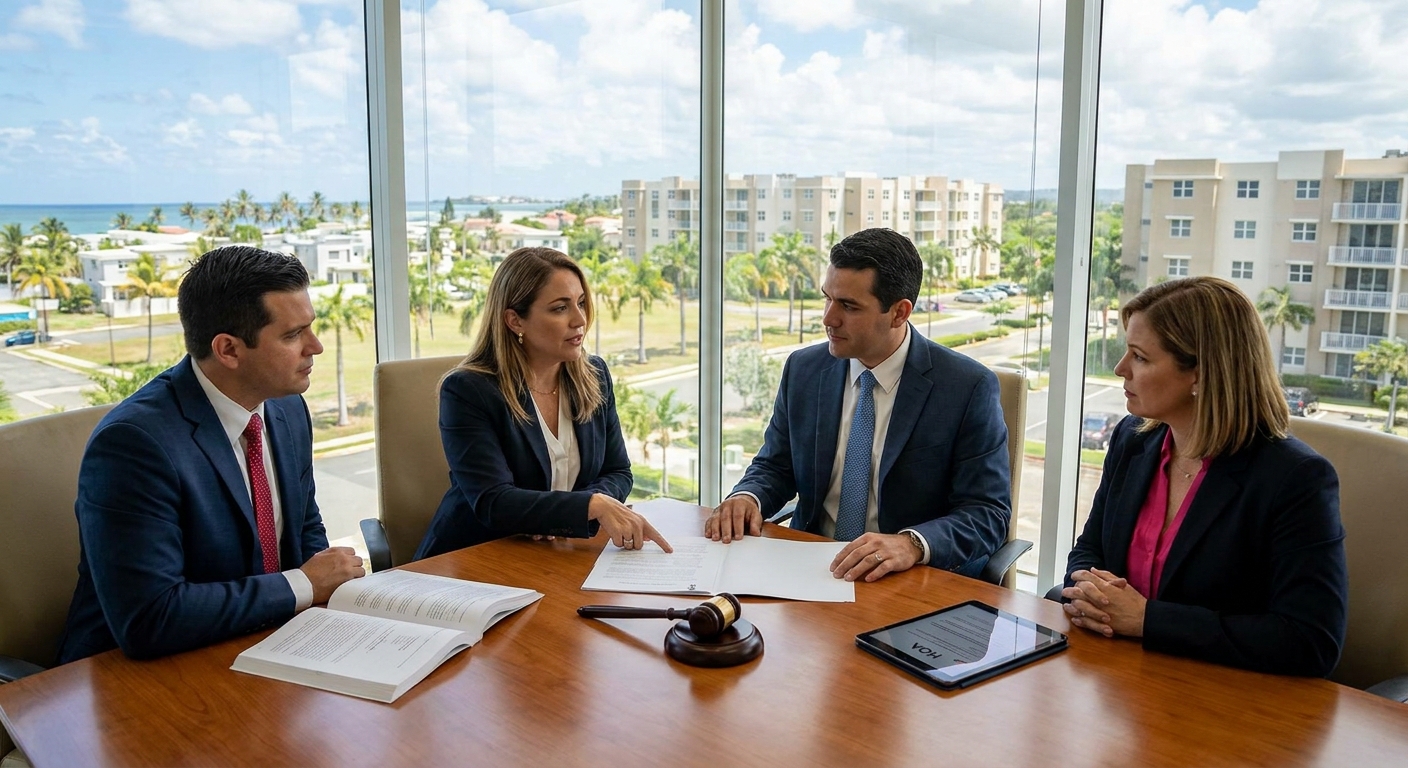

HOA disputes in Puerto Rico carry real financial and legal consequences that demand immediate attention
Homeowners association litigation in Puerto Rico presents a distinct set of challenges rooted in local property law, condominium statutes, and the specific governance structures that apply to residential communities across the island. Whether you own property within an HOA or serve on a board, disputes over assessments, maintenance obligations, architectural approvals, or enforcement actions can escalate quickly without proper legal guidance. The stakes are high: unpaid assessments can result in liens against your property, board decisions can be challenged in court, and procedural missteps can undermine otherwise valid claims or defenses.
This article covers the legal framework governing HOA litigation in Puerto Rico, the most common disputes that arise, the remedies available to both owners and associations, and how to protect your interests when conflict emerges.
The Legal Framework for HOAs in Puerto Rico
Puerto Rico's condominium and HOA law is primarily governed by Act 257-2018, known as the Condominium Act, which replaced the previous 1988 statute. This law establishes the rights and obligations of unit owners, the powers and duties of boards of directors, and the procedures for resolving internal disputes. Understanding this framework is essential because it defines what an HOA can and cannot do, what owners must pay, and what remedies exist when violations occur.
The Condominium Act requires that all condominiums and HOAs maintain bylaws and house rules that comply with the statute. These documents must address assessment collection, the board's authority to enforce rules, procedures for amending governing documents, and the process for resolving disputes between the association and its members. Many disputes arise because either the association or individual owners misunderstand what the law actually permits or requires.
One critical point: the Condominium Act grants HOAs significant enforcement power, but that power is not unlimited. Boards cannot act arbitrarily or in violation of the statute. They must follow proper procedures, provide notice to affected owners, and act in the best interests of the community as a whole. When a board overreaches, owners have grounds to challenge the action in court.
Common Types of HOA Disputes in Puerto Rico
HOA litigation in Puerto Rico typically falls into several categories, each with its own legal considerations and potential outcomes.
Assessment and Collection Disputes
Assessment disputes are among the most frequent conflicts between HOAs and owners. These cases involve disagreements over the amount of monthly or special assessments, the validity of the assessment process, or the owner's obligation to pay. An HOA may claim that an owner owes unpaid assessments and seek to enforce a lien against the property. The owner may counter that the assessment was improper, that the board lacked authority to impose it, or that the amount was calculated incorrectly.
Puerto Rico law permits HOAs to place liens on properties for unpaid assessments, but the lien must be properly recorded and the assessment must have been validly imposed. If an HOA fails to follow the correct procedures for imposing a special assessment, such as failing to provide proper notice or failing to obtain the required vote from the membership, the assessment may be invalid and the lien unenforceable. Owners facing assessment liens should have an experienced attorney review the assessment process to identify any procedural defects.
Special assessments are particularly contentious because they often involve large, unexpected costs. The Condominium Act requires that special assessments be approved by a specified percentage of unit owners, typically a majority or supermajority depending on the nature of the expense. If the board imposed a special assessment without proper approval, the assessment can be challenged and potentially reversed.
Architectural Review and Modification Disputes
Most HOAs maintain architectural review committees or require board approval before owners can make modifications to their units or common areas. These requirements exist to maintain aesthetic consistency and protect property values. However, disputes arise when owners believe the board has unreasonably denied a modification request or when the board's standards are vague or applied inconsistently.
Puerto Rico courts recognize that HOAs have legitimate authority to regulate modifications, but that authority must be exercised reasonably. A board cannot deny a modification request based on arbitrary or capricious reasoning. If an owner can demonstrate that the board's decision was unreasonable, inconsistent with prior approvals, or not supported by the governing documents, the decision may be overturned. These cases often require detailed documentation of prior approvals and evidence of inconsistent enforcement.
Rule Enforcement and Violation Disputes
HOAs enforce community rules through violation notices, fines, and in some cases, suspension of amenities or other enforcement mechanisms. Owners frequently challenge these enforcement actions, claiming that the rule was not properly adopted, that the violation did not occur, or that the enforcement was disproportionate or discriminatory.
The Condominium Act requires that rules be adopted through proper procedures and that owners receive notice of violations and an opportunity to be heard before fines are imposed. If an HOA fails to follow these procedural requirements, the enforcement action may be invalid. Additionally, if an owner can demonstrate that the rule is unreasonable or that the board has applied it selectively to certain owners while ignoring violations by others, the enforcement action may be challenged successfully.
Board Election and Governance Disputes
Disputes over board elections, the validity of board decisions, and the removal of board members are common in HOA litigation. These cases involve questions about whether proper notice was given for elections, whether voting procedures were followed correctly, or whether a board member has engaged in misconduct that warrants removal.
The Condominium Act establishes specific procedures for board elections and removal. If these procedures are not followed, election results can be challenged and potentially invalidated. Similarly, if a board member has violated fiduciary duties or engaged in self-dealing, other board members or unit owners may seek removal through the courts.
Maintenance and Repair Disputes
Disagreements over the HOA's responsibility to maintain and repair common areas, or disputes about the quality of maintenance work, can lead to litigation. Owners may claim that the HOA has failed to maintain the property in a safe and habitable condition, while the HOA may argue that certain repairs are the owner's responsibility or that the owner has failed to pay assessments needed to fund repairs.
The Condominium Act clearly delineates which areas are common property and which are the owner's responsibility. Understanding this distinction is critical to resolving maintenance disputes. If the HOA has failed to maintain common areas properly, owners may have grounds to sue for damages or to seek a court order requiring the HOA to perform necessary repairs.
The Litigation Process for HOA Disputes in Puerto Rico
HOA litigation in Puerto Rico follows the procedures established in the Puerto Rico Code of Civil Procedure. Understanding the basic steps in the litigation process can help you prepare for what lies ahead.
Pre-Litigation Steps
Before filing a lawsuit, most HOA disputes go through informal resolution attempts. Many governing documents require that disputes be addressed through a complaint process or mediation before litigation begins. Even if not required, attempting to resolve the dispute informally can save time and money. This stage typically involves sending a formal letter to the HOA or the owner outlining the dispute and requesting a response or meeting to discuss resolution.
During this phase, it is important to document all communications, gather evidence supporting your position, and clearly articulate what resolution you are seeking. If the other party is unwilling to resolve the matter informally, you can proceed to litigation.
Filing the Complaint
HOA litigation begins with the filing of a complaint in the appropriate court. In Puerto Rico, most HOA disputes are filed in the Court of First Instance. The complaint must clearly state the facts supporting your claim, identify the legal basis for relief, and specify what remedy you are seeking, whether that is monetary damages, an injunction, or a declaration that a board decision is invalid.
The complaint must comply with the Puerto Rico Code of Civil Procedure and must be served on the defendant according to the rules of civil procedure. Failure to properly serve the defendant can result in dismissal of the case.
Discovery and Pretrial Proceedings
After the complaint is filed, both parties enter the discovery phase, during which they exchange documents and information relevant to the dispute. In HOA cases, discovery typically includes requests for the HOA's governing documents, meeting minutes, financial records, correspondence with the owner, and any other documents related to the dispute.
Discovery also includes depositions, in which witnesses and parties are questioned under oath. These depositions can be critical in HOA cases because they allow you to obtain testimony from board members, property managers, and other witnesses about how decisions were made and whether proper procedures were followed.
Pretrial proceedings may include motions to dismiss, motions for summary judgment, and settlement conferences. Many cases are resolved during this phase without proceeding to trial.
Trial and Appeal
If the case is not resolved through settlement or summary judgment, it will proceed to trial. At trial, both parties present evidence and arguments to a judge, who then issues a decision. In some cases, either party may appeal the decision to a higher court if they believe the judge made an error of law or fact.
Remedies Available in HOA Litigation
The remedies available in HOA litigation depend on the nature of the dispute and the relief sought. Understanding what remedies are available can help you determine whether litigation is worthwhile and what outcome you can realistically expect.
Monetary Damages
In cases where an HOA or owner has caused financial harm, the court may award monetary damages. For example, if an HOA has wrongfully collected assessments, the court may order the HOA to refund the amounts collected plus interest. If an owner has damaged common property, the court may order the owner to pay for repairs. In some cases, courts also award damages for emotional distress or harm to reputation, though these are less common in HOA cases.
Injunctive Relief
An injunction is a court order requiring a party to do something or to stop doing something. In HOA cases, injunctions are commonly used to stop an HOA from enforcing an invalid rule, to require an HOA to perform maintenance on common areas, or to prevent an owner from violating community rules. To obtain an injunction, you must typically demonstrate that you will suffer irreparable harm if the injunction is not granted and that monetary damages would not be an adequate remedy.
Declaratory Relief
A declaration is a court judgment that clarifies the rights and obligations of the parties. In HOA cases, declaratory relief is often sought to determine whether a particular rule is valid, whether an assessment was properly imposed, or whether a board decision was made in accordance with the governing documents and the law. A declaration does not necessarily award money or require specific action, but it does establish the legal rights of the parties going forward.
Attorneys' Fees and Costs
In some HOA cases, the prevailing party may recover attorneys' fees and court costs from the losing party. The Condominium Act and Puerto Rico law provide for fee-shifting in certain circumstances, particularly when one party has acted in bad faith or when the governing documents provide for fee recovery. This can significantly increase the financial stakes of HOA litigation and should be considered when evaluating whether to pursue or defend a claim.
Key Defenses in HOA Litigation
If you are defending against an HOA claim, several defenses may be available depending on the nature of the dispute.
Procedural Defects
Many HOA claims fail because the HOA failed to follow proper procedures. If the HOA did not provide proper notice, did not follow the voting procedures required by the governing documents, or did not comply with the Condominium Act, the action may be invalid. Procedural defects are often the strongest defense in HOA cases because they do not require you to prove the merits of the underlying dispute.
Lack of Authority
The HOA's authority is limited to what is granted in the governing documents and the Condominium Act. If the HOA took an action that exceeds its authority, such as imposing a fine that is not permitted by the rules or making a decision that is reserved to the membership, the action may be invalid.
Unreasonableness
Even if the HOA had authority to take an action, the action may be invalid if it was unreasonable. For example, if an architectural review committee denied a modification request without providing a reason or based on arbitrary criteria, the denial may be overturned as unreasonable. Similarly, if a fine is grossly disproportionate to the violation, it may be reduced or eliminated.
Waiver and Estoppel
If the HOA has previously allowed similar conduct or has failed to enforce a rule consistently, it may have waived its right to enforce the rule against you. Estoppel may also apply if the HOA has led you to believe that a particular action was permitted and you have relied on that representation to your detriment.
Working with an Experienced Attorney
HOA litigation in Puerto Rico requires a thorough understanding of the Condominium Act, Puerto Rico civil procedure, and the specific facts of your case. An experienced attorney can help you evaluate the strength of your claim or defense, identify procedural defects or other weaknesses in the opposing party's position, and develop a strategy for resolving the dispute efficiently and favorably.
Whether you are an owner facing an assessment lien, a board member defending against a challenge to a board decision, or an HOA seeking to enforce community rules, having competent legal representation can make the difference between a favorable outcome and a costly loss. An experienced attorney can also help you avoid common mistakes that can undermine your case, such as failing to preserve evidence, missing deadlines, or making statements that can be used against you later.
For commercial and business disputes, including those involving real property and HOA matters, the commercial litigation services available through our firm provide focused representation tailored to the specific needs of your case.
Next Steps
If you are involved in an HOA dispute in Puerto Rico, the time to seek legal guidance is now. The longer you wait, the more evidence may be lost, deadlines may pass, and your position may be weakened. Contact our firm for a free initial evaluation of your situation. During this evaluation, we will review the facts of your case, explain your rights and options, and discuss a path forward. You can schedule your free initial evaluation by visiting our evaluation page or by contacting our office directly. Do not let an HOA dispute escalate without professional legal guidance.