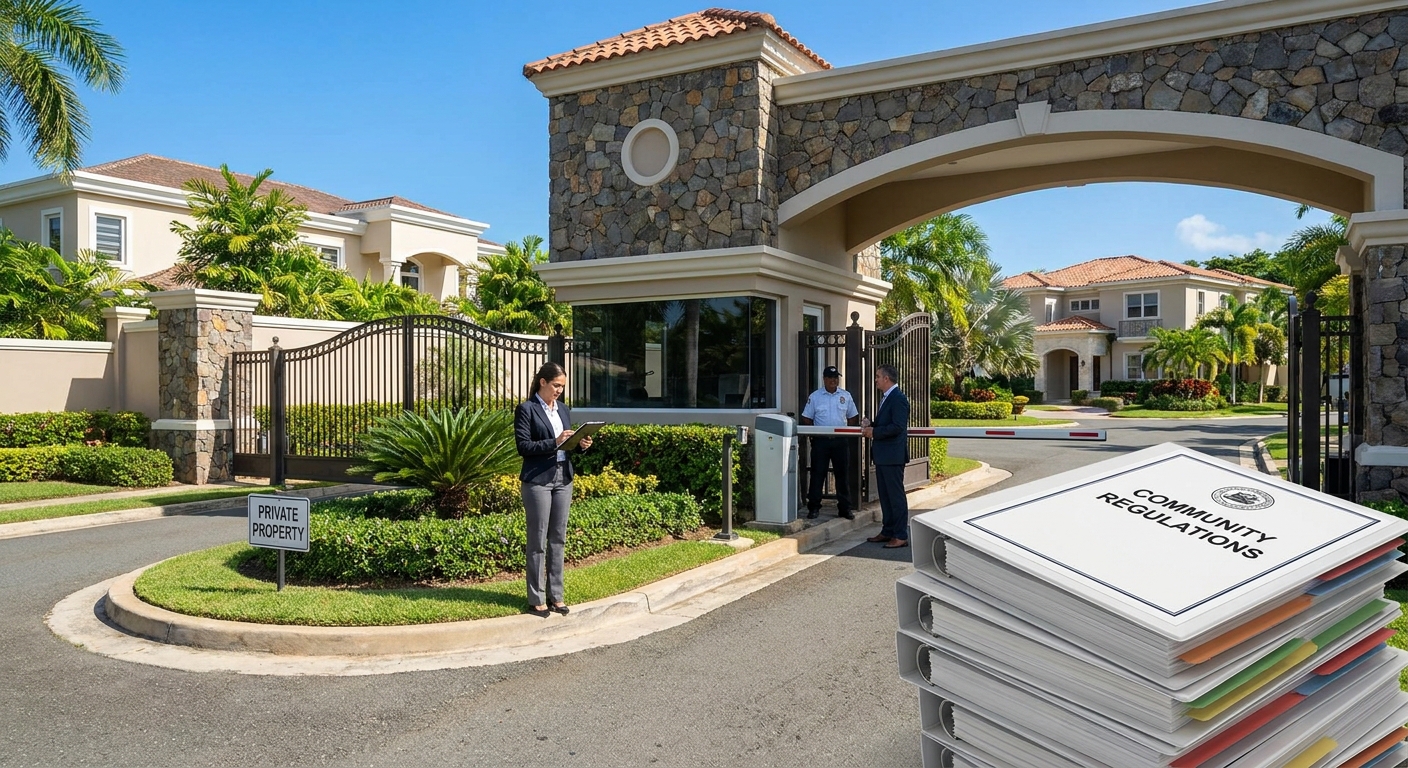

Gated communities operate under a specific legal framework in Puerto Rico, and understanding these regulations is essential for property owners, developers, and residents who want to maintain compliance and protect their investments.
Gated communities represent a significant portion of Puerto Rico's residential real estate market. Whether you own property in an established gated community, are developing a new one, or serve as a board member or property manager, you need to understand the rules that govern these communities. Puerto Rico's legal system imposes clear requirements on how gated communities are organized, operated, and maintained. Failure to comply with these regulations can result in fines, legal disputes, and complications when buying or selling property.
What Constitutes a Gated Community in Puerto Rico
A gated community in Puerto Rico is a residential development with restricted access, typically enclosed by walls, fences, or gates. The definition matters because it determines which regulations apply to your property. Puerto Rico law recognizes gated communities as distinct from standard residential subdivisions, and this distinction carries legal consequences.
The key characteristic is controlled access. If your community has a single entry point with security personnel or an automated gate system, it likely qualifies as a gated community under Puerto Rico law. Some communities use electronic access cards, keypads, or security guards. Others rely on physical barriers alone. Regardless of the method, the intent to restrict access is what matters.
Size and density also factor into the classification. A gated community typically contains multiple residential units, though Puerto Rico law does not specify a minimum number. A single-family home with a private gate does not constitute a gated community. The regulation applies to developments with multiple owners sharing common areas and infrastructure.
The legal status of the land also matters. Gated communities can be built on private land or on land held in common by residents. The ownership structure affects which regulations apply and how the community must be governed.
Governance Requirements for Gated Communities
Puerto Rico requires gated communities to establish a formal governing structure. This structure typically takes the form of a homeowners association, condominium association, or similar entity. The governing body must be registered with the appropriate government agencies and must follow specific procedures for decision-making.
The governing board must have bylaws that outline how the community operates. These bylaws must address several key areas: the election of board members, the collection of assessments and fees, the maintenance of common areas, the enforcement of community rules, and the handling of disputes among residents. The bylaws must be provided to all residents and must be available for inspection.
Board members have fiduciary duties to the community. This means they must act in the best interests of all residents, not just a select few. They cannot use their position for personal gain, and they must manage community funds responsibly. Violations of these duties can result in removal from the board and legal liability.
Meetings must be held regularly, typically at least once per year. Residents have the right to attend these meetings and to vote on major decisions. The board must maintain records of all meetings, including attendance, votes, and decisions made. These records must be made available to residents upon request.
Financial Management and Assessment Requirements
Gated communities in Puerto Rico must establish a system for collecting assessments from residents to cover the costs of maintaining common areas and providing community services. These assessments are mandatory, and failure to pay can result in liens against the property.
The board must prepare an annual budget that outlines expected expenses and the assessments needed to cover them. This budget must be provided to residents before it is adopted. Residents have the right to review the budget and to ask questions about how their money will be spent.
The board must maintain separate accounts for community funds. These funds cannot be commingled with personal funds or used for purposes other than community maintenance and operations. The board must keep detailed records of all income and expenses, and these records must be audited annually by an independent accountant.
Special assessments may be imposed for unexpected expenses or major repairs. However, special assessments typically require approval from a majority of residents. The board cannot unilaterally impose large special assessments without resident input.
Residents have the right to know how their assessments are being used. The board must provide financial statements to residents at least annually. These statements must show income from assessments, expenses for maintenance and services, and the current balance in community accounts.
Common Area Maintenance and Liability
The board is responsible for maintaining all common areas within the gated community. Common areas typically include roads, sidewalks, parks, pools, clubhouses, and security infrastructure. The board must ensure that these areas are kept in safe and usable condition.
Maintenance standards are set by Puerto Rico law and by the community's bylaws. The board must perform regular inspections of common areas and must address any safety hazards promptly. Failure to maintain common areas can result in liability if a resident or visitor is injured.
The board must also maintain adequate insurance coverage for common areas and community property. This insurance protects the community from liability claims and covers the cost of repairs if common areas are damaged. The board must ensure that insurance policies are current and that coverage limits are appropriate for the community's assets.
Residents may be held liable for damage they cause to common areas. If a resident's negligence damages community property, the board may pursue a claim against that resident for the cost of repairs. This is separate from any assessment the resident must pay as part of their ownership in the community.
Security and Access Control Regulations
Security is a primary reason residents choose gated communities, and Puerto Rico law recognizes the importance of maintaining secure access. The board must establish and enforce rules regarding who can enter the community and under what circumstances.
Access control systems must be maintained in working order. If the community uses electronic gates or security systems, the board must ensure that these systems are regularly serviced and updated. Malfunctioning security systems can expose the community to liability and can violate residents' expectations regarding security.
The board must establish clear policies regarding visitor access, delivery services, and contractor entry. These policies must balance security with the practical need to allow residents to receive visitors and services. Policies that are too restrictive may violate residents' rights, while policies that are too permissive may compromise security.
Security personnel, if employed, must be properly trained and must follow established protocols. The board is responsible for ensuring that security staff comply with Puerto Rico labor laws and that they do not violate residents' rights. Security personnel cannot discriminate against residents or visitors based on protected characteristics.
The board must also address cybersecurity if the community uses electronic access systems. Resident data and security system information must be protected from unauthorized access. Breaches of security systems can expose residents to identity theft and other crimes.
Enforcement of Community Rules and Dispute Resolution
Gated communities must have rules that govern resident conduct. These rules typically address noise levels, parking, landscaping, pet ownership, and the use of common areas. The board is responsible for enforcing these rules fairly and consistently.
Before imposing penalties for rule violations, the board must provide the resident with notice of the alleged violation and an opportunity to respond. This due process requirement protects residents from arbitrary enforcement and ensures that rules are applied fairly. The board cannot impose penalties without giving the resident a chance to explain their conduct.
Penalties for rule violations must be proportionate to the violation. Common penalties include warnings, fines, or temporary suspension of access to common areas. The board cannot impose penalties that are excessive or that effectively exclude a resident from the community.
Disputes between residents and the board, or between residents themselves, must be resolved through established procedures. Many communities require residents to attempt mediation before pursuing legal action. Mediation can resolve disputes more quickly and at lower cost than litigation.
If mediation fails, residents have the right to pursue legal remedies. This may include filing a complaint with Puerto Rico's consumer protection agency or pursuing a claim in court. The board must not retaliate against residents who exercise their legal rights.
Architectural Review and Property Standards
Many gated communities require residents to obtain approval before making exterior modifications to their homes. This architectural review process helps maintain the community's aesthetic standards and property values. However, the board must apply these standards fairly and cannot reject requests arbitrarily.
The community's bylaws must specify what types of modifications require approval. Common examples include additions to the home, changes to the roof or siding, landscaping changes, and the installation of exterior structures like decks or pools. The bylaws should also specify the criteria the board will use when reviewing requests.
The board must respond to architectural review requests within a reasonable timeframe, typically 30 days. If the board denies a request, it must provide written reasons for the denial. Residents have the right to appeal denials and to request reconsideration if circumstances change.
Architectural standards must be applied consistently. If the board approves a similar modification for one resident, it cannot deny the same modification for another resident without a valid reason. Inconsistent enforcement can expose the board to legal liability.
Insurance and Liability Considerations
Gated communities face unique insurance challenges. The board must maintain adequate liability insurance to protect the community from claims arising from injuries or property damage in common areas. The board must also ensure that individual residents maintain homeowners insurance that covers their personal property and liability.
The community's insurance policy should cover the cost of defending against liability claims and the cost of any judgments or settlements. The board must review insurance coverage annually to ensure that limits are appropriate for the community's size and assets.
Residents should understand their own insurance obligations. Most mortgage lenders require homeowners insurance, and this insurance typically covers the resident's home and personal property. However, homeowners insurance does not cover damage to common areas or liability for injuries in common areas. The community's insurance covers these risks.
The board must also consider directors and officers liability insurance. This insurance protects board members from personal liability for decisions made in their official capacity. This coverage is important because board members can face personal liability if they breach their fiduciary duties or violate residents' rights.
Compliance with Puerto Rico Environmental and Building Codes
Gated communities must comply with Puerto Rico's environmental regulations and building codes. These regulations address stormwater management, waste disposal, energy efficiency, and structural safety. The board must ensure that the community's infrastructure meets these standards.
Environmental compliance is particularly important in Puerto Rico, where hurricane season poses significant risks. The community's drainage systems must be designed to handle heavy rainfall, and structures must be built to withstand high winds. The board must maintain these systems and must address any deficiencies promptly.
Building codes also address accessibility for residents with disabilities. Common areas must be accessible to people with mobility limitations, and the community must provide reasonable accommodations for residents with disabilities. Failure to comply with accessibility requirements can result in legal liability and complaints to government agencies.
The board should conduct regular inspections of community infrastructure to identify any code violations or safety hazards. If violations are found, the board must take corrective action promptly. Delaying repairs or ignoring code violations can result in fines from government agencies and liability for injuries caused by unsafe conditions.
Disclosure Requirements for Property Sales
When a property in a gated community is sold, the seller must disclose certain information to the buyer. This disclosure requirement ensures that buyers understand their obligations as community members and the costs associated with community living.
Sellers must provide buyers with copies of the community's bylaws, rules, and recent financial statements. Buyers must also be informed of the current assessment amount and any planned special assessments. This information allows buyers to make informed decisions about whether to purchase the property.
Sellers must also disclose any pending legal disputes involving the community or any violations of community rules. If the community is facing a lawsuit or if there are unresolved disputes with residents, buyers need to know about these issues before purchasing.
Failure to provide required disclosures can result in liability for the seller. Buyers who discover undisclosed information after purchasing may have grounds to rescind the sale or to pursue a claim for damages. Real estate agents and attorneys involved in the transaction must ensure that all required disclosures are provided.
Tax Implications for Gated Community Residents
Residents of gated communities may be eligible for certain tax benefits in Puerto Rico. If you are considering relocating to Puerto Rico or establishing residency in a gated community, you should understand how Puerto Rico's tax incentive programs work. Act 60 provides significant tax benefits for eligible individuals and businesses, including reduced income tax rates and exemptions from certain taxes.
However, tax benefits are subject to specific requirements and limitations. You must establish bona fide residency in Puerto Rico, and you must maintain that residency to continue receiving benefits. Living in a gated community does not automatically qualify you for tax benefits, but it may be part of your overall residency strategy.
For more information about Puerto Rico's tax incentive programs, visit the Act 60 page.
Dispute Resolution and Legal Remedies
Disputes involving gated communities can arise between residents and the board, between individual residents, or between the community and outside parties. Puerto Rico law provides several mechanisms for resolving these disputes.
Mediation is often the first step in dispute resolution. A neutral third party helps the parties communicate and work toward a mutually acceptable solution. Mediation is typically faster and less expensive than litigation, and it allows the parties to maintain a working relationship.
If mediation fails, the parties may pursue arbitration or litigation. Arbitration involves submitting the dispute to a neutral arbitrator who makes a binding decision. Litigation involves filing a lawsuit in court. The choice between arbitration and litigation depends on the nature of the dispute and the preferences of the parties.
For disputes involving commercial aspects of gated community operations, such as disputes over contracts or financial matters, the commercial litigation page provides information about how these disputes are handled in Puerto Rico courts.
Next Steps: Getting Legal Guidance on Gated Community Regulations
Gated community regulations in Puerto Rico are complex, and compliance requires careful attention to legal requirements. Whether you are a property owner, a board member, a developer, or a prospective resident, understanding these regulations is essential for protecting your interests and avoiding legal problems.
Christian M. Frank Fas, Esq. has over 20 years of experience in Puerto Rico business and commercial law, including work with gated communities and residential developments. A free initial evaluation can help you understand your specific situation and identify any compliance issues that need to be addressed.
Contact the firm to schedule your free initial evaluation. Visit the free evaluation page to get started.