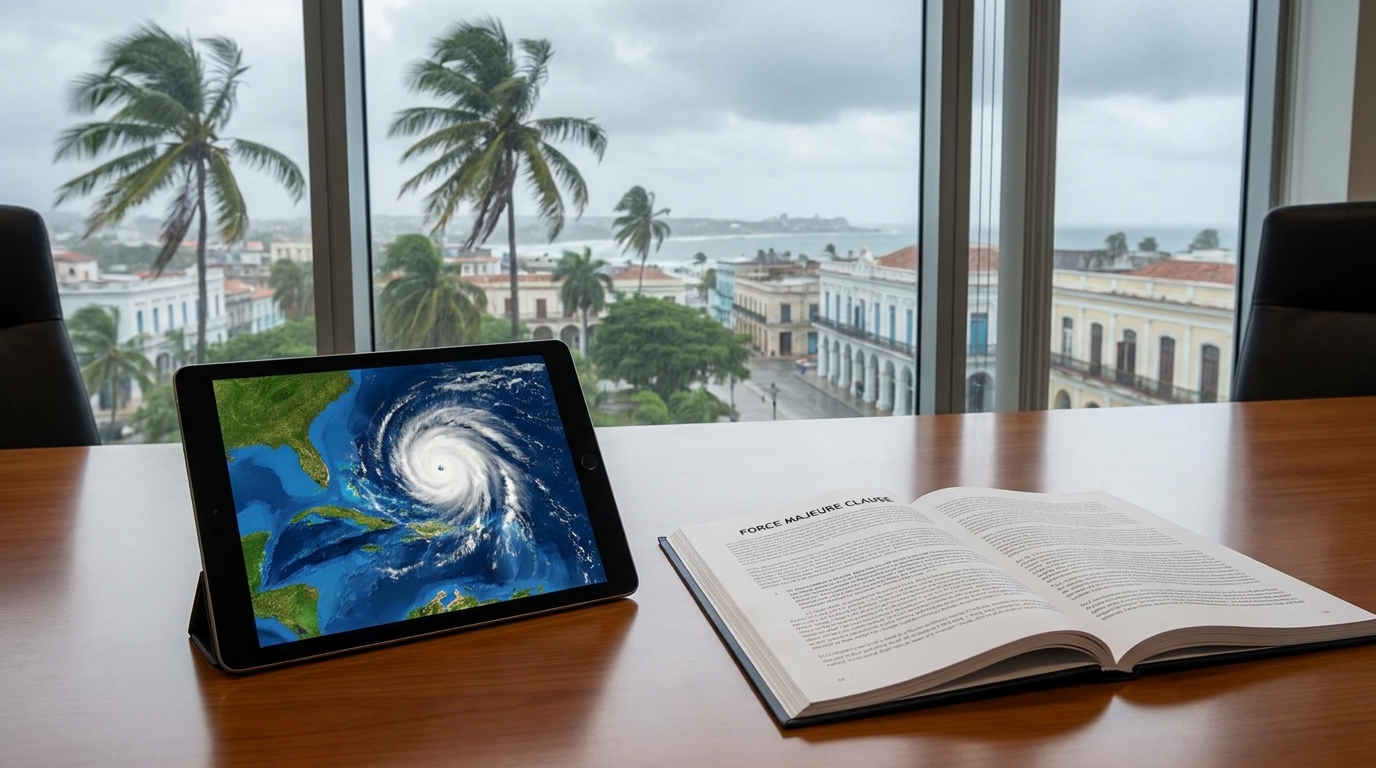

Why Force Majeure Clauses Matter in Puerto Rico's Hurricane Season
Puerto Rico sits in the Atlantic hurricane belt. Between June and November each year, businesses face genuine risk of catastrophic weather events that can halt operations, destroy property, and make contract performance impossible. A force majeure clause is not optional protection for companies operating here. It is a contractual provision that can determine whether your business survives a hurricane or faces bankruptcy through breach of contract claims.
Force majeure clauses allow parties to suspend or terminate contractual obligations when unforeseen events beyond their control make performance impossible or impracticable. In Puerto Rico, where hurricanes are a documented, recurring threat, these clauses serve a specific and vital function. Without them, a business could be held liable for failing to deliver goods, provide services, or meet payment obligations during a hurricane that destroyed its facilities or supply chains.
The difference between a well-drafted force majeure clause and a poorly written one can mean the difference between business continuity and financial ruin. Puerto Rico courts recognize force majeure as a valid defense to breach of contract claims, but only when the clause is properly drafted and the triggering event meets specific legal requirements.
How Force Majeure Clauses Work Under Puerto Rico Law
Puerto Rico's legal system is based on civil law, not common law. This distinction matters significantly when interpreting force majeure clauses. Puerto Rico courts apply the Puerto Rico Civil Code and commercial statutes to determine whether a party can invoke force majeure protection.
Under Puerto Rico law, a force majeure clause operates as follows. First, an event must occur that is beyond the control of the party seeking to invoke the clause. Second, that event must make performance of the contract impossible or impracticable. Third, the party invoking the clause must have acted with reasonable diligence to prevent or mitigate the event's effects. Fourth, the clause itself must specifically include the type of event that occurred, or use sufficiently broad language to encompass it.
Puerto Rico courts interpret force majeure clauses strictly. If your clause does not specifically mention hurricanes or natural disasters, a court may find that you cannot invoke it when a hurricane strikes. This is why the language of your force majeure clause matters enormously. A clause that says "acts of God" may be interpreted narrowly. A clause that specifically lists "hurricanes, tropical storms, and severe weather events" provides clearer protection.
The burden of proof falls on the party invoking force majeure. You must demonstrate that the hurricane made performance impossible, not merely difficult or expensive. If you could have performed your obligations with extra effort or cost, a court may find that force majeure does not apply.
What Constitutes a Triggering Event in Puerto Rico
Not every weather event qualifies as force majeure. Puerto Rico courts distinguish between events that are truly unforeseeable and events that are foreseeable or preventable.
A major hurricane that causes widespread destruction and makes physical performance impossible will almost certainly qualify as force majeure if your clause includes hurricane language. Hurricane Maria in 2017 and Hurricane Irma in the same year caused damage that clearly met the threshold for force majeure in most contracts. These were events of such magnitude that no reasonable business could have performed its obligations.
However, a tropical storm that causes minor flooding or brief power outages may not qualify. If your business could have continued operations with temporary disruptions, a court may find that force majeure does not apply. The key question is whether the event made performance impossible or merely inconvenient.
Foreseeable events present a different problem. If your contract was signed during hurricane season and your clause does not specifically address hurricanes, a court may find that you assumed the risk of hurricane damage. You cannot invoke force majeure for an event you should have anticipated and protected against through your contract language.
This is why businesses in Puerto Rico must include specific hurricane language in their force majeure clauses. The fact that hurricanes occur regularly in Puerto Rico means they are foreseeable. A generic force majeure clause may not protect you because the court may conclude that you knew about hurricane risk and failed to address it in your contract.
Drafting Effective Force Majeure Clauses for Puerto Rico Businesses
An effective force majeure clause for Puerto Rico must include several specific elements. First, it must explicitly list hurricanes, tropical storms, and severe weather events as triggering events. Do not rely on vague language like "acts of God" or "natural disasters." Be specific.
Second, your clause should define what constitutes impossibility of performance. Does the clause apply only when physical performance is impossible, or does it also apply when performance becomes commercially impracticable? Puerto Rico courts recognize both standards, but your clause should specify which one applies to your contract.
Third, your clause should address notice requirements. When a hurricane occurs, how quickly must you notify the other party that you cannot perform? What information must you provide? A clause that requires prompt written notice with specific details about the hurricane's impact and your mitigation efforts will be more enforceable than a clause with no notice requirement.
Fourth, your clause should address the duration of the force majeure protection. Does the clause suspend your obligations for the duration of the hurricane, or only for a specific number of days? What happens if the hurricane causes damage that takes months to repair? Your clause should specify whether your obligations resume once the hurricane passes or whether you have additional time to restore your operations.
Fifth, your clause should address mitigation obligations. You must demonstrate that you took reasonable steps to prevent or minimize the hurricane's impact on your ability to perform. This might include maintaining backup power systems, securing inventory, or establishing alternative supply chains. Your clause should specify what mitigation efforts you will undertake.
Sixth, your clause should address the consequences of force majeure. If you cannot perform, can you terminate the contract, or must you resume performance once the hurricane passes? Can the other party terminate if you cannot perform within a certain timeframe? These questions should be addressed in your clause.
A well-drafted force majeure clause for Puerto Rico should read something like this: "Neither party shall be liable for failure to perform its obligations under this Agreement if such failure results from hurricanes, tropical storms, severe weather events, flooding, or other natural disasters beyond the reasonable control of the party. The affected party must provide written notice to the other party within 48 hours of the event, describing the nature of the event and its impact on performance. The affected party shall take all reasonable steps to mitigate the effects of the event and resume performance as soon as practicable. If performance cannot resume within 30 days of the triggering event, either party may terminate this Agreement without liability."
This language is specific, addresses notice and mitigation, and provides a clear timeline for resuming performance or terminating the contract.
Common Mistakes in Force Majeure Clauses
Many businesses in Puerto Rico make predictable mistakes when drafting force majeure clauses. Understanding these mistakes can help you avoid them.
The first mistake is using generic language. Clauses that refer only to "acts of God" or "unforeseeable events" often fail to protect against hurricanes because Puerto Rico courts may find that hurricanes are foreseeable in Puerto Rico. Your clause must specifically mention hurricanes.
The second mistake is failing to address notice requirements. If your clause does not specify how and when you must notify the other party of force majeure, a court may find that you waived your right to invoke the clause by failing to provide timely notice. Always include clear notice requirements.
The third mistake is failing to address mitigation obligations. If your clause does not require you to take reasonable steps to prevent or minimize the hurricane's impact, the other party may argue that you failed to mitigate damages. Always include specific mitigation obligations.
The fourth mistake is failing to address the duration of force majeure protection. If your clause does not specify how long you can suspend performance, disputes will arise about when your obligations resume. Always include a timeline for resuming performance or terminating the contract.
The fifth mistake is failing to address the consequences of force majeure. If your clause does not specify whether you can terminate the contract or must resume performance, the other party may argue that you must continue performing indefinitely. Always address the consequences of force majeure.
The sixth mistake is including language that is too broad. If your clause allows you to suspend performance for any reason beyond your control, the other party may refuse to sign the contract. Your clause should be specific enough to address genuine risks while remaining reasonable to the other party.
Force Majeure and Commercial Contracts in Puerto Rico
Force majeure clauses appear in many types of commercial contracts. Supply agreements, service contracts, construction contracts, and lease agreements all benefit from clear force majeure language.
In supply agreements, a force majeure clause protects you if a hurricane destroys your inventory or disrupts your supply chain. Without this clause, you could be liable for breach of contract if you cannot deliver goods because a hurricane destroyed your warehouse or prevented shipments from arriving.
In service contracts, a force majeure clause protects you if a hurricane makes it impossible to provide services. If you provide IT services, maintenance services, or consulting services, a hurricane could prevent you from accessing your client's facilities or your own offices. A force majeure clause allows you to suspend your obligations until you can resume service.
In construction contracts, a force majeure clause protects you if a hurricane damages the construction site or prevents workers from accessing the site. Construction delays caused by hurricanes are common in Puerto Rico, and a clear force majeure clause can prevent disputes about responsibility for delays and cost overruns.
In lease agreements, a force majeure clause can address what happens if a hurricane damages the leased property. Does the tenant continue paying rent if the property is uninhabitable? Can the tenant terminate the lease? These questions should be addressed in your force majeure clause.
For businesses operating under Puerto Rico's tax incentive programs, such as Act 60, force majeure clauses are particularly important. These businesses often have contracts with mainland suppliers, customers, and service providers. A hurricane that disrupts operations could trigger breach of contract claims from parties who do not understand Puerto Rico's hurricane risk. A clear force majeure clause protects these businesses from liability.
Force Majeure and Insurance
Force majeure clauses and insurance serve different purposes. A force majeure clause protects you from breach of contract liability. Insurance protects you from property damage and business interruption losses. You need both.
If a hurricane destroys your property, your insurance should cover the damage. However, if your insurance does not cover business interruption, you will lose income during the time your business is shut down. A force majeure clause does not compensate you for these losses. It only protects you from breach of contract liability.
Conversely, if a hurricane prevents you from performing your contract obligations, your insurance may not cover the resulting breach of contract liability. Insurance typically covers property damage and business interruption, not contractual liability. A force majeure clause protects you from this liability.
Puerto Rico businesses should maintain comprehensive insurance coverage and include clear force majeure clauses in all contracts. These two protections work together to minimize your exposure to hurricane-related losses.
Enforcing Force Majeure Clauses in Puerto Rico Courts
If a hurricane occurs and you invoke a force majeure clause, the other party may dispute your right to suspend performance. If the dispute cannot be resolved through negotiation, you may need to pursue commercial litigation to enforce your clause.
Puerto Rico courts will examine your force majeure clause carefully. The court will determine whether the hurricane qualifies as a triggering event under your clause language. The court will examine whether you provided timely notice to the other party. The court will examine whether you took reasonable steps to mitigate the hurricane's impact. The court will examine whether performance was truly impossible or merely difficult.
To successfully enforce a force majeure clause in Puerto Rico court, you must be prepared to present evidence that the hurricane made performance impossible. This might include photographs of damage, expert reports about the hurricane's severity, documentation of your mitigation efforts, and testimony about the steps you took to resume performance.
You must also be prepared to demonstrate that you complied with all notice and mitigation requirements in your clause. If your clause required notice within 48 hours and you provided notice after one week, the court may find that you waived your right to invoke force majeure.
Puerto Rico courts recognize force majeure as a valid defense to breach of contract claims, but only when the party invoking the clause has met all requirements. A well-drafted clause with clear language about triggering events, notice requirements, and mitigation obligations will be much easier to enforce than a vague or poorly drafted clause.
Next Steps for Puerto Rico Business Owners
If your business operates in Puerto Rico, you should review all of your commercial contracts to ensure that your force majeure clauses are adequate. Many businesses have outdated or poorly drafted clauses that will not protect them if a hurricane strikes.
Your force majeure clauses should specifically mention hurricanes and tropical storms. They should include clear notice requirements. They should address mitigation obligations. They should specify how long you can suspend performance and what happens if you cannot resume performance within a reasonable timeframe.
If you are negotiating a new contract with a Puerto Rico business or a business that will perform work in Puerto Rico, you should insist on a clear force majeure clause that addresses hurricane risk. Do not accept vague language or clauses that do not specifically mention hurricanes.
Christian M. Frank Fas, Esq. has over 20 years of experience in commercial and business law in Puerto Rico. He can review your existing contracts and help you draft new force majeure clauses that will protect your business. Contact the firm for a free initial evaluation to discuss your contract needs and ensure that your force majeure clauses provide adequate protection against hurricane risk.