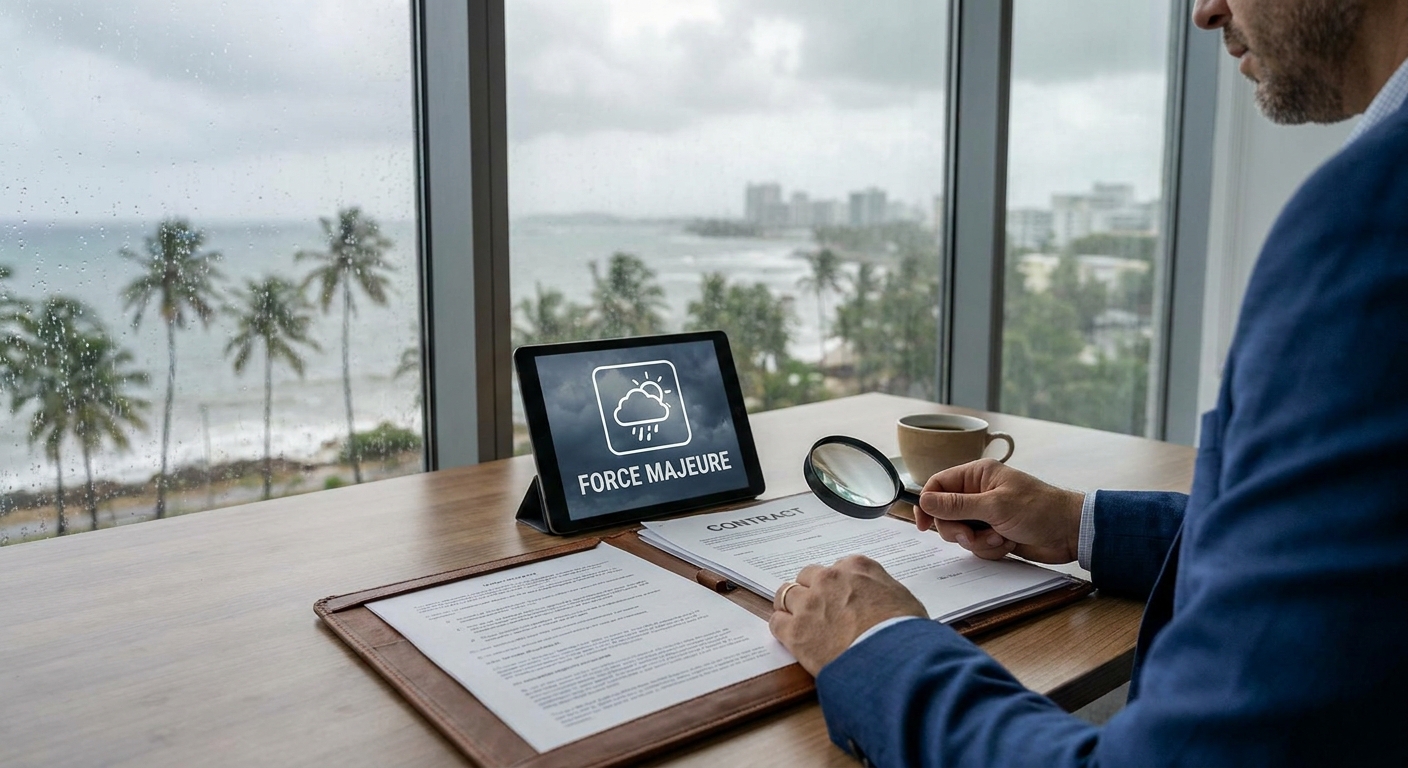

Why Force Majeure Clauses Matter in Puerto Rico's Hurricane Season
Puerto Rico sits in the Atlantic hurricane belt. Between June and November each year, businesses face genuine risk of catastrophic weather events that can halt operations, destroy property, and make contract performance impossible. A force majeure clause is not optional protection for companies operating here. It is a contractual provision that can determine whether your business survives a major hurricane or faces bankruptcy from breach of contract claims.
Force majeure clauses allow parties to suspend or terminate contractual obligations when unforeseen events beyond their control make performance impossible or impracticable. In Puerto Rico, where hurricanes are a documented, recurring threat, these clauses serve a specific and vital function. Without them, a business could be held liable for failing to deliver goods, provide services, or meet payment obligations during a hurricane that destroyed its facilities or supply chains.
The difference between a well-drafted force majeure clause and a poorly written one can mean the difference between business continuity and financial ruin. Puerto Rico courts recognize force majeure as a valid defense to breach of contract claims, but only when the clause is properly drafted and the triggering event meets specific legal requirements.
How Force Majeure Clauses Work Under Puerto Rico Law
Puerto Rico's legal system is based on civil law, not common law. This distinction matters significantly when interpreting force majeure clauses. Puerto Rico courts apply the Puerto Rico Civil Code and interpret contracts according to the plain language of the agreement, the intent of the parties, and established legal principles.
Under Puerto Rico law, a force majeure clause operates as follows. First, an event must occur that is beyond the control of the party seeking to invoke the clause. Second, that event must make performance of the contract impossible or impracticable. Third, the party invoking the clause must have acted with reasonable diligence to prevent or mitigate the effects of the event. Fourth, the event must fall within the specific categories listed in the force majeure clause itself.
Puerto Rico courts do not automatically recognize all unforeseeable events as force majeure. The clause must explicitly list the types of events that qualify. A clause that says "acts of God" or "natural disasters" may be interpreted narrowly. A clause that specifically names hurricanes, tropical storms, and weather-related events provides much stronger protection.
The burden of proof falls on the party invoking the force majeure clause. That party must demonstrate that the event occurred, that it was beyond their control, and that it made performance impossible or impracticable. Simply showing that performance became more difficult or expensive is not sufficient. The event must render performance objectively impossible.
Specific Language Requirements for Hurricane Protection
A generic force majeure clause will not adequately protect your business during a Puerto Rico hurricane. Courts interpret these clauses strictly, particularly in commercial contracts. If your clause does not specifically mention hurricanes, tropical storms, or weather-related events, a court may find that a hurricane does not qualify as force majeure under your agreement.
Effective force majeure language for Puerto Rico businesses should include the following elements:
- Explicit reference to hurricanes, tropical storms, and severe weather events
- Clear definition of what constitutes "impossibility" versus mere difficulty or increased cost
- Specification of the party's obligations during the force majeure event, such as notice requirements and mitigation efforts
- Timeline for suspension of obligations and conditions for resumption
- Consequences if the force majeure event prevents performance for an extended period
- Procedures for terminating the contract if performance cannot resume within a specified timeframe
The clause should also address whether the force majeure event must directly affect the performing party's facilities or whether it can include events affecting suppliers, transportation routes, or other third parties in the supply chain. A hurricane in Puerto Rico may not directly damage your warehouse, but it could destroy your supplier's facility or make shipping impossible. Your force majeure clause should address these scenarios.
Language matters. A clause stating that force majeure applies when performance is "impossible" is stronger than one stating it applies when performance is "impracticable" or "difficult." However, Puerto Rico courts recognize both standards. The key is consistency and clarity in how the clause defines the triggering condition.
Notice and Mitigation Obligations During a Hurricane
Invoking a force majeure clause is not automatic. Most well-drafted clauses require the affected party to provide prompt written notice to the other party. This notice must typically include details about the event, its impact on performance, and the expected duration of the disruption.
Failure to provide timely notice can result in loss of the force majeure defense, even if the hurricane itself qualifies. Puerto Rico courts expect parties to communicate promptly when performance becomes impossible. Waiting weeks or months to notify the other party that you cannot perform due to a hurricane will weaken your position.
The clause should specify the method and timing of notice. Email, certified mail, and phone calls should all be acceptable methods. The notice period should be realistic, typically 24 to 48 hours after the event occurs or the party becomes aware of its impact on performance.
Beyond notice, most force majeure clauses require the affected party to take reasonable steps to mitigate the impact of the event and resume performance as quickly as possible. This does not mean the party must perform at any cost or take unreasonable risks. It means the party must act reasonably to minimize the disruption and restore normal operations.
Mitigation might include securing temporary facilities, arranging alternative suppliers, or implementing contingency plans. If you have a force majeure clause but fail to take any steps to resume performance after a hurricane passes, a court may find that you did not act with reasonable diligence and therefore cannot invoke the clause.
Distinguishing Between Impossibility and Impracticability
Puerto Rico law recognizes two standards for force majeure: impossibility and impracticability. Understanding the difference is critical to drafting effective protection.
Impossibility means that performance is objectively impossible. A hurricane destroys your manufacturing facility, and you have no way to produce the goods you promised to deliver. The contract cannot be performed. This is true impossibility.
Impracticability means that performance is theoretically possible but would require extreme difficulty, expense, or hardship. A hurricane damages your facility, but you could rent temporary space and resume production at triple the normal cost. Performance is impracticable, not impossible.
Puerto Rico courts are more willing to excuse performance based on impossibility than impracticability. If your force majeure clause relies solely on impracticability, you face a higher burden of proof. The other party can argue that you could have performed if you were willing to spend more money or accept greater risk.
The strongest force majeure clauses address both standards. They state that performance is excused if it becomes impossible or impracticable due to the listed events. However, if you must choose one standard, impossibility provides stronger protection in Puerto Rico courts.
Force Majeure and Supply Chain Disruptions
Modern business contracts often involve complex supply chains. A hurricane in Puerto Rico may not directly damage your facility, but it could destroy your supplier's warehouse or make transportation impossible. Your force majeure clause must address these indirect impacts.
Some clauses limit force majeure protection to events that directly affect the performing party's own operations. These clauses provide weak protection in a hurricane scenario. If your supplier cannot deliver materials because of a hurricane, but your clause only covers events affecting your own facility, you may still be in breach of your contract with your customer.
Better clauses include language covering events that affect "the performance of this contract" rather than events that affect "the performing party's operations." This broader language covers supply chain disruptions, transportation delays, and other indirect impacts of a hurricane.
If your business depends on suppliers or transportation networks, review your force majeure clauses carefully. Ensure they cover disruptions to your supply chain, not just direct damage to your own facilities. This is particularly important for businesses importing goods into Puerto Rico or exporting goods from the island.
Contractual Disputes and Force Majeure Claims
When a hurricane occurs and a party invokes a force majeure clause, disputes often arise. The other party may argue that the clause does not apply, that the event was foreseeable, or that the affected party failed to mitigate damages. These disputes can escalate to litigation.
Puerto Rico courts have addressed force majeure claims in various contexts. The courts generally require clear and specific language in the clause. Vague or ambiguous language is interpreted against the party seeking to invoke the clause, particularly in commercial contracts where both parties had the opportunity to negotiate the terms.
Courts also consider whether the parties contemplated the specific event when drafting the contract. If both parties knew that hurricanes were a risk in Puerto Rico and still failed to include specific hurricane language in the force majeure clause, a court may be less sympathetic to a force majeure claim based on a hurricane.
Conversely, if the contract explicitly addresses hurricanes and weather events, and a hurricane occurs, the court is more likely to enforce the force majeure clause as written. This is why specific, detailed language is essential.
If you face a contractual dispute involving a force majeure claim, the strength of your position depends largely on the language of your clause and the facts surrounding the event. Experienced legal counsel can help you evaluate your rights and obligations under the specific contract language and Puerto Rico law.
Drafting Force Majeure Clauses for Puerto Rico Businesses
If you are entering into a contract in Puerto Rico, do not rely on standard force majeure language from templates or contracts used in other jurisdictions. Puerto Rico's civil law system and its specific exposure to hurricanes require tailored language.
Your force majeure clause should include the following components:
- A clear definition of what constitutes a force majeure event, with specific reference to hurricanes, tropical storms, and severe weather
- A statement that performance is excused if the event makes performance impossible or impracticable
- A requirement that the affected party provide prompt written notice of the event and its impact
- A requirement that the affected party take reasonable steps to mitigate the impact and resume performance
- A specification of how long the clause suspends obligations and under what conditions obligations resume
- A provision allowing either party to terminate the contract if the force majeure event prevents performance for a specified period, such as 30, 60, or 90 days
- A statement that the clause does not excuse payment obligations that accrued before the force majeure event
- Language addressing whether the clause covers indirect impacts on supply chains and third-party performance
The clause should also specify the procedure for invoking the clause. Must the affected party provide written notice within a specific timeframe? What information must the notice contain? Who must receive the notice? These procedural details matter in litigation.
Consider also whether your clause should address partial performance. If a hurricane makes it impossible to deliver 100 percent of the goods on time, can you deliver 50 percent and invoke force majeure for the remainder? Your clause should address this scenario.
Insurance and Force Majeure Interaction
Force majeure clauses and insurance coverage serve different purposes, but they interact in important ways. A force majeure clause excuses performance of contractual obligations. Insurance compensates you for losses caused by the event.
If you invoke a force majeure clause to avoid liability for non-performance, you may still have insurance coverage for the physical damage caused by the hurricane. Conversely, if your insurance does not cover a particular loss, the force majeure clause may still excuse your contractual performance.
However, some contracts include language stating that force majeure does not apply if the affected party has insurance coverage for the loss. This language can significantly limit your protection. If your insurance policy has a high deductible or excludes certain types of damage, you could lose both your insurance recovery and your force majeure defense.
Review your insurance policies and your force majeure clauses together. Ensure that your insurance covers the types of losses that could trigger a force majeure claim. If your insurance is inadequate, your force majeure clause becomes more important.
Recurring Hurricanes and the Foreseeability Argument
One argument that frequently arises in force majeure disputes is that hurricanes are foreseeable in Puerto Rico, and therefore they should not qualify as force majeure. This argument has some merit, but it is not dispositive.
Puerto Rico is in the hurricane belt, and hurricanes occur regularly. However, the specific timing, intensity, and path of any particular hurricane are not foreseeable. A party cannot predict that a hurricane will strike on a specific date and cause specific damage.
Puerto Rico courts recognize that while hurricanes are a general risk in Puerto Rico, the occurrence of a specific hurricane at a specific time is not foreseeable. Therefore, a force majeure clause that specifically names hurricanes as a covered event will be enforced even though hurricanes are generally foreseeable in Puerto Rico.
The key is that your clause must explicitly mention hurricanes. If your clause is silent on hurricanes and relies on vague language like "acts of God" or "natural disasters," a court may find that hurricanes are foreseeable and therefore do not qualify as force majeure. But if your clause specifically lists hurricanes, the foreseeability argument fails.
Next Steps: Protecting Your Business
If you operate a business in Puerto Rico, your contracts should include well-drafted force majeure clauses that specifically address hurricanes and tropical storms. If you are currently operating under contracts with weak or ambiguous force majeure language, you should consider renegotiating those contracts before the next hurricane season.
If you face a contractual dispute involving a force majeure claim, or if you need to review and strengthen your existing force majeure clauses, contact the Puerto Rico Business Law Firm for a free initial evaluation. Christian M. Frank Fas, Esq. has over 20 years of experience in commercial and business law in Puerto Rico and can help you understand your rights and obligations under your specific contracts.
Visit lawyerinpr.com/start to schedule your free initial evaluation. You can also learn more about our commercial litigation services if you are currently involved in a contract dispute.