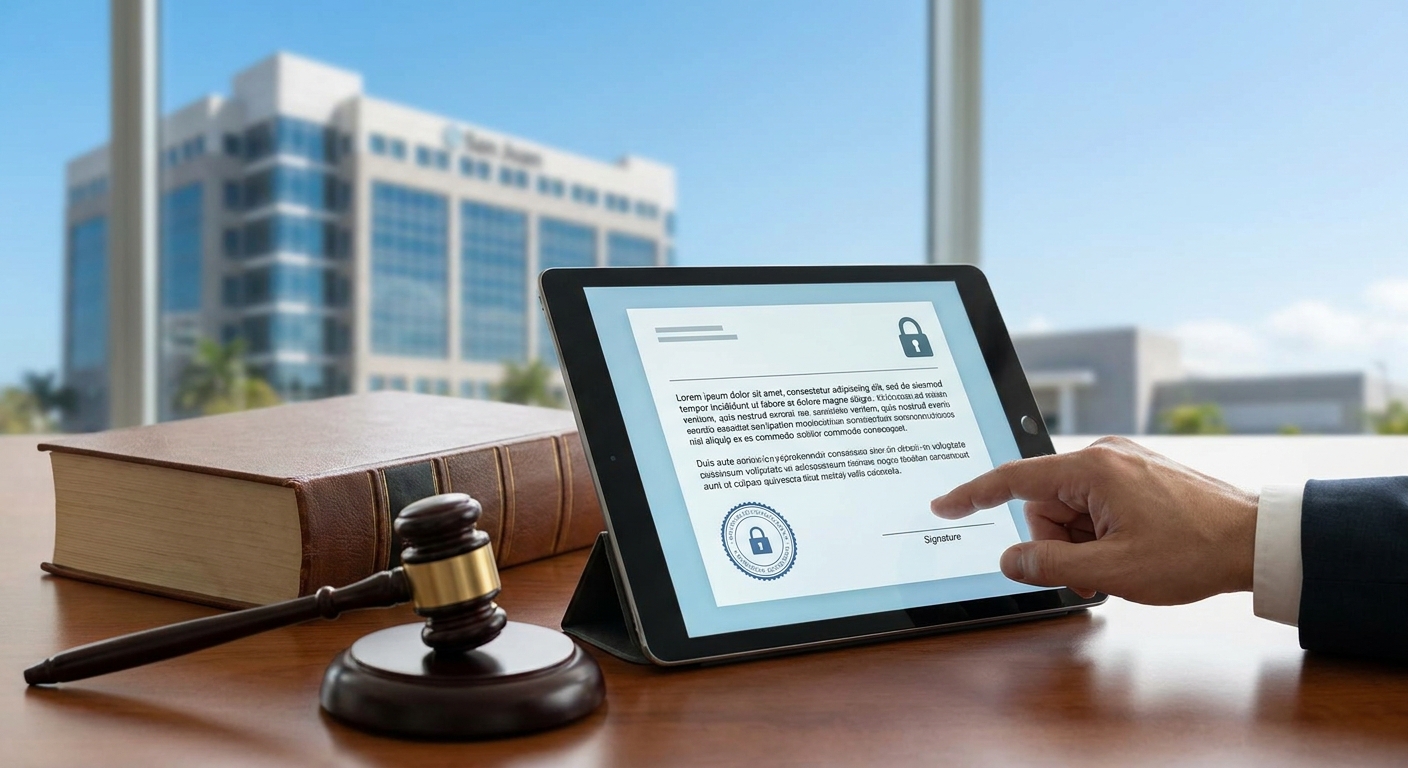

Electronic records carry the same legal weight as paper documents in Puerto Rico, but only when they meet specific authentication standards
Businesses operating in Puerto Rico increasingly rely on digital documents, electronic signatures, and cloud-based record systems. The legal validity of these records depends on proper authentication. Without understanding Puerto Rico's authentication requirements, companies risk having critical business documents rejected in court, regulatory proceedings, or commercial disputes. This article explains what electronic record authentication means under Puerto Rico law, how to implement compliant systems, and why this matters for your business operations.
What Electronic Record Authentication Means Under Puerto Rico Law
Electronic record authentication is the process of establishing that a digital document is genuine, unaltered, and created or signed by the person claiming to have created or signed it. Puerto Rico recognizes electronic records as legally equivalent to paper records when they satisfy authentication requirements set forth in the Puerto Rico Commercial Code and related statutes.
Authentication serves three core functions. First, it proves the record exists and has not been tampered with since creation. Second, it establishes the identity of the person who created or signed the record. Third, it demonstrates that the person intended to authenticate the record, meaning they deliberately took action to confirm its validity.
Puerto Rico law does not require any specific technology or method for authentication. A record can be authenticated through electronic signatures, digital certificates, timestamps, metadata analysis, or other means that reliably establish the three elements above. The focus is on whether the authentication method actually proves what it claims to prove in the context of the specific transaction or dispute.
Electronic Signatures and Their Role in Authentication
Electronic signatures form the foundation of most authentication systems in Puerto Rico. An electronic signature is any electronic sound, symbol, or process attached to or logically associated with a record and executed or adopted by a person with the intent to sign the record.
This definition is intentionally broad. An electronic signature can be as simple as typing your name in an email, clicking an "I agree" button on a website, or using a sophisticated digital certificate from a trusted certification authority. Puerto Rico law does not mandate any particular level of technological sophistication.
However, the strength of an electronic signature as authentication evidence depends on the circumstances. A typed name in an email provides minimal authentication protection because anyone with access to the email account could have typed it. A digital signature using public key infrastructure, by contrast, provides strong authentication because it relies on cryptographic technology that makes forgery extremely difficult.
For high-value transactions, sensitive agreements, or documents that will likely face legal challenge, businesses should use qualified electronic signatures. These signatures use digital certificates issued by accredited certification service providers and meet international standards for authentication strength. Puerto Rico recognizes qualified electronic signatures as presumptively valid, meaning a party challenging the signature bears the burden of proving it is not authentic.
Statutory Requirements for Electronic Records in Puerto Rico
Puerto Rico's Commercial Code establishes baseline requirements for electronic records and signatures. The statute provides that a record or signature may not be denied legal effect or enforceability solely because it is in electronic form. This means businesses cannot be forced to use paper documents if they prefer electronic alternatives.
The law also requires that electronic records be retained in a form that accurately reflects the information set forth in the record at the time it was first generated in final form. If a record is modified after creation, the system must preserve evidence of the modification. This requirement applies whether the record is stored on a company server, in cloud storage, or with a third-party service provider.
For records required by law to be in writing, an electronic record satisfies the writing requirement if the information contained in the record is accessible so as to be usable for subsequent reference. The record must also be retained by the recipient in the form received or in a form that accurately reproduces the information set forth in the record.
Certain categories of records are excluded from these rules. Puerto Rico law does not permit electronic authentication for wills, trusts, powers of attorney, and certain family law documents. These documents must be executed in paper form with wet signatures. Businesses should verify whether specific documents they need to authenticate fall within excluded categories before implementing electronic systems.
Authentication Standards for Different Business Contexts
The appropriate authentication method depends on the business context and the level of risk if the record is later challenged. Low-risk internal communications may require minimal authentication. High-value contracts, financial transactions, and regulatory filings require stronger authentication measures.
For routine business communications and internal records, basic electronic signatures suffice. Email exchanges, instant messages, and digital notes with timestamps provide adequate authentication for most operational purposes. These records should be retained in their original form, including metadata showing creation date and sender identity.
For commercial contracts and agreements between businesses, Puerto Rico courts expect stronger authentication. The signature should clearly identify the signatory and demonstrate intent to be bound by the document. Using electronic signature platforms that create audit trails, capture IP addresses, and record the time of signature strengthens authentication. These platforms generate evidence that can be presented in court if the signature is later disputed.
For financial transactions, banking relationships, and securities matters, authentication requirements are more stringent. Banks and financial institutions typically require qualified electronic signatures or multi-factor authentication combining something the user knows (password), something the user has (security token), and something the user is (biometric data). These requirements exceed Puerto Rico's baseline statutory standards but reflect industry practice and risk management principles.
For regulatory filings and compliance documents, the relevant regulatory agency may impose specific authentication requirements. The Puerto Rico Securities Commissioner, the Commissioner of Financial Institutions, and other regulatory bodies have issued guidance on acceptable authentication methods for documents filed with their offices. Businesses must comply with agency-specific requirements in addition to general Puerto Rico law.
Digital Certificates and Certification Authorities
Digital certificates provide a technical foundation for strong electronic authentication. A digital certificate is a digital file that binds a person's identity to a public cryptographic key. The certificate is issued by a certification authority, a trusted third party that verifies the certificate holder's identity before issuing the certificate.
When a person signs a document using a digital certificate, the signature is created using the certificate holder's private key, a secret number known only to that person. The signature can be verified using the corresponding public key contained in the digital certificate. If the signature verifies correctly, it proves that the document was signed by the holder of the private key and has not been altered since signing.
Puerto Rico recognizes digital certificates issued by accredited certification service providers. The accreditation process ensures that the certification authority follows strict procedures for identity verification, key management, and record retention. Certificates issued by accredited providers carry a legal presumption of authenticity, meaning a party challenging the signature must present affirmative evidence of forgery or tampering.
Businesses can obtain digital certificates for employees who regularly sign documents electronically. The cost is modest, typically ranging from fifty to two hundred dollars per certificate per year. The investment is justified for any employee who signs contracts, agreements, or other documents that may later be subject to legal challenge.
Timestamp and Metadata Authentication
Timestamps and metadata provide authentication evidence independent of signatures. A timestamp is a record of the date and time a document was created or modified. Metadata is information about the document, such as the author, creation date, modification history, and file properties.
Puerto Rico courts recognize timestamps and metadata as authentication evidence. If a document contains a timestamp from a trusted time authority, the timestamp proves when the document was created. If metadata shows the document was created by a specific user on a specific date, that metadata supports authentication of the document.
However, timestamps and metadata can be manipulated if the underlying system is not secure. A document stored on a personal computer can have its timestamp and metadata altered by anyone with access to the computer. Timestamps and metadata generated by secure, audited systems are more reliable. Cloud storage services, document management systems, and blockchain-based systems create timestamps and metadata that are difficult to alter without detection.
For maximum authentication strength, businesses should combine multiple authentication methods. A document signed with a digital certificate, timestamped by a trusted time authority, and stored in a secure document management system provides multiple layers of authentication evidence. If one authentication method is challenged, the others remain available to prove the document's authenticity.
Blockchain and Distributed Ledger Authentication
Blockchain technology offers a novel approach to electronic record authentication. A blockchain is a distributed ledger that records transactions across multiple computers in a way that makes tampering extremely difficult. Each record is cryptographically linked to the previous record, creating a chain that cannot be altered without detection.
Puerto Rico has not yet enacted specific legislation governing blockchain authentication, but the general principles of electronic record authentication apply. A record stored on a blockchain can be authenticated if the blockchain system reliably establishes that the record has not been altered and was created by the person claiming to have created it.
Blockchain authentication is particularly useful for records that require proof of creation date and immutability. Supply chain documents, intellectual property records, and timestamped agreements can be stored on a blockchain to create a permanent, tamper-evident record. However, blockchain systems require careful implementation to ensure they comply with Puerto Rico's data retention requirements and do not create regulatory compliance problems.
Businesses considering blockchain-based authentication should consult with experienced counsel before implementation. The technology is sound, but the legal framework is still developing. Proper implementation ensures that blockchain records will be recognized as authenticated under Puerto Rico law. For more information on blockchain compliance in Puerto Rico, see our blockchain compliance guide.
Authentication in Commercial Disputes and Litigation
Electronic record authentication becomes critical when documents are presented as evidence in commercial disputes or litigation. Puerto Rico courts apply the same rules of evidence to electronic records as to paper documents. An electronic record is admissible if it is authenticated by testimony or other evidence sufficient to support a finding that the record is what the proponent claims it to be.
Authentication in litigation typically requires testimony from a witness with personal knowledge of the record. The witness must testify that the record is genuine, that it was created or signed by the person claiming to have created or signed it, and that it has not been altered. For electronic records, the witness may also testify about the system used to create, sign, or store the record and explain how that system ensures authenticity.
If no witness with personal knowledge is available, authentication can be established through circumstantial evidence. The court may consider the record's appearance, the presence of signatures or digital certificates, timestamps, metadata, and other factors that collectively support a finding of authenticity. The stronger the authentication evidence, the less likely a court will exclude the record or give it reduced weight.
Businesses should implement authentication systems with litigation in mind. Records that may eventually be presented in court should be created and stored in ways that generate strong authentication evidence. This means using electronic signature platforms that create audit trails, storing records in systems that preserve metadata and timestamps, and maintaining documentation of the systems and procedures used to create and authenticate records.
For guidance on how electronic records may be used in commercial disputes, see our commercial litigation page.
Data Security and Authentication
Authentication is only as strong as the security of the underlying system. If a system is compromised, authentication evidence becomes unreliable. A hacker who gains access to a company's email system can forge emails. A person who steals an employee's password can create fraudulent digital signatures. A breach of a document storage system can allow unauthorized modification of records.
Businesses must implement reasonable security measures to protect electronic records and the systems that authenticate them. Reasonable security includes password protection, multi-factor authentication, encryption, access controls, audit logging, and regular security updates. The level of security should be proportionate to the sensitivity of the records and the risk of loss if the records are compromised.
Puerto Rico law does not specify particular security measures, but courts will consider whether a company's security practices were reasonable when evaluating authentication evidence. A company that stores sensitive documents in an unencrypted folder on a shared network drive may find that courts give reduced weight to authentication evidence from that system. A company that stores documents in an encrypted, access-controlled system with audit logging will find that courts readily accept authentication evidence from that system.
Businesses should also implement procedures for detecting and responding to security breaches. If a system is compromised, the company should immediately notify affected parties, preserve evidence of the breach, and take steps to prevent further unauthorized access. Documentation of breach response procedures strengthens the company's position if authentication is later challenged.
Regulatory Compliance and Industry Standards
Different industries and regulatory regimes impose specific authentication requirements that exceed Puerto Rico's baseline statutory standards. Financial institutions, healthcare providers, and companies handling personal data must comply with authentication requirements set by their regulators.
The Puerto Rico Commissioner of Financial Institutions has issued guidance requiring banks and financial institutions to use strong authentication for electronic transactions. This typically means multi-factor authentication combining at least two of the following: something the user knows (password or PIN), something the user has (security token or smart card), or something the user is (biometric data).
Companies handling personal data must comply with Puerto Rico's data protection laws, which require reasonable security measures including authentication controls. The specific authentication requirements depend on the sensitivity of the data and the risk of unauthorized access.
Businesses should review applicable regulatory requirements and industry standards before implementing electronic authentication systems. Compliance with regulatory requirements ensures that authentication evidence will be recognized by regulators and courts. Non-compliance can result in regulatory penalties and may undermine the legal validity of authenticated records.
Best Practices for Electronic Record Authentication
Businesses can strengthen their electronic record authentication by following established best practices. First, use electronic signature platforms that create audit trails and capture metadata. These platforms generate evidence that supports authentication if records are later challenged.
Second, implement document management systems that preserve the original form of records and prevent unauthorized modification. Cloud-based systems with version control, access logs, and encryption provide strong protection.
Third, use digital certificates for employees who regularly sign important documents. The modest cost is justified by the legal presumption of authenticity that qualified digital signatures provide.
Fourth, establish clear policies and procedures for creating, signing, and storing electronic records. Document these procedures and train employees on proper implementation. Written procedures demonstrate that the company takes authentication seriously and has implemented reasonable controls.
Fifth, maintain records of the systems and procedures used to create and authenticate documents. If authentication is later challenged, this documentation allows the company to explain how the authentication system works and why it reliably establishes authenticity.
Sixth, implement reasonable security measures proportionate to the sensitivity of the records. Encryption, access controls, multi-factor authentication, and audit logging protect records from unauthorized access and modification.
Seventh, establish procedures for detecting and responding to security breaches. Prompt notification and remediation demonstrate that the company takes security seriously and strengthens the company's position if authentication is later challenged.
Next Steps
Electronic record authentication is a technical and legal issue that requires careful attention. Businesses operating in Puerto Rico should review their current systems and procedures to ensure they comply with Puerto Rico law and generate strong authentication evidence.
The Puerto Rico Business Law Firm can help you evaluate your current authentication systems, identify compliance gaps, and implement improvements. Christian M. Frank Fas, Esq. has over twenty years of experience advising businesses on commercial law matters, including electronic records and digital transactions.
Contact the firm for a free initial evaluation of your electronic record authentication practices. During the evaluation, we will review your current systems, explain Puerto Rico's legal requirements, and recommend specific improvements. To schedule your free initial evaluation, visit our evaluation page.