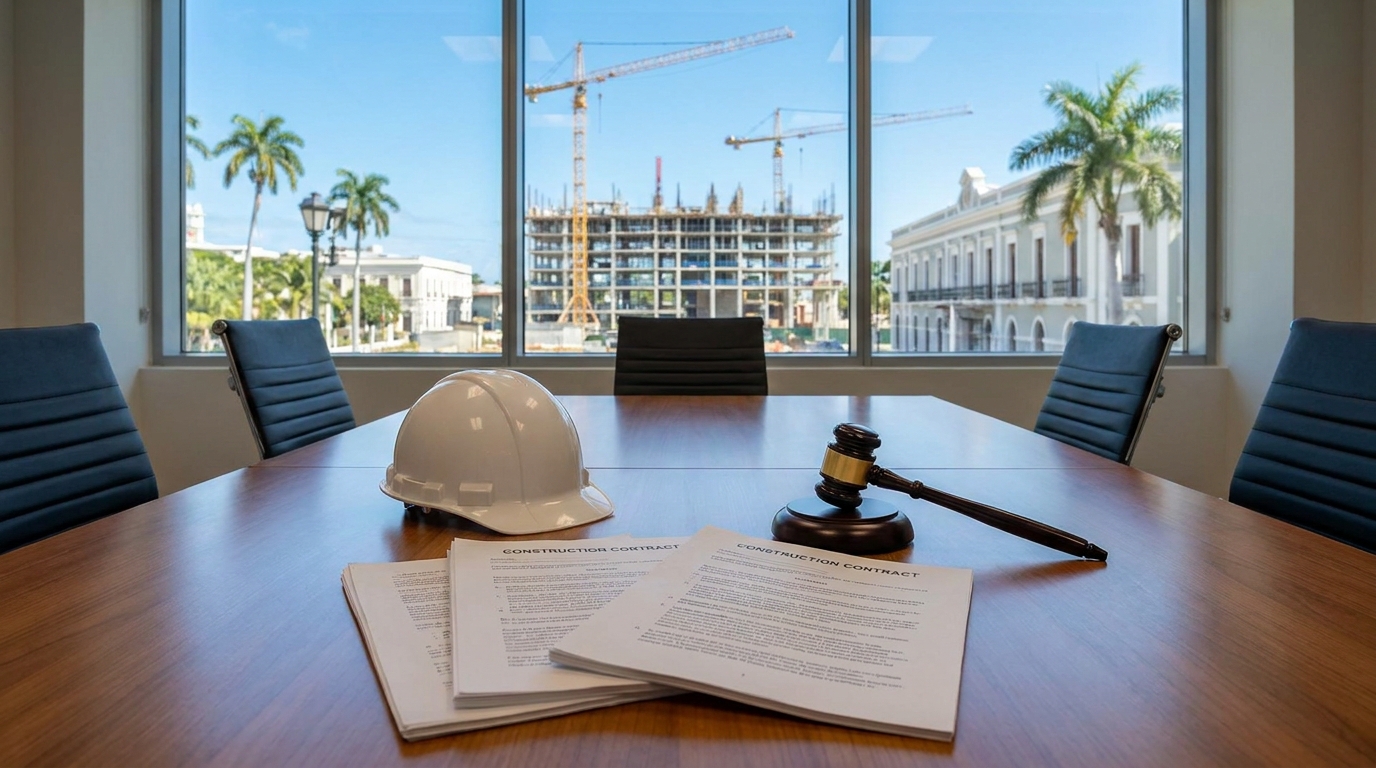

Construction Contract Disputes in Puerto Rico Require Immediate Legal Action
Construction projects in Puerto Rico involve substantial financial commitments, complex timelines, and multiple parties with competing interests. When disputes arise between contractors, subcontractors, property owners, and suppliers, the financial and operational consequences can be severe. A single unresolved contract disagreement can halt work, drain resources, and create liability exposure that extends far beyond the original project scope. Understanding your legal rights and the remedies available under Puerto Rico law is essential to protecting your business interests.
Common Types of Construction Contract Disputes
Construction disputes take many forms, and each presents distinct legal and practical challenges. The most frequent disputes involve payment delays or non-payment, scope of work disagreements, defective workmanship claims, and delays in project completion. Payment disputes are particularly common in Puerto Rico's construction sector, where cash flow problems can cascade through the entire supply chain. A general contractor may withhold payment from a subcontractor, which then prevents that subcontractor from paying suppliers or their own workers.
Scope of work disputes occur when parties disagree about what services or materials were included in the original contract price. One party may claim that additional work was performed and deserves additional compensation, while the other party contends that the work was part of the original scope. These disagreements often stem from ambiguous contract language, incomplete specifications, or changes made verbally rather than documented in writing.
Defective workmanship claims arise when the completed work fails to meet the quality standards specified in the contract or fails to perform its intended function. The property owner or general contractor may refuse final payment, claiming that the work is substandard. The contractor or subcontractor, meanwhile, may argue that the work meets the contract specifications or that any defects result from factors beyond their control.
Delay disputes occur when a project extends beyond the scheduled completion date. The property owner or general contractor may claim that delays caused by the contractor or subcontractor justify withholding payment or assessing liquidated damages. The contractor may counter that delays resulted from circumstances beyond their control, such as weather, supply chain disruptions, or changes ordered by the owner.
Puerto Rico's Legal Framework for Construction Contracts
Puerto Rico's construction law draws from both civil law traditions and commercial law principles. The Puerto Rico Civil Code establishes the foundational rules governing contracts, including requirements for formation, performance, and remedies for breach. Construction contracts in Puerto Rico must contain clear terms regarding price, scope of work, timeline, and payment schedule. Ambiguities in contract language are typically interpreted against the party who drafted the contract, which often means that property owners or general contractors bear the burden of unclear terms they imposed on subcontractors.
Puerto Rico recognizes the concept of substantial performance, which means that a contractor who has substantially completed the work according to the contract specifications may recover payment even if minor defects exist. However, the defects must truly be minor and must not defeat the essential purpose of the contract. A contractor cannot claim substantial performance if the defects are material or if the work fails to function as intended.
The law also recognizes the right to suspend work when payment is not made. If a contractor or subcontractor is not paid according to the contract schedule, they may have the right to stop work and potentially recover damages for the suspension. However, this right must be exercised carefully and in accordance with the contract terms and applicable law, as improper suspension can itself constitute a breach.
Mechanic's Liens and Payment Security in Puerto Rico
Puerto Rico law provides mechanic's lien protections for contractors, subcontractors, and suppliers who furnish labor or materials to a construction project. A mechanic's lien is a legal claim against the property itself, giving the lien holder priority over other creditors in certain circumstances. This protection is critical because it provides security when payment is uncertain or when the property owner's financial condition is questionable.
To preserve a mechanic's lien in Puerto Rico, specific notice requirements must be followed. Contractors and subcontractors must provide written notice to the property owner within a specified timeframe, typically before or shortly after beginning work. Failure to provide proper notice can result in loss of lien rights, leaving the contractor with only an unsecured claim against the general contractor or property owner.
The amount of the lien is limited to the contract price or the reasonable value of the work performed, whichever is less. If a contractor has been overpaid through previous progress payments, the lien amount may be reduced accordingly. Understanding these limitations is important when calculating the actual security provided by a mechanic's lien.
Payment bonds are another mechanism for securing payment in construction projects. A payment bond is a guarantee issued by a surety company, typically required on public works projects and sometimes on private projects. The payment bond guarantees that all contractors, subcontractors, and suppliers will be paid. If the general contractor fails to pay, the claimant can make a claim directly against the payment bond. Payment bond claims are subject to strict notice and timing requirements, and failure to comply with these requirements can result in loss of the claim.
Breach of Contract Claims and Damages
A breach of contract occurs when one party fails to perform its obligations under the contract. In construction disputes, breach claims typically involve failure to pay, failure to perform work according to specifications, or failure to complete work by the deadline. To establish a breach, the non-breaching party must prove that a valid contract existed, that they performed their obligations, that the other party failed to perform, and that they suffered damages as a result.
Damages in construction contract disputes are typically calculated as the cost to complete the work or repair defects, the cost of materials and labor that were not paid, or the profit that would have been earned if the contract had been fully performed. In some cases, damages may include consequential damages, such as lost business opportunities or damage to reputation, but these are more difficult to prove and are not always recoverable.
Liquidated damages clauses are common in construction contracts. These clauses specify a predetermined amount of damages that will be owed if certain events occur, such as failure to complete by the deadline. Puerto Rico courts will enforce liquidated damages clauses if the amount is a reasonable estimate of the anticipated harm and is not so large as to constitute a penalty. If a liquidated damages clause is found to be an unenforceable penalty, the non-breaching party may still recover actual damages, but the burden of proof shifts to them.
Defenses to Construction Contract Claims
Contractors and subcontractors facing payment disputes or breach claims have several potential defenses. The most common defense is that the other party breached first, excusing the defendant's performance. For example, if a property owner fails to provide access to the site or fails to make timely decisions about design changes, the contractor may be excused from meeting the original deadline.
Impossibility or impracticability is another defense. If performance becomes impossible due to circumstances beyond the contractor's control, such as a natural disaster or a change in law, the contractor may be excused from performance. However, this defense is narrowly construed, and the contractor must show that the circumstances were truly unforeseeable and not within the risks allocated by the contract.
Waiver is a defense available when the other party has waived strict compliance with the contract terms. If a property owner has accepted late payments or has accepted work that does not strictly comply with specifications, they may have waived their right to enforce those terms strictly in the future. However, waiver must be clear and unambiguous, and a single instance of acceptance does not necessarily constitute a waiver of future compliance.
Statute of limitations defenses apply to construction disputes. In Puerto Rico, the statute of limitations for breach of contract claims is typically four years from the date of breach. However, for defective workmanship claims, the statute of limitations may be longer in some circumstances, particularly if the defect is latent and not discoverable through reasonable inspection.
Dispute Resolution Options in Puerto Rico
Construction disputes can be resolved through negotiation, mediation, arbitration, or litigation. Negotiation is often the fastest and least expensive option, but it requires both parties to be willing to compromise. Many construction contracts include mediation clauses requiring the parties to attempt mediation before pursuing litigation or arbitration.
Arbitration is a common dispute resolution method in construction contracts. In arbitration, a neutral third party, called an arbitrator, hears evidence from both sides and makes a binding decision. Arbitration is typically faster and more private than litigation, and the arbitrator can be selected for construction industry experience. However, arbitration awards are difficult to appeal, and the parties lose the right to a jury trial.
Litigation in Puerto Rico courts is available when the contract does not require arbitration or when arbitration has failed. Construction disputes are typically handled in the Commercial Court, which has judges with experience in business and construction matters. Litigation provides the right to appeal and the right to a jury trial, but it is generally slower and more expensive than arbitration.
The choice between arbitration and litigation depends on the specific circumstances, the contract terms, and the preferences of the parties. An experienced attorney can advise on the advantages and disadvantages of each option in your particular situation.
Documentation and Evidence in Construction Disputes
The outcome of a construction dispute often depends on the quality and completeness of documentation. Contracts should be detailed and specific, clearly defining the scope of work, the price, the payment schedule, the timeline, and the quality standards. Change orders should be documented in writing and signed by authorized representatives of both parties. Progress reports, photographs, and inspection records should be maintained throughout the project.
Email communications, text messages, and other written communications can be critical evidence in disputes. These communications often reveal the parties' understanding of the contract terms and can show whether one party was aware of problems or delays. However, informal communications can also create ambiguities and misunderstandings, so it is important to follow up verbal discussions with written confirmation.
Payment records, invoices, and proof of payment are essential documentation. If payment disputes arise, clear records showing what was paid, when it was paid, and what work it was for can resolve the dispute quickly. Conversely, lack of documentation can make it difficult to prove that payment was or was not made.
Preventing Construction Contract Disputes
Many construction disputes can be prevented through careful contract drafting and clear communication. Contracts should be specific about the scope of work, including detailed specifications and drawings. The price should be clearly stated, and the payment schedule should specify when payments are due and what work must be completed to trigger each payment. The timeline should be realistic and should account for potential delays.
Change order procedures should be clearly defined in the contract. Any changes to the scope of work, the price, or the timeline should be documented in writing and signed by authorized representatives. Verbal agreements to changes should be followed up with written confirmation.
Regular communication between the parties is essential. Progress meetings should be held regularly, and any issues or concerns should be addressed promptly. If a problem arises, the parties should discuss it and attempt to resolve it before it becomes a major dispute.
Insurance and bonding requirements should be clearly specified in the contract. Contractors should maintain appropriate liability insurance and workers' compensation insurance. Performance bonds and payment bonds should be required on projects where the financial risk is significant.
When to Seek Legal Assistance
Construction disputes can escalate quickly, and delays in seeking legal assistance can result in loss of important rights. If you are involved in a construction dispute, you should seek legal assistance as soon as possible. An experienced attorney can review your contract, assess your legal position, and advise you on the best course of action.
Legal assistance is particularly important if payment is being withheld, if the other party is claiming breach, if you are considering suspending work, or if you need to file a mechanic's lien or payment bond claim. These situations involve strict deadlines and technical requirements, and failure to comply can result in loss of your rights.
An experienced attorney can also help you negotiate a resolution, represent you in mediation or arbitration, or litigate your case in court. The goal is to protect your financial interests and your business reputation.
Next Steps
Construction contract disputes require prompt and informed action. If you are facing a payment dispute, a breach claim, or any other construction-related legal issue in Puerto Rico, contact the Puerto Rico Business Law Firm for a free initial evaluation. Christian M. Frank Fas, Esq. has over 20 years of experience in commercial and business law, including construction disputes. During your free initial evaluation, we will review your situation, explain your legal options, and advise you on the best course of action.
Visit our commercial litigation page to learn more about how we handle construction and business disputes, or schedule your free initial evaluation today.