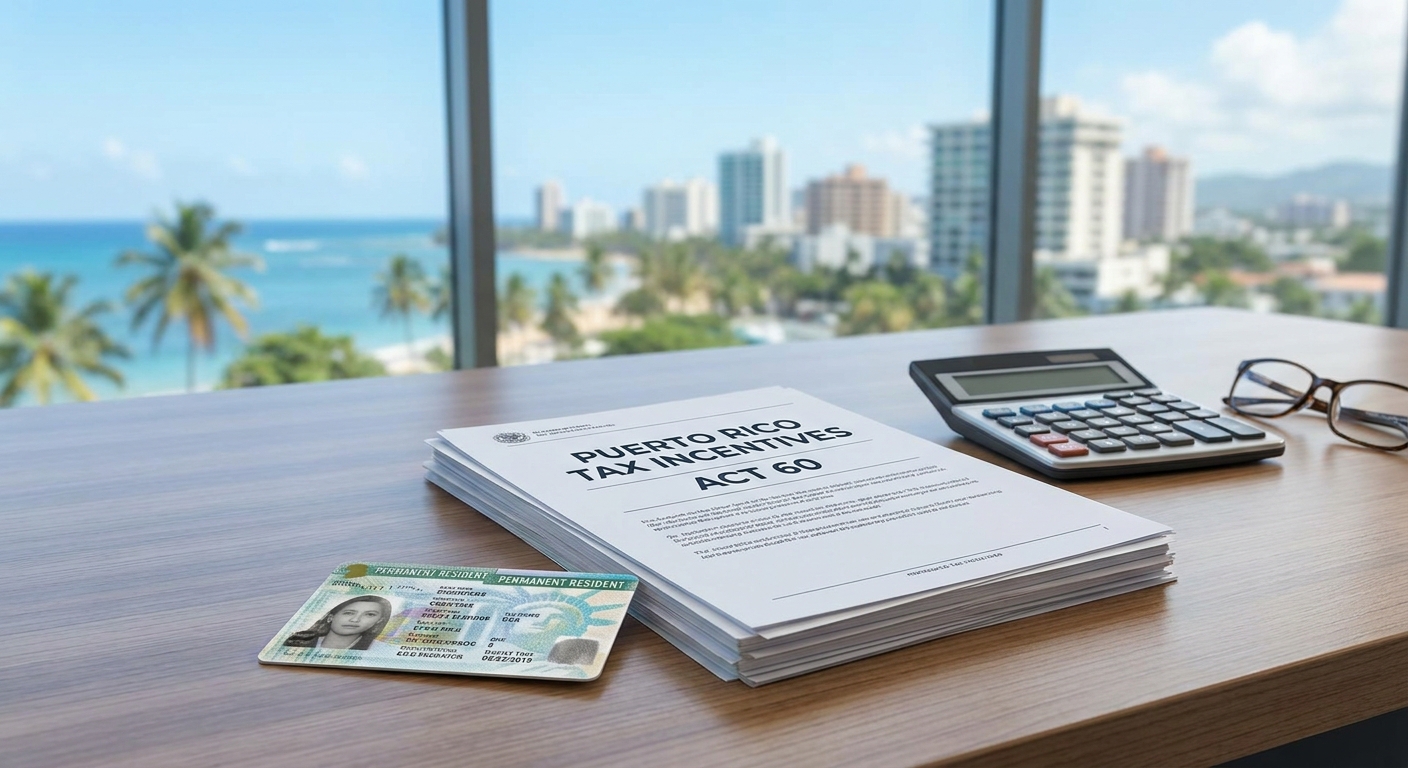

Green Card Holders Can Access Act 60 Benefits Under Specific Conditions
Green card holders who establish bona fide Puerto Rico residency can qualify for Act 60 tax incentives, but the rules differ significantly from those applying to U.S. citizens and other foreign nationals. Understanding these distinctions is essential because the tax code treats green card holders as U.S. persons for federal tax purposes, which creates both opportunities and constraints when applying for Act 60 benefits. This article explains how green card holders can access these incentives, what documentation you need, and what ongoing compliance obligations apply.
What Act 60 Offers to Qualifying Residents
Act 60 provides three primary tax incentive programs for individuals who establish Puerto Rico residency: individual income tax rates as low as 0%, capital gains tax rates as low as 0%, and corporate tax rates as low as 37%. The law also includes provisions for export services businesses, which can benefit from reduced corporate tax rates and other advantages.
For green card holders, the most relevant provisions typically involve the individual income tax incentive and the capital gains incentive. These programs allow qualifying residents to earn Puerto Rico source income at significantly reduced rates compared to federal tax obligations. The capital gains incentive applies to gains realized after establishing Act 60 residency, which can be particularly valuable for investors managing portfolios or planning asset sales.
The export services business incentive may also apply to green card holders who establish qualifying businesses in Puerto Rico. This program targets businesses that generate revenue from outside Puerto Rico while operating from the island, including consulting firms, software development companies, and professional service providers.
Residency Requirements for Green Card Holders
Green card holders must satisfy the same residency requirements as other Act 60 applicants. You must establish bona fide Puerto Rico residency, which means you must physically relocate to Puerto Rico and demonstrate that the island is your primary home. The law does not specify a minimum number of days you must spend in Puerto Rico annually, but the IRS and Puerto Rico tax authorities examine multiple factors to determine whether your residency is genuine.
These factors include where you maintain your primary residence, where your family lives, where you conduct business activities, where you maintain bank accounts and financial records, and where you hold professional licenses or memberships. You must also sever ties with your previous state of residence by changing your driver's license, voter registration, and vehicle registration to Puerto Rico. Maintaining a home in another state, keeping your previous driver's license, or spending most of your time outside Puerto Rico will undermine your residency claim.
The timing of your Act 60 application matters significantly. You should apply for Act 60 benefits after you have established residency, not before. Applying too early, before you have moved to Puerto Rico and created sufficient evidence of residency, can result in denial. The Puerto Rico tax authorities review your residency status as of your application date and will examine your activities during the months preceding your application.
How Green Card Status Affects Act 60 Eligibility
Green card holders are classified as U.S. persons for federal income tax purposes. This classification creates a critical distinction from foreign nationals who may qualify for Act 60 benefits. While foreign nationals can exclude Puerto Rico source income from U.S. taxation under the bona fide residency test, green card holders remain subject to U.S. worldwide income taxation regardless of their Puerto Rico residency status.
However, Act 60 provides a separate mechanism for green card holders. If you are a green card holder and you establish bona fide Puerto Rico residency, you can claim Act 60 benefits on Puerto Rico source income. This means income earned from Puerto Rico sources receives the reduced tax rates under Act 60, while income from U.S. sources remains subject to federal taxation. The key is properly characterizing your income as Puerto Rico source or U.S. source.
Green card holders cannot use Act 60 to exclude U.S. source income from federal taxation. If you receive income from investments, businesses, or employment in the United States, that income remains subject to federal tax at regular rates. Only income that qualifies as Puerto Rico source income can benefit from Act 60 rates.
Determining Puerto Rico Source Income
Correctly identifying Puerto Rico source income is essential for green card holders claiming Act 60 benefits. The tax code provides specific rules for different types of income. Wages and salaries are Puerto Rico source if you perform the work in Puerto Rico. Investment income, including dividends and interest, is generally Puerto Rico source if it derives from Puerto Rico sources, such as Puerto Rico corporations or Puerto Rico real estate. Capital gains on the sale of Puerto Rico real property are Puerto Rico source. Rental income from Puerto Rico property is Puerto Rico source.
The analysis becomes more complex for business income, particularly for businesses that operate across multiple jurisdictions or serve clients in multiple locations. A consulting business that serves Puerto Rico clients generates Puerto Rico source income. A software development company that serves international clients but operates from Puerto Rico may have Puerto Rico source income if the work is performed in Puerto Rico, though the analysis depends on the specific facts and the nature of the services.
Green card holders must maintain detailed records documenting the source of their income. This documentation becomes critical if the IRS or Puerto Rico tax authorities audit your returns. You should work with a focused tax professional who understands Act 60 requirements to ensure your income characterization is defensible and complies with applicable regulations.
Act 60 Application Process for Green Card Holders
The application process for Act 60 benefits requires submission of specific documentation to the Puerto Rico Department of Economic Development and Commerce. You must provide proof of bona fide residency, which typically includes a lease or deed for your Puerto Rico residence, utility bills in your name, Puerto Rico driver's license, Puerto Rico vehicle registration, and evidence of employment or business operations in Puerto Rico.
You must also provide documentation of your immigration status, including a copy of your green card. The Puerto Rico tax authorities will verify that you are a lawful permanent resident and that you have established residency in Puerto Rico. Your application should include a detailed description of your income sources and an explanation of how your income qualifies as Puerto Rico source income.
The application process typically takes several weeks to several months. The Puerto Rico tax authorities will review your documentation and may request additional information if they have questions about your residency or income sources. Once approved, you receive a certificate of Act 60 benefits, which you must maintain and present to Puerto Rico tax authorities when filing your returns.
Tax Filing Obligations After Act 60 Approval
Green card holders with Act 60 benefits must file Puerto Rico tax returns reporting their Puerto Rico source income at the reduced Act 60 rates. You must also file U.S. federal tax returns reporting your worldwide income, including Puerto Rico source income. The Act 60 benefits reduce your Puerto Rico tax liability, but they do not eliminate your federal tax obligations on Puerto Rico source income.
You must file Form 1040 with the IRS and Form 482.2 or the applicable Puerto Rico tax return with the Puerto Rico tax authorities. Your Puerto Rico return should clearly identify your Act 60 status and report your Puerto Rico source income separately from any U.S. source income. Failure to properly report your income sources or to claim Act 60 benefits correctly can result in penalties, interest, and potential loss of your Act 60 status.
The IRS and Puerto Rico tax authorities share information and coordinate audits. If you claim Act 60 benefits on your Puerto Rico return but report the same income differently on your federal return, you will likely face audit and examination. Consistency between your Puerto Rico and federal filings is essential.
Maintaining Act 60 Status as a Green Card Holder
Once you receive Act 60 approval, you must maintain bona fide Puerto Rico residency to keep your benefits. The tax authorities conduct periodic reviews to ensure that Act 60 beneficiaries continue to meet residency requirements. If you move away from Puerto Rico, spend most of your time outside Puerto Rico, or fail to maintain your Puerto Rico residence, you risk losing your Act 60 status.
You must also comply with all Puerto Rico tax filing requirements. Filing your Puerto Rico tax return on time, reporting all Puerto Rico source income, and paying any Puerto Rico taxes owed are mandatory. Failure to file or pay can result in penalties and potential revocation of your Act 60 benefits.
Green card holders should be aware that their Act 60 benefits may be affected by changes in their immigration status. If your green card is revoked or if you become a U.S. citizen, your Act 60 status may change. Consult with an experienced immigration attorney if you anticipate any changes to your immigration status.
Common Mistakes Green Card Holders Make with Act 60
Many green card holders applying for Act 60 benefits make preventable errors that result in application denials or loss of benefits. One common mistake is applying for Act 60 before establishing genuine residency in Puerto Rico. The tax authorities will deny applications from individuals who have not yet moved to Puerto Rico or who have not spent sufficient time on the island to demonstrate bona fide residency.
Another frequent error involves mischaracterizing income sources. Green card holders sometimes claim Act 60 benefits on U.S. source income, which is not eligible for the program. This mistake can trigger audits and penalties. Proper income source analysis requires careful attention to where the income is earned and where the services are performed.
Green card holders also sometimes fail to maintain adequate documentation of their residency. Without clear evidence that you live in Puerto Rico, the tax authorities will question your Act 60 status. You should maintain copies of your lease or deed, utility bills, driver's license, vehicle registration, and any other documents that demonstrate your Puerto Rico residency.
Finally, some green card holders neglect to file Puerto Rico tax returns after receiving Act 60 approval. Failure to file is a serious violation that can result in penalties and loss of benefits. You must file your Puerto Rico return every year, even if you have no Puerto Rico source income in a particular year.
Interaction Between Act 60 and Federal Tax Obligations
Green card holders must understand that Act 60 benefits do not eliminate federal tax obligations. The program reduces your Puerto Rico tax liability on Puerto Rico source income, but the IRS still taxes that income at federal rates. You cannot use Act 60 to avoid federal taxation.
However, Puerto Rico source income that qualifies for Act 60 benefits may receive favorable treatment under certain federal provisions. For example, if you are a bona fide Puerto Rico resident and you meet the requirements of Internal Revenue Code Section 933, you may be able to exclude Puerto Rico source income from federal taxation. The interaction between Act 60 and Section 933 is complex and depends on your specific circumstances.
You should work with a focused tax professional who understands both Puerto Rico and federal tax law to ensure that you are claiming all available benefits and complying with all applicable requirements. Improper tax planning can result in significant federal and Puerto Rico tax liabilities.
Act 60 Benefits for Green Card Holders in Specific Situations
Green card holders who are investors may benefit significantly from Act 60 capital gains provisions. If you establish Puerto Rico residency and receive Act 60 approval, capital gains on the sale of Puerto Rico assets may qualify for reduced tax rates. This can be valuable if you plan to sell Puerto Rico real estate or Puerto Rico business interests.
Green card holders who are business owners can establish Puerto Rico businesses that generate Puerto Rico source income. If your business serves Puerto Rico clients or operates from Puerto Rico, the business income may qualify for Act 60 benefits. This can be particularly valuable for service businesses, consulting firms, and professional practices.
Green card holders who are employees can benefit from Act 60 if they work for Puerto Rico employers and earn Puerto Rico source wages. If you relocate to Puerto Rico and accept employment with a Puerto Rico company, your wages may qualify for Act 60 benefits, subject to the income limits and other requirements of the program.
Next Steps for Green Card Holders Considering Act 60
If you are a green card holder considering Act 60 benefits, your first step should be to understand your specific situation and determine whether Act 60 makes sense for your circumstances. The program offers significant tax savings, but it requires genuine relocation to Puerto Rico and ongoing compliance with Puerto Rico tax requirements.
Contact the Puerto Rico Business Law Firm for a free initial evaluation. Christian M. Frank Fas, Esq., has over 20 years of experience with Puerto Rico business law and can review your situation to determine whether Act 60 benefits are available to you. During your evaluation, we will discuss your income sources, your residency plans, and your long-term business objectives.
Learn more about Act 60 and other Puerto Rico tax incentives on our website. We can also help you understand how Act 60 interacts with your specific business structure and help you plan your Puerto Rico residency to maximize your tax benefits while maintaining full compliance with Puerto Rico and federal tax requirements.
Schedule your free initial evaluation today by visiting our evaluation page. We will answer your questions about Act 60 eligibility, help you understand your tax obligations, and guide you through the application process.