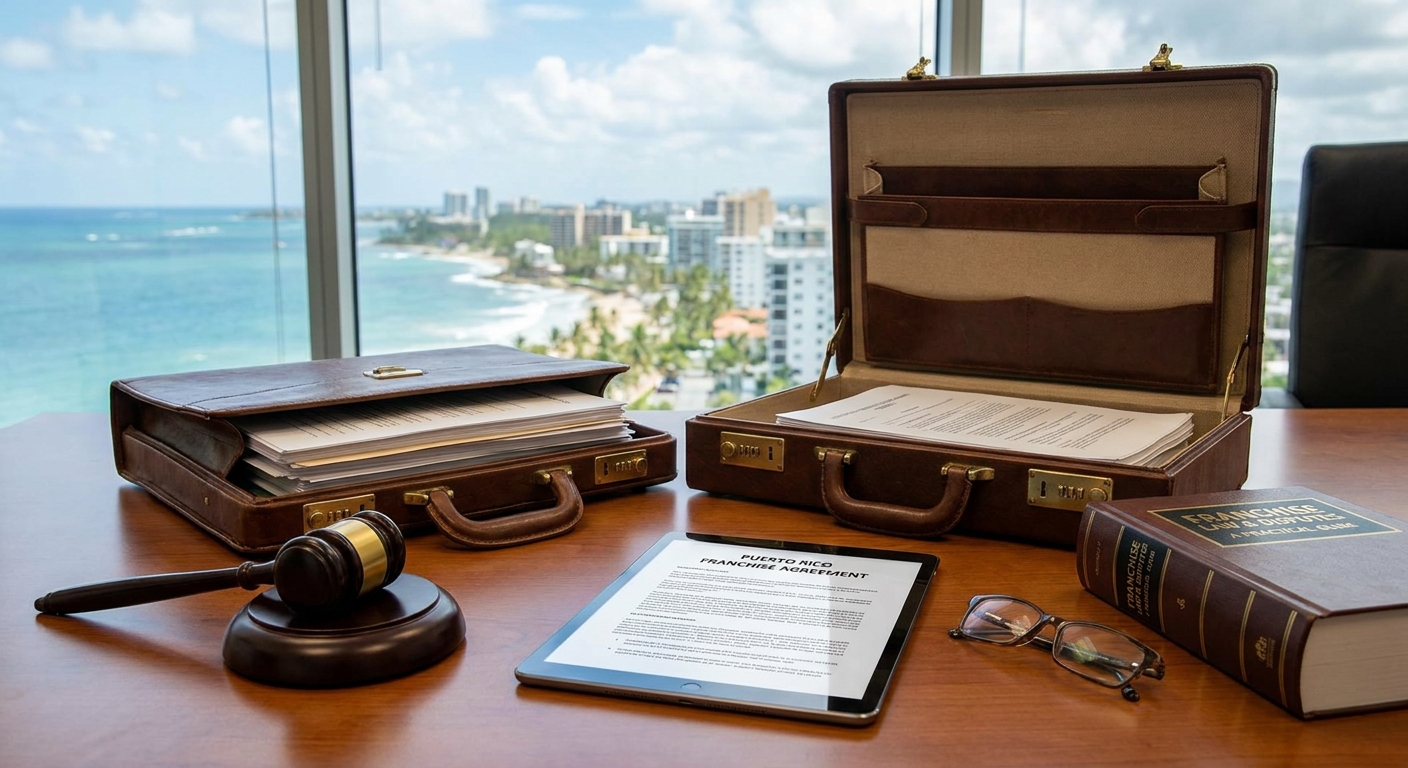

Franchise termination disputes in Puerto Rico carry significant financial and operational consequences for both franchisors and franchisees.
When a franchise relationship breaks down, the stakes are high. A franchisor may face claims of wrongful termination, breach of contract, or violation of Puerto Rico's franchise laws. A franchisee may lose their business, their investment, and their livelihood. The legal framework governing these disputes is complex, combining Puerto Rico's commercial law with federal franchise regulations and the specific terms of individual franchise agreements. Understanding your rights, obligations, and available remedies is essential before a dispute escalates into costly litigation.
The Legal Framework for Franchise Relationships in Puerto Rico
Puerto Rico does not have a dedicated franchise disclosure law comparable to the federal Franchise Rule or the franchise laws of many U.S. states. However, franchise relationships are governed by Puerto Rico's general commercial law, contract law, and principles of good faith and fair dealing. The Puerto Rico Civil Code imposes obligations on both parties to act in good faith and to refrain from conduct that would deprive the other party of the benefits of the contract.
Franchise agreements in Puerto Rico are treated as commercial contracts. The terms of the agreement control the relationship, including provisions regarding termination, renewal, territory, fees, and dispute resolution. However, even where a contract grants broad termination rights, Puerto Rico courts will examine whether termination was exercised in bad faith or in violation of the implied covenant of good faith and fair dealing.
The absence of a specific franchise statute in Puerto Rico means that disputes often turn on the language of the franchise agreement itself, the conduct of the parties, and general principles of contract interpretation. This creates both opportunities and risks. A well-drafted franchise agreement can provide clear procedures and remedies. A poorly drafted agreement can leave both parties vulnerable to costly disputes over ambiguous terms.
Common Grounds for Franchise Termination Disputes
Franchise termination disputes arise from several recurring issues. Understanding these common sources of conflict can help you identify problems early and take corrective action before they escalate.
Breach of Franchise Agreement Terms
The most straightforward termination disputes involve alleged breaches of the franchise agreement. A franchisor may claim that a franchisee failed to maintain quality standards, failed to pay royalties or fees, failed to comply with operational requirements, or failed to maintain required insurance or licenses. A franchisee may dispute whether the alleged breach actually occurred, whether it was material, or whether the franchisor properly followed the notice and cure procedures specified in the agreement.
These disputes often hinge on factual questions. Did the franchisee actually fail to meet the standard? Was the failure material or trivial? Did the franchisor provide adequate notice and a reasonable opportunity to cure? The answers determine whether termination was justified.
Failure to Follow Termination Procedures
Many franchise agreements specify detailed procedures for termination, including notice periods, opportunities to cure, and dispute resolution steps. If a franchisor terminates without following these procedures, the termination may be invalid even if the underlying breach occurred. Conversely, if a franchisee fails to follow required procedures for disputing a termination notice, they may lose important rights.
Procedural disputes are common because the procedures themselves are often ambiguous. What constitutes adequate notice? How long is a reasonable cure period? What steps must be taken before termination becomes effective? These questions frequently become the subject of litigation.
Bad Faith Termination
Puerto Rico law recognizes that even where a contract grants termination rights, those rights cannot be exercised in bad faith. Bad faith termination occurs when a franchisor terminates to avoid paying earned commissions, to eliminate a successful franchisee and take over the territory, to force a franchisee to accept unfavorable terms, or for other improper motives unrelated to legitimate business reasons.
Proving bad faith requires evidence of the franchisor's intent and conduct. This might include evidence that the franchisor terminated the franchisee shortly after the franchisee became profitable, that the franchisor terminated without providing notice or opportunity to cure, that the franchisor applied termination standards inconsistently to different franchisees, or that the franchisor's stated reason for termination contradicts other evidence.
Disputes Over Renewal Rights
Many franchise agreements include renewal provisions. Disputes arise when a franchisor refuses to renew a franchise agreement, either because the franchisee allegedly breached the agreement or because the franchisor simply chooses not to renew. If the agreement grants a renewal right, the franchisor cannot refuse renewal without valid cause unless the agreement explicitly permits non-renewal at the franchisor's discretion.
Disputes Over Territory and Exclusivity
Franchise agreements often grant exclusive territory rights to franchisees. Disputes arise when a franchisor grants another franchisee rights in the same territory, opens a company-owned location in the franchisee's territory, or permits the franchisee's competitors to operate in the territory. These disputes may lead to termination if the franchisee claims the franchisor breached the exclusivity provision.
Remedies Available in Franchise Termination Disputes
When a franchise termination dispute arises, several remedies may be available depending on the circumstances and the terms of the franchise agreement.
Damages for Wrongful Termination
If a court finds that a franchisor wrongfully terminated a franchise agreement, the franchisee may recover damages. These damages typically include lost profits from the period between termination and the date of judgment, the diminished value of the franchisee's business, costs incurred in winding down operations, and in some cases, punitive damages if the termination was particularly egregious.
Calculating damages in franchise termination cases is complex. The franchisee must prove the amount of profits that would have been earned but for the wrongful termination. This requires evidence of historical profitability, market conditions, and projections of future performance. The franchisor will typically argue that the franchisee's damages should be limited or that the franchisee failed to mitigate damages by finding alternative business opportunities.
Specific Performance and Reinstatement
In some cases, a franchisee may seek specific performance, requiring the franchisor to reinstate the franchise agreement rather than paying damages. This remedy is available when damages would be an inadequate remedy and when the court determines that reinstatement is feasible and appropriate. However, courts are often reluctant to order specific performance in franchise relationships because the relationship requires ongoing cooperation and trust.
Reinstatement may be ordered when the termination was procedurally defective, when the franchisor failed to provide adequate notice or opportunity to cure, or when the breach was minor and easily remedied. Reinstatement is less likely when the relationship has deteriorated significantly or when the franchisor has already replaced the franchisee with another operator.
Injunctive Relief
A franchisee may seek a preliminary injunction to prevent termination from becoming effective while the dispute is being resolved. To obtain a preliminary injunction, the franchisee must demonstrate a likelihood of success on the merits, that irreparable harm will result if the injunction is not granted, that the balance of equities favors the franchisee, and that the public interest is not disserved by the injunction.
Preliminary injunctions in franchise cases are difficult to obtain because courts recognize that both parties have legitimate interests. However, an injunction may be granted if the franchisee demonstrates that the termination violates clear contractual procedures, that the franchisor acted in bad faith, or that the franchisee will suffer irreparable harm that cannot be compensated by damages.
Restitution and Disgorgement
If a franchisor wrongfully terminates a franchisee and then takes over the franchisee's territory or customer base, the franchisee may seek restitution of profits earned by the franchisor from the territory or customer base. This remedy is based on the principle that the franchisor should not be permitted to profit from its own wrongdoing.
Attorney's Fees and Costs
Puerto Rico law permits courts to award attorney's fees and costs to the prevailing party in commercial disputes under certain circumstances. If the franchise agreement includes a provision permitting attorney's fees to the prevailing party, or if the court determines that the losing party acted in bad faith or without reasonable basis, the prevailing party may recover attorney's fees and litigation costs. This can significantly increase the financial stakes of franchise termination disputes.
Dispute Resolution Options Before Litigation
Franchise termination disputes do not necessarily require immediate litigation. Several alternative dispute resolution options may resolve the dispute more quickly and cost-effectively.
Negotiation and Settlement
Many franchise termination disputes are resolved through direct negotiation between the parties. A franchisee who receives a termination notice should carefully review the notice, assess the validity of the franchisor's claims, and consider whether settlement is preferable to litigation. Similarly, a franchisor should consider whether the cost of litigation exceeds the benefit of terminating the franchisee.
Effective negotiation requires understanding the strengths and weaknesses of each party's position. A franchisee with a strong legal position may be able to negotiate a favorable settlement. A franchisor with a weak legal position may prefer to settle rather than risk an adverse judgment.
Mediation
Mediation involves a neutral third party who helps the franchisor and franchisee reach a mutually acceptable resolution. Mediation is less formal and less expensive than litigation, and it preserves the possibility of an ongoing business relationship. Many franchise agreements include mediation provisions requiring the parties to attempt mediation before pursuing litigation.
Mediation is particularly useful in franchise disputes because it allows the parties to focus on their underlying interests rather than their legal positions. A franchisor may be interested in maintaining quality standards and protecting its brand. A franchisee may be interested in continuing to operate the business or obtaining fair compensation for the loss of the business. A skilled mediator can help the parties find creative solutions that address both interests.
Arbitration
Many franchise agreements include arbitration clauses requiring disputes to be resolved through arbitration rather than litigation. Arbitration involves a neutral arbitrator or panel of arbitrators who hear evidence and render a binding decision. Arbitration is typically faster and more private than litigation, but it offers limited appeal rights and may be more expensive than mediation.
If your franchise agreement includes an arbitration clause, you must follow the arbitration procedures specified in the agreement. Failure to follow these procedures may result in dismissal of your claim or defense.
Protecting Your Interests in Franchise Agreements
The best approach to franchise termination disputes is prevention. A well-drafted franchise agreement that clearly specifies the rights and obligations of both parties, the procedures for termination, and the remedies available in case of breach can prevent many disputes from arising.
If you are a franchisor, your franchise agreement should clearly specify the grounds for termination, the notice and cure procedures, the consequences of termination, and the franchisor's rights regarding the franchisee's assets and customer base. The agreement should also include provisions addressing renewal, territory, exclusivity, quality standards, and dispute resolution.
If you are a franchisee, your franchise agreement should clearly specify your rights regarding renewal, territory, and exclusivity. The agreement should include protections against arbitrary termination, should specify the notice and cure procedures, and should address your rights to compensation if the franchisor terminates without cause. You should also ensure that the agreement includes dispute resolution procedures that are fair and accessible.
Both franchisors and franchisees should ensure that their franchise agreements comply with applicable law and that the agreements are reviewed by an experienced attorney before execution. A franchise agreement that is ambiguous, one-sided, or non-compliant with law is more likely to generate disputes.
Commercial Litigation in Puerto Rico Franchise Disputes
If negotiation, mediation, or arbitration does not resolve the franchise termination dispute, litigation in Puerto Rico courts may be necessary. Puerto Rico's commercial litigation process involves pleadings, discovery, motion practice, and trial. The process is governed by Puerto Rico's Code of Civil Procedure and the rules of the Puerto Rico courts.
Franchise termination litigation is complex and expensive. The parties must exchange documents and information through discovery, must respond to written interrogatories and requests for admission, and may be required to provide testimony through depositions. Expert witnesses may be needed to testify regarding industry standards, damages calculations, or other technical matters.
The outcome of franchise termination litigation depends on the specific facts and circumstances of the case, the terms of the franchise agreement, and the applicable law. A court may find that the termination was justified, that the termination was wrongful, or that both parties breached their obligations. The court may award damages, order reinstatement, or grant other remedies as appropriate.
If you are involved in a franchise termination dispute that may require litigation, you should consult with an experienced attorney who understands Puerto Rico commercial law and has experience with franchise disputes. An experienced attorney can evaluate your legal position, advise you regarding your options, and represent you in negotiations, mediation, arbitration, or litigation.
Next Steps
Franchise termination disputes require prompt attention and careful legal analysis. If you are facing a franchise termination dispute, whether as a franchisor or franchisee, you should take action immediately to protect your interests.
Contact the Puerto Rico Business Law Firm for a free initial evaluation of your franchise termination dispute. Christian M. Frank Fas, Esq., has more than 20 years of experience in commercial and business law, including franchise disputes. During your free initial evaluation, we will review the facts of your case, analyze your franchise agreement, assess your legal position, and discuss your options for resolving the dispute.
Visit lawyerinpr.com/start to schedule your free initial evaluation. You can also contact us by phone or email to discuss your franchise termination dispute. The sooner you seek legal advice, the better positioned you will be to protect your rights and achieve a favorable outcome.
For more information about commercial litigation in Puerto Rico, visit our commercial litigation page.