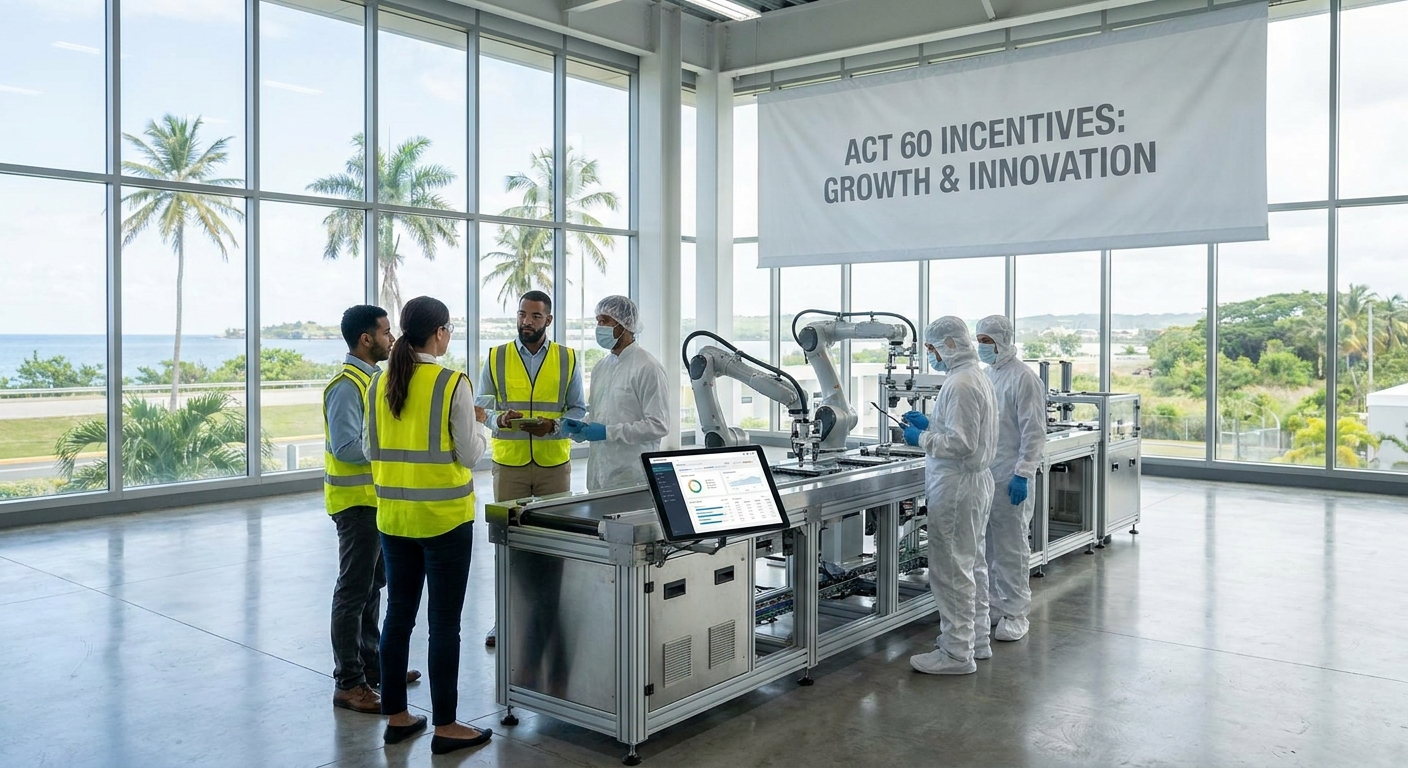

Manufacturing in Puerto Rico Offers Substantial Tax Benefits Under Act 60
Manufacturing companies operating in Puerto Rico can access some of the most significant tax incentives available in the United States through Act 60. These incentives reduce corporate tax rates to 4 percent, eliminate capital gains taxes, and provide import duty exemptions on raw materials and equipment. For manufacturers, these benefits translate directly to improved margins, faster capital recovery, and competitive advantages that extend across domestic and international markets.
The difference between operating a manufacturing facility in Puerto Rico versus the mainland United States is measurable and substantial. A company that relocates manufacturing operations to Puerto Rico and qualifies under Act 60 can retain substantially more revenue for reinvestment, expansion, and shareholder returns. This article explains how Act 60 works for manufacturers, which businesses qualify, what requirements you must meet, and how to structure your operation for maximum benefit.
Understanding Act 60 and Its Manufacturing Focus
Act 60, formally known as the Puerto Rico Export Services Act, replaced the previous Acts 20 and 22 in 2022. The law creates a comprehensive incentive structure for businesses that generate income from sources outside Puerto Rico or that manufacture products for export. Manufacturing companies fall squarely within the scope of Act 60 because they produce tangible goods, which qualifies them for the most favorable tax treatment available under the statute.
The core benefit is a 4 percent corporate tax rate on business income derived from manufacturing activities. This applies to net income from the production, assembly, or processing of goods. The rate applies regardless of whether the manufactured products are sold domestically within Puerto Rico, exported to the mainland United States, or shipped to international markets. The key requirement is that the manufacturing activity occurs in Puerto Rico.
Beyond the corporate tax rate, Act 60 provides additional benefits that compound the value of manufacturing operations in Puerto Rico. Capital gains on the sale of business assets are exempt from taxation. Dividend distributions to shareholders are taxed at 0 percent. Import duties on raw materials, components, and manufacturing equipment are eliminated. These provisions work together to create a tax environment that is fundamentally different from what manufacturers face in other jurisdictions.
Which Manufacturing Companies Qualify for Act 60
Act 60 applies to a broad range of manufacturing activities. The statute does not limit benefits to specific industries or product categories. A company that manufactures pharmaceuticals, medical devices, electronics, food products, textiles, machinery, chemicals, or consumer goods all qualify equally. The determining factor is whether the business engages in manufacturing, processing, or assembly of tangible products in Puerto Rico.
The definition of manufacturing under Act 60 includes any activity that transforms raw materials or components into finished goods or intermediate products. This includes assembly operations, packaging, quality control, and finishing processes. A company does not need to perform every step of production in Puerto Rico. If the substantial manufacturing activity occurs in Puerto Rico, the business qualifies for Act 60 benefits.
Service businesses do not qualify for Act 60 manufacturing benefits. A company that provides consulting, software development, professional services, or other non-manufacturing services must qualify under different provisions of Act 60 that apply to export services. Similarly, a business that merely imports finished goods and resells them without manufacturing or substantial processing does not qualify as a manufacturer under the statute.
The size of the manufacturing operation does not affect eligibility. A startup manufacturing company with a single facility and a handful of employees qualifies for the same tax benefits as a large multinational manufacturer with multiple facilities and hundreds of workers. Act 60 applies equally to small, medium, and large manufacturers.
Tax Benefits Breakdown for Manufacturing Operations
The primary tax benefit is the 4 percent corporate tax rate on net business income. This rate applies to all income derived from manufacturing activities conducted in Puerto Rico. For comparison, the federal corporate tax rate on the mainland is 21 percent, and most states impose additional corporate income taxes ranging from 2 to 12 percent. A manufacturer in a high-tax state might face a combined federal and state rate of 30 to 35 percent. The Act 60 rate of 4 percent represents a reduction of 75 to 85 percent compared to mainland rates.
Capital gains taxation is eliminated for Act 60 participants. When a manufacturer sells business assets, real property, equipment, or the business itself, the gain is not subject to Puerto Rico income tax. This benefit applies to gains realized after the business qualifies for Act 60 status. A manufacturer that builds significant value in equipment, facilities, or goodwill can exit the business without capital gains tax consequences.
Dividend distributions to shareholders are taxed at 0 percent under Act 60. This means that profits retained in the corporation and later distributed to owners as dividends incur no Puerto Rico income tax. The benefit applies to both individual shareholders and corporate shareholders. This provision is particularly valuable for manufacturers that generate substantial profits and distribute earnings to investors.
Import duty exemptions apply to raw materials, components, and manufacturing equipment imported into Puerto Rico. A manufacturer can import materials and equipment without paying federal import duties or Puerto Rico import taxes. This reduces the cost of goods sold and the capital expenditure required for facility setup and equipment purchases. The exemption applies to all imports used directly in manufacturing, including packaging materials, if those materials become part of the finished product.
Property tax benefits are available for real property and equipment used in manufacturing. Manufacturers can obtain property tax exemptions or reductions on facilities and equipment used in production. The specific benefit depends on the classification of the property and the terms of the Act 60 decree issued to the business.
Requirements for Maintaining Act 60 Status
Obtaining Act 60 status requires filing an application with the Puerto Rico Department of Economic Development and Commerce. The application must demonstrate that the business will engage in qualifying manufacturing activities in Puerto Rico. The department reviews the application and issues a decree that grants Act 60 status and specifies the terms and conditions of the incentive grant.
Once approved, the business must maintain Puerto Rico residency and physical presence. The manufacturing facility must operate in Puerto Rico. The business must maintain records demonstrating that manufacturing activities occur in Puerto Rico and that income is derived from those activities. The business must file annual tax returns with the Puerto Rico tax authority and comply with all reporting requirements.
The business must also comply with Puerto Rico labor laws and employment regulations. This includes registering employees with the Puerto Rico Social Security system, withholding and remitting payroll taxes, and complying with workplace safety and employment standards. Act 60 does not exempt businesses from labor law compliance.
Owners and key employees must establish Puerto Rico residency to receive the full benefits of Act 60. An individual who owns or controls an Act 60 business must be a Puerto Rico resident for tax purposes. This requires establishing a permanent home in Puerto Rico and spending sufficient time on the island to demonstrate residency intent. The residency requirement applies to the business owner or controlling shareholders, not necessarily to all employees.
The business must maintain the manufacturing focus specified in its Act 60 decree. If the business shifts to non-manufacturing activities or ceases manufacturing operations, Act 60 status may be revoked. The decree specifies the scope of qualifying activities, and the business must operate within that scope.
Structuring a Manufacturing Business for Act 60 Benefits
The most common structure for an Act 60 manufacturing business is a Puerto Rico corporation. The corporation is incorporated under Puerto Rico law, maintains its principal place of business in Puerto Rico, and conducts manufacturing operations in Puerto Rico. The corporation applies for Act 60 status and receives a decree granting the tax benefits. Shareholders can be individuals or entities located anywhere in the world.
Some manufacturers use a holding company structure. A mainland or foreign parent company owns a Puerto Rico subsidiary that conducts the manufacturing operations. The subsidiary applies for Act 60 status and receives the tax benefits. The parent company can own the subsidiary without affecting the subsidiary's Act 60 status, provided the subsidiary maintains its Puerto Rico residency and manufacturing focus.
A manufacturer can also structure operations to separate manufacturing from distribution or sales. The manufacturing facility operates in Puerto Rico as an Act 60 business. A separate distribution or sales entity operates on the mainland or in another jurisdiction. The manufacturing entity sells products to the distribution entity at cost or a negotiated price. This structure allows the manufacturer to claim Act 60 benefits on manufacturing income while the distribution entity handles sales and marketing.
Real property ownership requires careful consideration. Some manufacturers purchase or lease facilities in Puerto Rico. Others lease facilities from third parties. Act 60 status applies to the manufacturing business, not to real property ownership. A manufacturer can own real property in Puerto Rico and receive property tax benefits, or can lease facilities from unrelated parties. The choice depends on the manufacturer's long-term plans and capital structure.
Import Duty Exemptions and Supply Chain Optimization
The import duty exemption is one of the most valuable Act 60 benefits for manufacturers with significant material costs. A manufacturer that imports raw materials, components, or equipment can eliminate federal import duties and Puerto Rico import taxes. For manufacturers with high import volumes, this benefit can reduce costs by 5 to 15 percent depending on the product category and tariff rates.
The exemption applies to all materials and equipment used directly in manufacturing. Raw materials that become part of the finished product qualify. Components that are assembled into finished goods qualify. Manufacturing equipment, machinery, and tools qualify. Packaging materials that become part of the product qualify. Supplies used in the manufacturing process, such as lubricants or cleaning materials, may qualify depending on whether they are consumed in production.
The exemption does not apply to office supplies, administrative equipment, or materials used in non-manufacturing functions. A manufacturer must track and document which imports are used in manufacturing and which are used for other purposes. The Puerto Rico customs authority requires documentation showing the intended use of imported goods.
Manufacturers can optimize supply chains by consolidating imports through Puerto Rico. A company with manufacturing facilities in multiple locations can import materials to Puerto Rico and distribute them to other facilities. The import duty exemption applies to materials imported into Puerto Rico for use in Act 60 manufacturing operations.
Compliance and Reporting Obligations
Act 60 businesses must file annual tax returns with the Puerto Rico tax authority. The return must report all income derived from manufacturing activities and claim the 4 percent tax rate. The return must also report capital gains, dividend distributions, and other transactions subject to Act 60 benefits. The business must maintain detailed records supporting all income and deductions reported on the return.
The business must file annual reports with the Puerto Rico Department of Economic Development and Commerce. These reports demonstrate that the business continues to meet Act 60 requirements and that manufacturing activities continue in Puerto Rico. The reports must include information about employees, facilities, production volume, and other operational metrics.
Payroll tax compliance is mandatory. The business must register all employees with the Puerto Rico Social Security system, withhold income taxes and social security contributions, and remit these amounts to the Puerto Rico tax authority. The business must file quarterly payroll tax returns and annual wage reports. Failure to comply with payroll tax obligations can result in penalties and potential loss of Act 60 status.
Import documentation must be maintained for all goods imported under the duty exemption. The business must obtain and retain customs declarations, bills of lading, invoices, and other documentation showing the date, quantity, and intended use of imported materials. The Puerto Rico customs authority may audit import records to verify that goods were used in qualifying manufacturing activities.
The business must maintain separate accounting records for Act 60 activities. If the business engages in both qualifying and non-qualifying activities, the accounting system must clearly separate income and expenses by activity. This allows the business to calculate the correct tax liability and substantiate the 4 percent rate applied to manufacturing income.
Common Mistakes and How to Avoid Them
One common mistake is failing to establish clear Puerto Rico residency before applying for Act 60 status. The business owner must be a Puerto Rico resident for tax purposes. This requires more than simply moving to Puerto Rico. The individual must establish a permanent home in Puerto Rico, spend sufficient time on the island, and demonstrate intent to remain. Individuals who maintain significant ties to the mainland or other jurisdictions may fail the residency test. Establishing residency requires planning and documentation before the Act 60 application is filed.
Another mistake is misclassifying business activities. A business that engages in both manufacturing and non-manufacturing activities must properly allocate income between the two categories. Income from manufacturing qualifies for the 4 percent rate. Income from non-manufacturing activities may be subject to higher tax rates. Improper allocation can result in tax assessments and penalties.
Inadequate documentation of import duty exemptions is a frequent problem. The Puerto Rico customs authority requires detailed records showing that imported goods were used in manufacturing. Businesses that fail to maintain proper documentation may lose the exemption and face retroactive duty assessments. A manufacturer should implement a system to track all imports and document their use in production.
Failure to maintain the manufacturing focus specified in the Act 60 decree can result in loss of status. A business that shifts to non-manufacturing activities or ceases manufacturing operations may have its decree revoked. The business should monitor its activities to ensure they remain within the scope of the decree.
Inadequate payroll tax compliance is another serious issue. Some businesses attempt to minimize payroll taxes by misclassifying employees as independent contractors or by failing to report all wages. This violates Puerto Rico labor law and can result in substantial penalties and loss of Act 60 status. All employees must be properly classified and all wages must be reported.
Comparing Act 60 to Other Puerto Rico Tax Programs
Act 60 replaced the previous Acts 20 and 22, which provided similar but slightly different benefits. Act 60 consolidates these programs into a single statute with streamlined application procedures and clearer requirements. Businesses that qualified under the previous acts can transition to Act 60 status, though the terms may differ slightly.
Act 60 is more favorable than the standard Puerto Rico tax system for manufacturing businesses. A manufacturer that does not qualify for Act 60 is subject to the standard Puerto Rico corporate tax rate, which is approximately 37.5 percent on net income. The Act 60 rate of 4 percent represents a reduction of over 89 percent compared to the standard rate. This difference is substantial and justifies the effort required to establish Act 60 status.
Other jurisdictions offer tax incentives for manufacturing, but few match the breadth and depth of Act 60 benefits. Some states offer property tax abatements or sales tax exemptions for manufacturing equipment. Some countries offer reduced corporate tax rates for manufacturing businesses. Act 60 combines multiple benefits, including a low corporate tax rate, capital gains exemption, dividend tax exemption, and import duty exemption. This combination is rare in the global tax landscape.
Real-World Examples of Act 60 Manufacturing Benefits
Consider a pharmaceutical manufacturer that relocates production to Puerto Rico. The company manufactures generic medications for distribution in the United States and Latin America. Under Act 60, the company pays 4 percent tax on net income from manufacturing. The company imports raw materials and packaging without paying import duties. When the company sells products, it retains substantially more revenue than it would if the facility operated on the mainland. Over a five-year period, the tax savings can exceed millions of dollars, allowing the company to reinvest in facility expansion and research and development.
Consider an electronics manufacturer that establishes a Puerto Rico facility to assemble components into finished products. The company imports components from Asia and assembles them in Puerto Rico for sale in North America. The import duty exemption reduces the cost of components. The 4 percent tax rate on assembly income reduces the tax burden. The company can offer more competitive pricing than competitors operating in higher-tax jurisdictions, while maintaining higher profit margins.
Consider a food processing company that establishes a facility in Puerto Rico to process agricultural products. The company imports raw materials, processes them into finished products, and distributes them throughout the Caribbean and North America. Act 60 benefits reduce both the cost of imported materials and the tax burden on processing income. The company can expand production and increase employment in Puerto Rico while maintaining profitability.
Next Steps for Manufacturing Companies
If your manufacturing company is considering Puerto Rico operations or if you currently operate a facility in Puerto Rico, Act 60 benefits may be available to you. The process of establishing Act 60 status requires careful planning, proper documentation, and compliance with Puerto Rico requirements. Understanding the requirements and structuring your business correctly is essential to maximizing benefits and avoiding compliance problems.
The Puerto Rico Business Law Firm provides focused guidance on Act 60 applications, business structuring, and ongoing compliance for manufacturing companies. Christian M. Frank Fas, Esq. has over 20 years of experience in commercial and business law and understands the specific requirements for manufacturing businesses seeking Act 60 status. The firm can review your manufacturing operations, assess your eligibility, and guide you through the application process.
To discuss your manufacturing business and Act 60 opportunities, contact the Puerto Rico Business Law Firm for a free initial evaluation. Visit https://lawyerinpr.com/start to schedule your evaluation. You can also learn more about Act 60 incentives at https://lawyerinpr.com/puerto-rico-tax-incentives/.