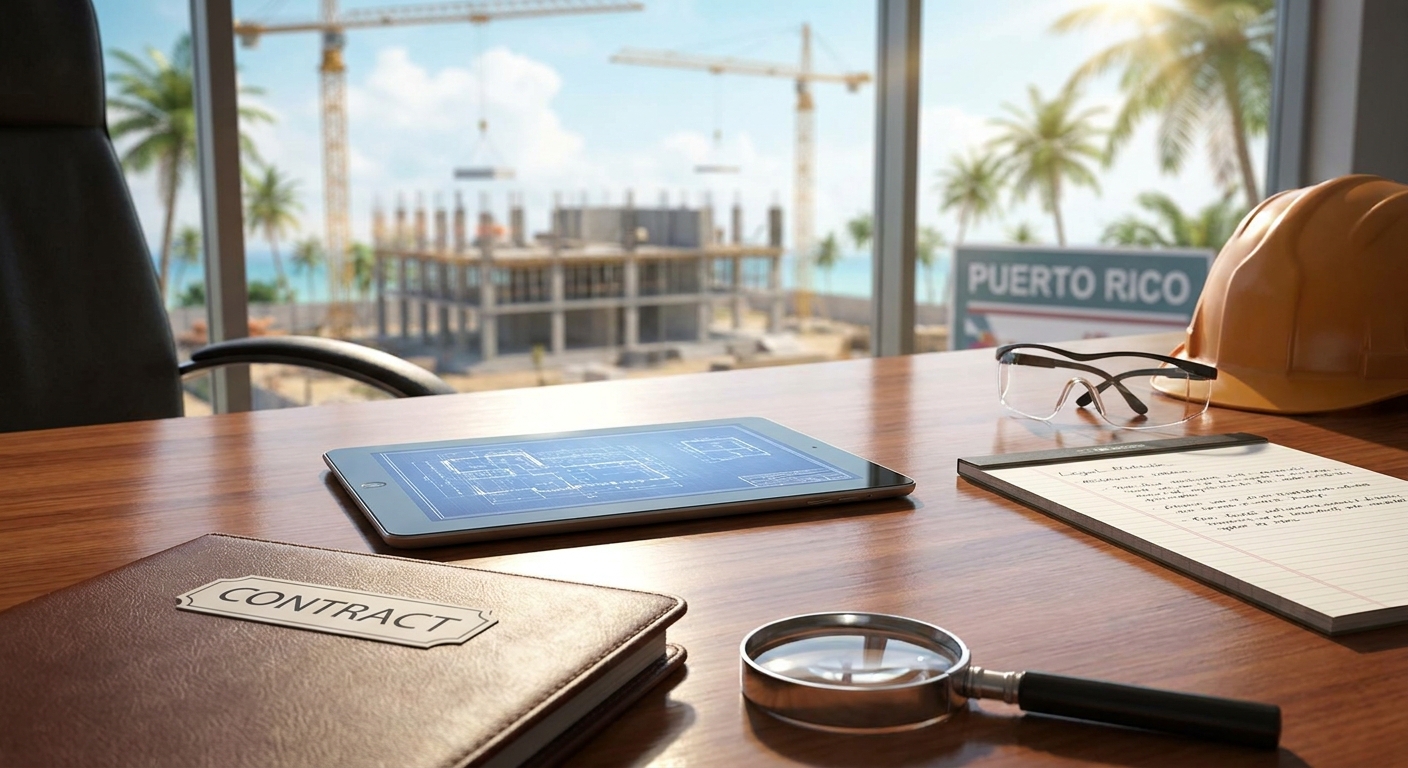

Construction contracts in Puerto Rico operate under a distinct legal framework that differs significantly from mainland U.S. standards. If you are planning, financing, or executing a construction project in Puerto Rico, the contract you sign will determine your rights, obligations, payment terms, and liability exposure. A poorly drafted construction contract can cost you hundreds of thousands of dollars in disputes, delays, and unrecovered expenses. Understanding the specific requirements and protections available under Puerto Rico law is not optional for anyone involved in construction.
Why Puerto Rico Construction Contracts Require Focused Attention
Puerto Rico's construction industry operates under Puerto Rico Civil Code provisions, local building codes, and regulations that do not mirror federal law or mainland state statutes. Contractors, developers, property owners, and lenders who assume their standard contracts will work in Puerto Rico often discover too late that critical protections are missing or unenforceable.
Construction projects in Puerto Rico frequently involve multiple parties: general contractors, subcontractors, material suppliers, design professionals, lenders, and government agencies. Each party has different interests and risk tolerances. A construction contract must clearly allocate responsibility for delays, cost overruns, defects, insurance, permits, and payment. Without these allocations in writing, disputes escalate quickly and resolution becomes expensive.
The stakes are particularly high in Puerto Rico because of the island's unique economic incentives, growing real estate market, and the involvement of both local and international investors. Projects funded under Act 60 tax incentive programs, for example, carry additional compliance obligations that must be reflected in construction contracts. Failure to address these requirements can jeopardize tax benefits and create liability for all parties involved.
Core Elements of a Valid Puerto Rico Construction Contract
A construction contract in Puerto Rico must contain specific elements to be enforceable and to protect all parties. These elements go beyond what many standard form contracts provide.
Scope of Work and Specifications
The scope of work must be detailed and unambiguous. Vague language about what is included, excluded, or optional creates disputes over whether additional work is a change order or part of the original contract price. Puerto Rico courts interpret ambiguous contract language against the drafter, which means the party who wrote the contract bears the risk of unclear terms.
Specifications should reference applicable Puerto Rico building codes, industry standards, and any local municipal requirements. Many construction projects in Puerto Rico must comply with both the Puerto Rico Building Code and local ordinances that vary by municipality. The contract should specify which codes apply and who is responsible for compliance and any costs associated with code changes during the project.
Payment Terms and Conditions
Payment terms must specify the contract price, payment schedule, conditions for payment, and procedures for change orders. Puerto Rico law does not automatically provide mechanics' lien rights to all parties in the construction chain, so payment terms become the primary mechanism for ensuring contractors and suppliers receive compensation.
The contract should address retainage (the percentage of payment withheld until project completion), the timing of payment after invoicing, and the consequences of late payment. Many construction contracts in Puerto Rico include interest provisions for late payment, but these must comply with Puerto Rico usury laws and be clearly stated in the contract.
Change order procedures are critical. The contract must specify how changes to the scope of work are requested, approved, priced, and documented. Without a clear change order process, disputes arise over whether additional work was authorized and what price should be paid for it.
Insurance and Liability Allocation
Construction contracts must specify what types of insurance are required, who must obtain and maintain each policy, and what coverage limits apply. Standard requirements include general liability insurance, workers' compensation insurance, and property damage insurance. For larger projects, additional coverage such as builders' risk insurance, professional liability insurance, and pollution liability insurance may be necessary.
The contract should also address indemnification, which is the obligation of one party to cover losses or damages incurred by another party. Indemnification clauses must be carefully drafted to comply with Puerto Rico law, which limits the enforceability of certain indemnity provisions, particularly those that require a party to indemnify another for that other party's own negligence.
Timeline and Delay Provisions
The contract must establish a project schedule with key milestones and a completion date. It should also address what happens if the project is delayed, including whether the contractor is entitled to additional compensation for delays caused by the owner or third parties, and what penalties apply if the contractor causes delays.
Delay provisions often include liquidated damages clauses, which specify a fixed amount of damages per day of delay rather than requiring the owner to prove actual damages. These clauses must be reasonable and not punitive under Puerto Rico law, or they will be unenforceable.
Dispute Resolution and Governing Law
The contract should specify that Puerto Rico law governs the agreement and that disputes will be resolved in Puerto Rico courts or through arbitration. This provision is essential because it determines which legal standards apply and where disputes will be litigated or arbitrated.
Many construction contracts include arbitration clauses, which require disputes to be resolved through arbitration rather than court litigation. Arbitration can be faster and more private than court proceedings, but it also limits the right to appeal and may be more expensive depending on the arbitrator's fees.
Permits, Licenses, and Regulatory Compliance
Construction in Puerto Rico requires multiple permits and licenses from various government agencies. The contract must clearly allocate responsibility for obtaining permits, paying permit fees, and ensuring compliance with all applicable regulations.
The Department of Housing (Departamento de Vivienda) oversees building permits and code compliance. Municipal governments issue additional permits for zoning, environmental impact, and local requirements. The contract should specify which party is responsible for each permit and what happens if a permit is delayed or denied.
If the project involves environmental considerations, such as construction near wetlands or coastal areas, additional permits from the Puerto Rico Department of Environmental Quality may be required. The contract should address who bears the cost and risk of environmental compliance and what happens if environmental issues are discovered during construction.
For projects funded through Act 60 tax incentive programs, the contract should reference the specific Act 60 requirements and confirm that the project complies with all conditions necessary to maintain tax benefits. Changes to the project scope or timeline that affect Act 60 compliance must be documented and approved by the appropriate government agency.
Defects, Warranties, and Remedies
Construction contracts must address what happens if the completed work contains defects or does not meet specifications. The contract should specify the contractor's warranty period, the owner's right to inspect work, and the procedures for identifying and correcting defects.
Puerto Rico law implies certain warranties in construction contracts, including a warranty that the work will be performed in a professional and workmanlike manner. However, the contract can modify or limit these implied warranties, subject to Puerto Rico law restrictions on liability waivers.
The contract should specify remedies available to the owner if defects are discovered, including the right to require the contractor to correct defects at no additional cost, the right to withhold payment until defects are corrected, and the right to hire another contractor to correct defects and deduct the cost from the contract price.
Punch list procedures should be included, which establish the process for identifying remaining work or minor defects at the end of the project and requiring the contractor to complete or correct them before final payment is made.
Subcontractor and Supplier Management
Most construction projects involve subcontractors and material suppliers. The general contractor's contract with the owner should address the general contractor's responsibility for subcontractor performance, payment, and compliance with applicable laws.
The contract should require the general contractor to obtain and maintain subcontractor agreements that flow down key terms from the owner-contractor agreement, including insurance requirements, indemnification obligations, and compliance with Puerto Rico law.
Payment flow-down provisions are critical. The contract should specify that the general contractor will pay subcontractors and suppliers promptly and will not withhold payment except as permitted by the contract. Puerto Rico law provides certain protections for subcontractors and suppliers, and the contract should not attempt to eliminate these protections.
The contract should also address the general contractor's responsibility for ensuring that subcontractors maintain required licenses and insurance and comply with all applicable laws, including labor laws and tax obligations.
Common Pitfalls in Puerto Rico Construction Contracts
Using Mainland Form Contracts Without Modification
Many parties attempt to use standard form contracts from mainland states without modification for Puerto Rico projects. These contracts often do not account for Puerto Rico's unique legal requirements, building codes, permit procedures, or regulatory environment. Terms that are enforceable in other jurisdictions may be unenforceable in Puerto Rico, leaving parties without the protections they believed they had.
Inadequate Insurance Requirements
Construction contracts that do not specify adequate insurance coverage or fail to require proof of insurance create significant risk. If a contractor is injured or property is damaged and the responsible party lacks insurance, the owner or other parties may be liable for damages that should have been covered by insurance.
Unclear Change Order Procedures
Contracts that do not establish a clear process for requesting, approving, and pricing change orders lead to disputes over whether changes were authorized and what price should be paid. Without a documented change order process, contractors may claim they are entitled to additional compensation for work they performed, and owners may refuse to pay, resulting in litigation.
Inadequate Dispute Resolution Provisions
Contracts that do not specify how disputes will be resolved or which law applies create uncertainty about where disputes will be litigated and what legal standards will apply. This uncertainty increases litigation costs and delays resolution.
Failure to Address Regulatory Compliance
Contracts that do not clearly allocate responsibility for obtaining permits, complying with building codes, and meeting regulatory requirements create disputes over who bears the cost and risk of compliance. If a project is delayed because permits are not obtained or code violations are discovered, disputes arise over whether the delay is the contractor's responsibility or the owner's responsibility.
Enforcement and Dispute Resolution
If a dispute arises under a Puerto Rico construction contract, the parties have several options for resolution. The contract should specify which option applies.
Negotiation and Mediation
Many construction disputes can be resolved through negotiation or mediation without litigation or arbitration. The contract may require the parties to attempt negotiation or mediation before pursuing other remedies. This approach is often faster and less expensive than litigation or arbitration.
Arbitration
Arbitration is a private process in which a neutral arbitrator hears evidence and makes a binding decision. Arbitration can be faster than court litigation and provides more privacy, but it also limits the right to appeal and may be more expensive depending on the arbitrator's fees and the complexity of the dispute.
Litigation in Puerto Rico Courts
If the contract does not require arbitration, disputes can be litigated in Puerto Rico courts. Court litigation provides the right to appeal and access to the full range of discovery procedures, but it is typically slower and more expensive than arbitration. For complex construction disputes involving multiple parties and significant damages, court litigation may be necessary to fully resolve all issues.
If a construction dispute escalates to litigation, the parties should be prepared for a lengthy process. Puerto Rico courts apply Puerto Rico Civil Code provisions and local procedural rules. An experienced attorney familiar with Puerto Rico construction law and court procedures is essential for protecting your interests.
Special Considerations for Act 60 Projects
Construction projects funded through Act 60 tax incentive programs require additional contract provisions to ensure compliance with tax incentive requirements. These projects must meet specific criteria related to investment amount, job creation, and project type to qualify for tax benefits.
The construction contract should reference the Act 60 requirements and confirm that the project scope, timeline, and budget are consistent with the Act 60 application. If the project scope changes during construction, the contract should address whether the change affects Act 60 compliance and what approvals are required.
The contract should also address the consequences if the project fails to meet Act 60 requirements. This may include loss of tax benefits, repayment of tax benefits already received, and potential penalties. All parties should understand these risks and agree on how they will be allocated.
Next Steps: Protecting Your Construction Project
A well-drafted construction contract is the foundation for a successful project. Whether you are an owner, contractor, subcontractor, or lender, the contract you sign will determine your rights and obligations throughout the project and in any disputes that arise.
If you are involved in a construction project in Puerto Rico, do not rely on form contracts or contracts used in other jurisdictions. Puerto Rico's unique legal framework requires focused attention to ensure your contract provides the protections you need and complies with all applicable laws.
Christian M. Frank Fas, Esq. has over 20 years of experience in Puerto Rico commercial and business law, including construction contracts and construction disputes. A free initial evaluation will help you understand your rights and obligations under your construction contract and identify any gaps or risks that need to be addressed.
Contact the firm for a free initial evaluation of your construction contract or construction dispute. The evaluation will provide you with a clear understanding of your legal position and the steps you should take to protect your interests.