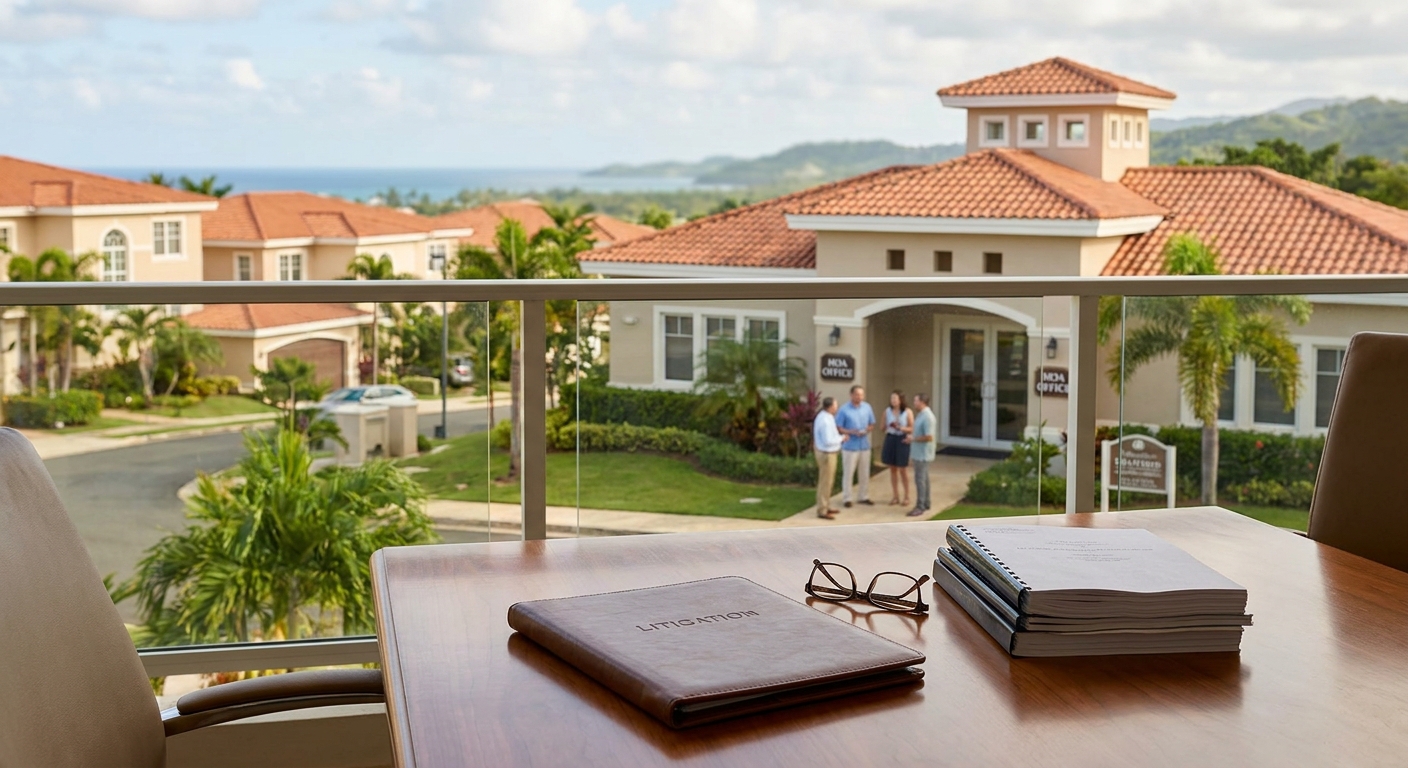

HOA disputes in Puerto Rico carry real financial and legal consequences that demand immediate attention
Homeowners association litigation in Puerto Rico involves complex statutory requirements, board governance obligations, and property owner rights that differ significantly from mainland U.S. law. Whether you are a property owner facing an unreasonable assessment, a board member defending board decisions, or a developer managing community formation, understanding the legal framework governing HOAs in Puerto Rico is essential to protecting your interests.
Puerto Rico's legal system applies its own civil code provisions, administrative regulations, and case law to HOA disputes. These disputes frequently involve assessment collection, architectural review denials, lease enforcement, special assessments, and conflicts between board authority and owner rights. The stakes are high. A single litigation matter can cost tens of thousands of dollars, damage community relationships, and create precedent that affects dozens or hundreds of property owners.
The Legal Foundation for HOAs in Puerto Rico
Puerto Rico recognizes homeowners associations as legal entities with specific powers and limitations. The primary statutory framework governing HOAs comes from Puerto Rico's civil code and administrative regulations that establish how associations are formed, how they operate, and what rights and obligations both boards and owners possess.
Unlike some U.S. states with comprehensive HOA statutes, Puerto Rico's legal framework requires careful interpretation of civil code provisions, administrative orders, and established case law. The Puerto Rico Supreme Court has issued decisions that clarify board authority, owner rights, and the standards courts apply when reviewing board decisions. Understanding these precedents is critical because they directly affect how disputes are resolved.
HOAs in Puerto Rico must operate within the scope of their governing documents, bylaws, and regulations. The board of directors holds fiduciary duties to the association and its members. These duties require the board to act in good faith, avoid conflicts of interest, and make decisions that benefit the association as a whole rather than individual board members or factions within the community.
Property owners, in turn, have rights to information about association finances, the right to attend meetings, the right to vote on major decisions, and protection against arbitrary or discriminatory enforcement of rules. When boards exceed their authority or violate owner rights, litigation becomes necessary to restore balance and enforce the law.
Common Types of HOA Litigation in Puerto Rico
HOA disputes take many forms, and the specific legal issues involved determine the strategy and likely outcome of litigation.
Assessment and Collection Disputes represent the most frequent category of HOA litigation. Boards assess owners for common area maintenance, insurance, utilities, and capital improvements. Owners sometimes dispute the amount of assessments, claim they were calculated improperly, or argue that the board failed to follow required procedures before imposing special assessments. Collection actions follow when owners refuse to pay. These cases require careful review of the association's budget, reserve studies, meeting minutes, and the procedures the board followed before imposing the assessment.
Architectural Review and Modification Disputes arise when owners seek approval to modify their units or common areas and the board denies the request. Owners may claim the denial was arbitrary, discriminatory, or not supported by the governing documents. Boards may defend their decisions based on aesthetic standards, structural concerns, or community rules. These disputes often turn on whether the board's decision was reasonable and whether the board followed proper procedures.
Enforcement and Rule Violation Cases involve disputes over whether an owner violated community rules and what consequences should follow. Boards may impose fines, require remediation, or pursue other enforcement actions. Owners may challenge whether the rule violation actually occurred, whether the rule itself is valid, or whether the enforcement action was proportionate and procedurally fair.
Election and Governance Disputes occur when owners challenge board elections, claim improper voting procedures, or dispute whether the board has authority to take certain actions. These cases can involve questions about who is eligible to vote, whether proper notice was given, and whether the election followed the bylaws and applicable law.
Financial Mismanagement and Breach of Fiduciary Duty claims arise when owners allege that board members misused association funds, failed to maintain adequate reserves, entered into improper contracts, or otherwise breached their fiduciary obligations. These cases require detailed financial analysis and often involve expert testimony about accounting standards and industry practices.
Lease and Occupancy Disputes involve conflicts over rental restrictions, lease terms, occupancy rights, or whether an owner properly disclosed lease terms to the association. Some associations restrict short-term rentals or require board approval for leases. Disputes arise when owners claim these restrictions are invalid or when boards claim owners violated lease-related rules.
Board Authority and Owner Rights in Puerto Rico
The relationship between board authority and owner rights creates the foundation for most HOA disputes. Boards have significant power to manage the association, but that power is not unlimited. Understanding where the line falls between proper board authority and improper overreach is essential to evaluating any HOA dispute.
Boards derive their authority from the association's governing documents, bylaws, and Puerto Rico law. The board can make decisions about day-to-day operations, enforce rules, collect assessments, and manage finances. However, major decisions often require owner approval through voting. The governing documents typically specify which decisions require owner consent and which decisions the board can make unilaterally.
Puerto Rico courts apply a reasonableness standard when reviewing board decisions. A board decision that is arbitrary, capricious, or made in bad faith can be overturned. However, courts generally defer to board decisions made in good faith and within the scope of board authority. This means that even if an owner disagrees with a board decision, the owner must show more than mere disagreement to prevail in litigation. The owner must demonstrate that the board acted unreasonably or outside its authority.
Owners have the right to information about association finances and operations. Boards must provide financial statements, meeting minutes, and other records upon reasonable request. Owners also have the right to attend board meetings and owner meetings, though some executive sessions may be closed. Owners have the right to vote on major decisions and to run for board positions. These rights are not absolute, but they are protected by law and by the association's governing documents.
When a board denies an owner's request for information or prevents an owner from attending a meeting, the owner may have grounds for litigation. Similarly, if a board fails to follow proper voting procedures or improperly excludes an owner from voting, the owner can challenge the board's actions in court.
Procedural Requirements and Notice Obligations
Puerto Rico law and most HOA governing documents require boards to follow specific procedures before taking action against owners or imposing significant financial obligations. Failure to follow these procedures can invalidate board decisions and expose the association to liability.
Before imposing a special assessment, the board typically must provide notice to owners, explain the reason for the assessment, and often must hold a meeting where owners can ask questions and voice concerns. The specific notice requirements depend on the governing documents and Puerto Rico law. Some associations must obtain owner approval before imposing a special assessment above a certain amount.
Before enforcing a rule violation or imposing a fine, the board must provide the owner with notice of the alleged violation and an opportunity to respond. The owner has the right to be heard before the board imposes consequences. This right to a hearing is fundamental to due process and is protected by Puerto Rico law. A board that imposes a fine without providing notice and an opportunity to be heard violates the owner's rights and can be challenged in court.
When the board denies an architectural modification request, the owner is entitled to a written explanation of the reasons for the denial. If the governing documents require the board to provide reasons, failure to do so can be grounds for overturning the denial.
Meeting notice requirements are also critical. The board must provide owners with notice of meetings in accordance with the bylaws and Puerto Rico law. Notice must be given within a specified timeframe, typically at least ten days before the meeting. The notice must include the date, time, location, and agenda for the meeting. Failure to provide proper notice can invalidate actions taken at the meeting.
Financial Disputes and Reserve Requirements
Many HOA disputes involve questions about whether the board is managing association finances properly. Puerto Rico law and industry standards require associations to maintain adequate reserves for capital improvements and major repairs. Disputes arise when owners claim the board is not maintaining sufficient reserves or when the board imposes large special assessments to fund repairs that should have been anticipated.
Boards have a duty to plan for future capital needs and to maintain reserves accordingly. A reserve study is a professional assessment of the association's physical assets and the cost of replacing or repairing them over time. Many associations conduct reserve studies to determine appropriate reserve levels. If a board ignores a reserve study and fails to maintain adequate reserves, the board may be breaching its fiduciary duty.
When a major repair becomes necessary and the association lacks adequate reserves, the board must impose a special assessment to fund the repair. Owners may challenge the special assessment by claiming the board should have anticipated the need and maintained reserves, or by claiming the assessment was calculated improperly. These disputes require detailed financial analysis and often involve expert testimony about reserve standards and the condition of the association's assets.
Boards also have a duty to manage association funds prudently. Funds should be held in accounts that provide reasonable returns and protect against loss. Boards should not invest association funds in risky ventures or make loans to board members or related entities. If a board mismanages funds or engages in self-dealing, owners can bring litigation to recover the losses and remove the board members responsible.
Enforcement Actions and Dispute Resolution
When an HOA dispute arises, the parties have several options for resolution. Understanding these options and their advantages and disadvantages is important for developing an effective strategy.
Many governing documents require the parties to attempt mediation or arbitration before filing a lawsuit. Mediation involves a neutral third party helping the parties reach a settlement. Arbitration involves a neutral arbitrator hearing evidence and making a binding decision. These processes are often faster and less expensive than litigation, but they may not be available if the governing documents do not require them.
If mediation or arbitration is not required or does not resolve the dispute, the parties can file a lawsuit in Puerto Rico court. The lawsuit will proceed through the civil litigation process, which includes pleadings, discovery, and trial. The court will apply Puerto Rico law to the dispute and issue a judgment.
In some cases, the association may seek to collect unpaid assessments through a collection action. The association files a lawsuit against the owner to recover the unpaid amount plus interest and attorney fees if the governing documents or law permit. The owner can defend the collection action by claiming the assessment was improper or that the board failed to follow required procedures.
Owners can bring affirmative litigation against the board or association to challenge board decisions, enforce owner rights, or recover damages for breach of fiduciary duty. These cases require careful pleading and often involve complex legal and factual issues.
Representation and Legal Strategy in HOA Litigation
HOA litigation in Puerto Rico requires experienced legal representation that understands both the substantive law governing associations and the procedural requirements of Puerto Rico courts. An experienced attorney can evaluate the strength of your position, identify the key legal and factual issues, and develop a strategy to achieve your objectives.
For property owners, an experienced attorney can review the board's actions, the governing documents, and Puerto Rico law to determine whether the board exceeded its authority or violated owner rights. The attorney can advise whether litigation is likely to succeed and what remedies are available. The attorney can also represent the owner in settlement negotiations or litigation.
For boards and associations, an experienced attorney can advise the board on its authority and obligations, help the board follow proper procedures, and defend the board's decisions if they are challenged. The attorney can also represent the association in collection actions and other litigation.
Effective legal strategy in HOA litigation requires careful attention to the facts, the governing documents, and Puerto Rico law. The attorney must understand the specific issues in dispute, the evidence available to support each party's position, and the likely outcome if the case goes to trial. The attorney can then advise the client on settlement options and the risks and benefits of proceeding to trial.
Next Steps: Getting Legal Evaluation for Your HOA Dispute
If you are involved in an HOA dispute in Puerto Rico, whether as a property owner, board member, or association representative, you need experienced legal guidance to protect your interests. The issues involved are complex, the stakes are high, and the procedural requirements are strict. A mistake in procedure or strategy can result in loss of your case or unnecessary expense.
Christian M. Frank Fas, Esq. has more than 20 years of experience in commercial and business law in Puerto Rico, including HOA and property-related disputes. The firm offers a free initial evaluation to discuss your situation, explain your options, and advise you on the best course of action.
Contact the firm today to schedule your free initial evaluation. Visit lawyerinpr.com/start to begin. You can also review the firm's commercial litigation services to learn more about how the firm handles complex business disputes.